
Trochosa
C. L. Koch, 1847
Species Guides
5- Trochosa abdita
- Trochosa ruricola(Rustic Wolf Spider)
- Trochosa sepulchralis
- Trochosa terricola(ground wolf spider)
- Trochosa urbana
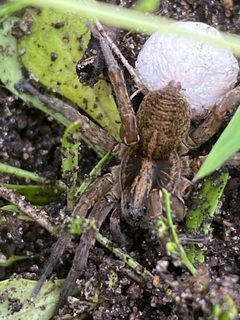
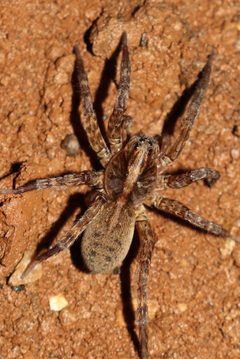
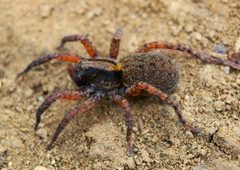
Trochosa is a large of wolf spiders (Lycosidae) with worldwide distribution. These medium-sized, ground-dwelling spiders are hunters that do not construct webs to capture prey. The genus is particularly well-documented in Europe and North America, though it remains taxonomically unrevised in Africa. As of October 2025, the genus contains 93 .
Pronunciation
How to pronounce Trochosa: /troʊˈkoʊ.sə/
These audio files are automatically generated. While they are not always 100% accurate, they are a good starting point.
Identification
Distinguished from similar wolf spider by the combination of: broad pale central band on expanded anteriorly with two darker patches; row slightly wider than eye row; and the characteristic spine on the fourth tibia ( spine dorsally thinner or more drawn out than one, sometimes reduced to a bristle). Male genitalia closely resemble those of Hogna, making genitalic characters of limited use for generic .
Images
Habitat
Free-running ground dwellers found in varied terrestrial . In Europe, associated with grass heaths and moist tussocks of Festuca . correlates with habitat structure and microhabitat characteristics.
Distribution
Worldwide distribution. Well-documented in Europe and North America; taxonomically unrevised in Africa. Specific records include: Colombia (Valle del Cauca), Denmark, Norway, Sweden, Brazil (Campinas region, Atlantic forest), and Norfolk, UK.
Seasonality
Activity patterns vary by life stage and . In Trochosa terricola, are while juveniles are . Adult males show an diplochrone activity pattern.
Host Associations
- Paracyphononyx scapulatus - koinobiont ectoparasitoidPompilidae ; larva develops on spider's
- Priocnemis minorata - ( for larval development)Pompilidae spider wasp; Trochosa terricola and other documented as
- Mermithidae (Nematoda) - wormEndoparasitic recorded from Trochosa spp.
Life Cycle
In Trochosa terricola, the extends over 2 or 3 years with eight male and nine female instars. Females produce sacs; mean number of juveniles emerging from first sac is 77.3, from second sac is 38.0. The remainder of the year is spent in stages until maturity.
Behavior
hunter spiders that do not build webs for prey capture. Free-running ground dwellers. activity in (in T. terricola), with juveniles showing activity. Some are agile climbers.
Ecological Role
in terrestrial . Serve as for (Pompilidae) and parasitoid (Mermithidae). suggest 'spreading of risk' strategy in variable environments.
Similar Taxa
- HognaMale genitalia closely resemble those of Trochosa, making them difficult to distinguish by this character alone; Trochosa distinguished by pattern and tibial spine characteristics
- Other Lycosidae generaTrochosa distinguished by combination of pale band pattern, row proportions, and fourth tibia spine
More Details
Taxonomic status
The has never been properly revised from Africa. Contains 93 as of October 2025.
Population dynamics
In Norfolk grass heath of T. terricola, overall ranged from 14.0 to 76.0 individuals per square meter, maximal in autumn after breeding. Population greatest during autumn (291.2 mg dry weight per square meter).
Sampling methods
Hand searching gives estimates between 38.3 and 70.1% of heat extraction for studies.
Sources and further reading
- BugGuide
- Wikipedia
- GBIF taxonomy match
- iNaturalist taxon
- NCBI Taxonomy
- Catalogue of Life
- Bug Eric: Priocnemis minorata
- Bug Eric: One Night, One House, Seventeen Spider Species
- Redescription of Trochosa urbana (Araneae: Lycosidae) with notes on its distribution
- Paracyphononyx scapulatus (Hymenoptera, Pompilidae), a koinobiont ectoparasitoid of Trochosa sp. (Araneae, Lycosidae)
- Figure 2 from: Souza HS, Messas YF, Masago F, dos Santos ED, Vasconcellos-Neto J (2015) Paracyphononyx scapulatus (Hymenoptera, Pompilidae), a koinobiont ectoparasitoid of Trochosa sp. (Araneae, Lycosidae). Journal of Hymenoptera Research 46: 165-172. https://doi.org/10.3897/JHR.46.5833
- New record of a parasitoid worm (Mermithidae, Nematoda) in a spider of the genus Trochosa (Lycosidae)
- Life cycle and population dynamics of Trochosa terricola Thorell (Araneae: Lycosidae) in a Norfolk grass heath
- Figure 1 from: Souza HS, Messas YF, Masago F, dos Santos ED, Vasconcellos-Neto J (2015) Paracyphononyx scapulatus (Hymenoptera, Pompilidae), a koinobiont ectoparasitoid of Trochosa sp. (Araneae, Lycosidae). Journal of Hymenoptera Research 46: 165-172. https://doi.org/10.3897/JHR.46.5833