
Coenonympha
Hübner, 1819
heaths, ringlets
Species Guides
2- Coenonympha haydenii(Hayden's ringlet)
- Coenonympha tullia(large heath)
Coenonympha is a of brush-footed butterflies in the Satyrinae, containing distributed across temperate regions of the Holarctic. Palearctic species are commonly called heaths, while Nearctic species are called ringlets. The genus exhibits complex evolutionary patterns involving hybrid speciation, with some showing homoploid hybrid speciation and extensive . Many species are associated with peatlands, salt marshes, or alpine meadows, and several are of conservation concern due to habitat degradation.
Pronunciation
How to pronounce Coenonympha: //siːˈnɒnɪmfə//
These audio files are automatically generated. While they are not always 100% accurate, they are a good starting point.
Identification
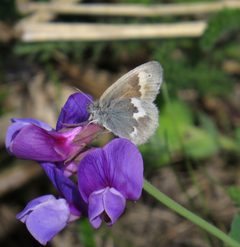
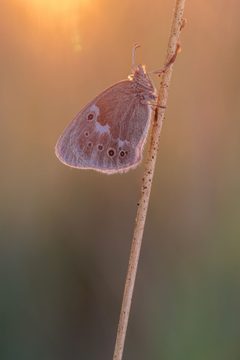
Coenonympha are small to medium-sized brown butterflies with rounded wings, typically displaying eyespots on the wing undersides. The is distinguished from other Satyrinae by a combination of wing pattern elements and genitalia structure, though species-level identification often requires examination of genitalia or molecular markers due to convergent wing patterns.
Images
Habitat
occupy diverse temperate including peatlands, blanket bogs, salt marshes, alpine meadows, and grasslands. Many are wetland : C. tullia is associated with raised and blanket bogs, C. nipisiquit is restricted to coastal salt marshes, and C. oedippus inhabits bog massifs. Alpine species occur along altitudinal gradients. Habitat specificity is pronounced, with many species sensitive to hydrological changes and vegetation .
Distribution
Holarctic distribution spanning temperate regions of North America, Europe, and Asia. Specific ranges vary by : C. nipisiquit is to ten salt marshes in Quebec and New Brunswick, Canada; C. tullia occurs across northern Europe and Asia; C. oedippus is found in Belarus and adjacent regions; alpine species show altitudinal zonation in European mountain systems.
Seasonality
periods vary by and latitude. C. nipisiquit emerge in mid-July, triggered by accumulation of 400 above 7°C following snowmelt. Activity is strongly temperature-dependent, with flight constrained by thermal conditions.
Life Cycle
Larvae of at least some overwinter, with C. tullia larvae showing behavioral adaptations to flooding in bog . development shows thermal : lowland species' eggs tolerate higher temperatures than high-altitude species' eggs. Specific plant relationships are largely unreported for the as a whole.
Behavior
exhibit behavioral through postural adjustments and microhabitat selection. C. inornata males alternate between basking and flying, spending up to 73% of time basking at 16°C versus >80% in at high temperatures. At low temperatures, males employ sit-and-wait mate-searching strategies; at high temperatures, active search strategies are used. Foraging constitutes a minor component of flight activity, with most flight devoted to mate-seeking.
Human Relevance
Several are conservation priorities. C. nipisiquit is endangered in Canada with continued decline despite conservation efforts. C. tullia ssp. davus has been subject to reintroduction efforts in the UK. Peatland restoration projects explicitly target Coenonympha species as indicator for bog health. Climate change and peatland degradation threaten multiple species.
Similar Taxa
- ErebiaBoth are brown satyrine butterflies with eyespots and overlapping alpine distributions; Erebia typically shows more extensive dark wing markings and faster, more erratic
- LasiommataSimilar size and preferences in grasslands; Lasiommata often have more angular wings and distinct banding patterns on undersides
- HyponephelePalearctic satyrines with similar ground coloration; Hyponephele often show reduced eyespot development and different male patterns
More Details
Evolutionary significance
Coenonympha has become a model system for studying hybrid speciation. A four- alpine complex (C. arcania, C. gardetta, C. cephalidarwiniana, and hybrid derivatives) demonstrates homoploid hybrid speciation with multiple reproductive isolation mechanisms: chemical divergence maintains prezygotic barriers, while genetic incompatibilities and the large Z-effect reinforce postzygotic isolation.
Genomic patterns
Genomic studies reveal extensive incomplete lineage sorting and widespread hybridization throughout the , particularly in the 'Hero' subclade. appears ubiquitous among closely related , with selection potentially maintaining adaptive . Diversification is primarily driven by geographic factors rather than ecological , despite occupation of diverse .
Conservation context
Peatland-dependent synergistic threats from drainage, burning, afforestation, and climate change. C. oedippus in Belarus are sensitive to bog overgrowth from lowered water tables and abandonment of traditional mowing. Fire management in peatlands directly impacts Coenonympha quality, with recovery of Sphagnum moss and flora potentially requiring decades to centuries after severe burns.
Sources and further reading
- BugGuide
- Wikipedia
- GBIF taxonomy match
- iNaturalist taxon
- NCBI Taxonomy
- Catalogue of Life
- Coenonympha nipisiquit Archives - Entomology Today
- Burning bogs. - Buglife Blog - Buglife
- Endangered Maritime Ringlet Shows Continued Decline in Eastern Canada
- Thermoregulation and Flight Activity Satyrine, Coenonympha Inornata (Lepidoptera: Satyridae)
- Spéciation hybride et adaptation chez les papillons alpins du genre Coenonympha
- Genomic insights into the patterns and processes of diversification in a genus of temperate butterflies (Nymphalidae : Coenonympha)
- The effects of flooding on the survival and behaviour of overwintering large heath butterfly Coenonympha tullia larvae
- Considerable genetic diversity and structure despite endemism and limited ecological specialization in the Hayden’s ringlet, Coenonympha haydenii
- Review for "Bringing back the Manchester Argus Coenonympha tullia ssp. davus (Fabricius, 1777): Quantifying the habitat resource requirements to inform the successful reintroduction of a specialist peatland butterfly"
- Особенности биологии и современное состояние популяций сенницы эдип Coenonympha oedippus (Fabricius, 1787) на территории Беларуси