
Erebia
Dalman, 1816
alpines, ringlets, arguses
Species Guides
10- Erebia callias(Colorado Alpine)
- Erebia disa(Arctic Ringlet)
- Erebia discoidalis(Red-disked Alpine)
- Erebia epipsodea(Common Alpine)
- Erebia fasciata(banded alpine)
- Erebia magdalena(Magdalena Alpine)
- Erebia mancinus(Taiga Alpine)
- Erebia pawloskii(yellow-dotted alpine)
- Erebia rossii(Ross's Alpine)
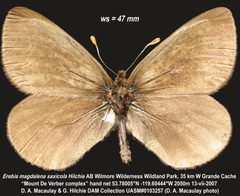
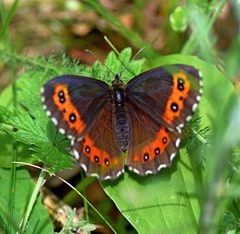
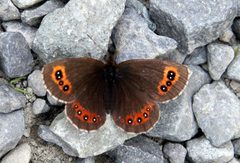
Erebia is a Holarctic of brush-footed butterflies in the Nymphalidae, containing approximately 90–100 . The genus is notable for its to cold environments, with most species inhabiting high-altitude or high-latitude regions. Members are predominantly dark brown to black with distinctive reddish-brown, orange, or rarely yellowish wing blotches or bands that typically contain black spots, sometimes with white centers. The genus exhibits complex taxonomic history with over 1300 described , many of which are junior synonyms. Erebia serves as an important model for studying climate change impacts on montane and arctic-alpine insects due to its thermal and distribution patterns.
Pronunciation
How to pronounce Erebia: //ɛˈrɛ.bi.a//
These audio files are automatically generated. While they are not always 100% accurate, they are a good starting point.
Identification
Erebia are distinguished from other Satyrinae by the combination of dark ground color with reddish-brown to orange or yellowish wing markings containing black spots. In North America, the 'alpines' refers to this ; in the Palearctic, 'ringlets' or 'arguses' are used, though these terms apply to other genera as well. Identification to species level requires careful examination of wing pattern details, genitalia, and geographic context due to extensive morphological variation and historical over-splitting. The genus is most readily confused with other dark satyrines, but the specific arrangement and coloration of wing spots and bands, combined with and distribution, aid separation.
Images
Habitat
Predominantly associated with cold environments including high-altitude mountain regions, forest clearings, high-latitude areas, and tundra. In Europe, frequently found in the Alps; in North America, common in the Rocky Mountains. Many occupy subarctic and Arctic zones, as well as cooler regions of Central Asia. Lowland exist but are less common; these occupy grassland and woodland where microclimate heterogeneity provides thermal refugia.
Distribution
Holarctic distribution encompassing North America, Europe, and Asia. In North America: Rocky Mountains and northern regions. In Europe: Alps, Pyrenees, other mountain systems, and northern latitudes. In Asia: Central Asian mountains, Siberia, and Arctic regions. Specific records include Republic of Macedonia (Bistra Mountains, 1200 m), with southeastern range extensions documented for some .
Seasonality
activity period varies by and altitude. Alpine and arctic species typically active during brief summer periods when temperatures permit. Lowland may exhibit extended periods. Activity constrained by thermal requirements; adults engage in behavioral to maintain body temperature within operational limits.
Life Cycle
Complete with , larval, pupal, and stages. Specific plant associations vary among ; many feed on grasses (Poaceae) typical of Satyrinae. Less mobile stages (eggs, larvae, pupae) likely dependent on microclimate structuring within for survival. Detailed information varies considerably among species and is incompletely documented for many.
Behavior
exhibit active behavioral , using microhabitat selection to regulate body temperature. Larger heat more slowly but reach similar asymptotic temperatures as smaller species. Lowland grassland species such as E. medusa maintain higher body temperatures and exploit warmer microclimates. Woodland species including E. aethiops and low-altitude E. euryale maintain lower body temperatures and exploit cooler microhabitats. Differences in temperature-dependence of daily activities observed between low-altitude and mountain species. Defensive documented in at least some species (e.g., E. aethiops).
Ecological Role
function as in montane and arctic-alpine . Larvae serve as herbivores, primarily on grasses. The represents a significant component of biodiversity in cold-adapted ecosystems and serves as an indicator group for climate change impacts on mountain and high-latitude insect . Microhabitat use by adults contributes to ecosystem function through pollination and nutrient cycling.
Human Relevance
Important model organisms for studying climate change impacts on insects, particularly regarding range shifts and thermal . Subject of extensive historical collecting in the Alps during the 19th and early 20th centuries, contributing to complex taxonomic history. Some of conservation concern due to specialization and climate vulnerability. sequencing completed for E. montana, supporting genomic research on Lepidoptera.
Similar Taxa
- Other Satyrinae genera (e.g., Coenonympha, Lasiommata)Similar reduced forelegs and overall body plan; distinguished by wing pattern details, preferences, and geographic distribution
- MelanargiaSome dark with light markings; distinguished by pattern details and lack of characteristic Erebia spot arrangement
Misconceptions
Historical over-description of 'varieties' and based on minor morphological variation has created persistent taxonomic confusion. Many named represent individual variation, seasonal forms, or environmental plasticity rather than distinct evolutionary lineages. Recent molecular studies are clarifying that many 20th-century subspecies designations represent distinct lineages warranting recognition, though not necessarily at subspecies rank.
More Details
Taxonomic complexity
The contains over 1300 described , but the majority are junior synonyms. The type is Papilio ligea Linnaeus, 1758 (Arran brown). Molecular phylogenetic studies are progressively resolving relationships, confirming the presence of many glacial relict taxa.
Thermoregulatory ecology
Body size, not identity per se, drives interspecific differences in body heating rates. Larger butterflies heat more slowly but reach equivalent asymptotic temperatures. Behavioral and microhabitat selection are critical for coping with thermal variation in mountain environments.
Conservation implications
Lowland of woodland Erebia may be more severely threatened by climate warming due to limited availability of cooler microhabitats for thermal . heterogeneity is expected to buffer climate change effects by providing diverse microclimates.
Sources and further reading
- BugGuide
- Wikipedia
- GBIF taxonomy match
- iNaturalist taxon
- NCBI Taxonomy
- Catalogue of Life
- Nota Lepidopterologica goes advanced open access with Pensoft Publishers | Blog
- Uncategorized | Blog - Part 22
- Pensoft Editorial Team | Blog - Part 126
- Diachora erebia . [Distribution map].
- Ecological and distributional notes on Erebia discoidalis
- De Prunner’s Ringlet Erebia triaria (de Prunner, 1798) (Lepidoptera: Nymphalidae: Satyrinae) – a new species for the Republic of Macedonia De-Prunnerjev rjavček Erebia triaria (de Prunner, 1798) (Lepidoptera: Nymphalidae: Satyrinae) – nova vrsta v Republiki Makedoniji
- Facing the heat: thermoregulation and behaviour of lowland species of a cold-dwelling butterfly genus, Erebia
- Defensive behaviour in the scotch argus Erebia aethiops (Lepidoptera: Nymphalidae)
- Defensive behaviour in the scotch argus Erebia aethiops (Lepidoptera: Nymphalidae)
- Body size, not species identity, drives body heating in alpine Erebia butterflies
- The genome sequence of Erebia montana Berg-Mohrenfalter (Lepidoptera: Nymphalidae).