
Erebia fasciata
Butler, 1868
banded alpine
Erebia fasciata, commonly known as the banded alpine, is a in the Nymphalidae, Satyrinae. It is distributed across high-latitude regions of the Northern Hemisphere, ranging from central Siberia through Alaska, Yukon, and the Canadian Arctic to Hudson Bay, with additional on Banks Island and Victoria Island. The exhibits a wingspan of 38–53 mm. are active from May to late July depending on location, with larvae feeding on Carex species.
Pronunciation
How to pronounce Erebia fasciata: /ɛˈrɛbiə fæsiˈɑtə/
These audio files are automatically generated. While they are not always 100% accurate, they are a good starting point.
Identification
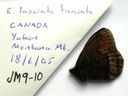
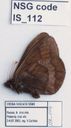
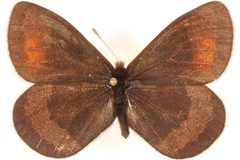
The can be distinguished from the similar red-disked alpine (Erebia discoidalis) by its wing pattern. According to Seitz's description, the ground color is sombre black-brown with a russet-brown incomplete band on the forewing that is traversed by and lacks ocelli. The hindwing displays a grey-brownish submarginal band of nearly even width extending from to hindmargin. The underside of the forewing shows a lighter, more prominent russet-brown band with the costal margin and part of the outer margin thinly dusted with grey. The hindwing beneath is dusted with grey at the base, with a dark brown somewhat dentate central area, pale ashy grey submarginal band, and distal area matching the central area color. Females are lighter throughout, with the forewing having a brownish tint and a somewhat longer and broader submarginal band on the hindwing; the basal area and submarginal band are whitish grey, while the central area and distal margin are grey-brown.
Images
Habitat
Arctic and subarctic alpine tundra environments. The has been documented at specific localities including Pokrofka and the mouth of the Yenisei River in East Siberia.
Distribution
Central Siberia; Alaska; Yukon; mainland Northwest Territories; Nunavut; Hudson Bay region; Banks Island; Victoria Island. GBIF records additionally indicate presence in Europe, European Union, and Russia.
Seasonality
are on wing from May to late July, with timing varying by location. In East Siberia, adults have been observed in June.
Diet
Larvae feed on Carex (sedges).
Similar Taxa
- Erebia discoidalisRed-disked alpine; similar in size and general appearance but distinguished by wing pattern details, particularly the presence of a red discal patch rather than the russet-brown incomplete band of E. fasciata
More Details
Subspecies
Three are recognized: Erebia fasciata fasciata (Nunavut to central Alaska); Erebia fasciata semo Grum-Grshimailo, 1899 (northern Siberia, western Chukot Peninsula, Far East); and Erebia fasciata avinoffi Holland, 1930 (north-western Alaska, eastern Russia).
Sources and further reading
- BugGuide
- Wikipedia
- GBIF taxonomy match
- iNaturalist taxon
- NCBI Taxonomy
- Catalogue of Life
- Coleoptera | Beetles In The Bush | Page 10
- Meet the Crevice Weaver: A Newly Discovered Urban Spider from Colombia | Blog
- Nota Lepidopterologica goes advanced open access with Pensoft Publishers | Blog
- Year of the Horse 2026: A selection of equine-related species to celebrate the Lunar New Year | Blog
- Platystomatidae | Beetles In The Bush