
Erebia discoidalis
Kirby, 1837
Red-disked Alpine
Erebia discoidalis, known as the red-disked alpine, is a in the Satyrinae of Nymphalidae. It has a transcontinental distribution spanning North America and Asia, occurring in and arctic-alpine . The is associated with open, acidic wetlands where its larvae feed on cottongrass (Eriophorum) species.
Pronunciation
How to pronounce Erebia discoidalis: /ɛˈrɛbiə dɪˌskɔɪˈdeɪlɪs/
These audio files are automatically generated. While they are not always 100% accurate, they are a good starting point.
Identification
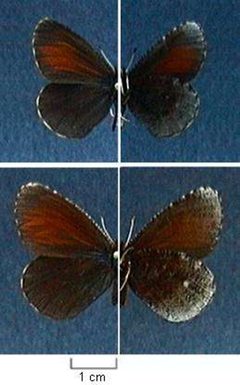
Distinguished from similar Erebia by the combination of narrow forewing with rounded apex, the specific pattern of brown and chocolate coloration with bluish-grey dusting on wing margins, and the characteristic oval whitish-grey spot at the apex of the hindwing . Most similar to Erebia fasciata (banded alpine), from which it differs in wing pattern details.
Images
Appearance
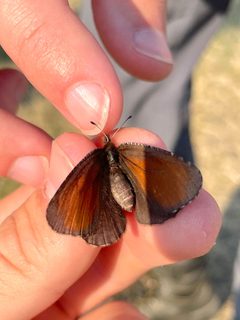
Wingspan 35–44 mm. Forewing narrow with rounded apex; costal margin brownish-grey, striated with whitish-grey and brown. Dull brown disc broadly bordered with dark chocolate anteriorly and posteriorly, with narrow border on side; dark apex feebly dusted with grey. Forewing beneath similar to above, with somewhat broader border to brown central area, apex and distal margin densely dusted with bluish-grey. Hindwing beneath dark brown from base to middle, thinly dusted with whitish-grey; outer half blue-grey with small dark brown . Oval whitish-grey spot at apex of ; 2–3 smaller spots at costal margin.
Habitat
Large, open, grassy bogs and other areas with acidic soils. Occupies and arctic-alpine wetland environments.
Distribution
North America: eastern Quebec, northern Ontario (south to Sudbury), northern Prairies, northern British Columbia, Northwest Territories, Yukon, Alaska, and marginally into northern U.S. between Michigan and Montana. Asia: Chukot Peninsula to eastern Sayan Mountains and Amur region. Four recognized: E. d. discoidalis (nominate), E. d. lena (tundra of northern Siberia, Chukot Peninsula, Russian Far East), E. d. yablonoica (Transbaikalia, Amur), and E. d. mcdunnoughi (Alaska).
Seasonality
on wing from May to late July, depending on location. period varies with latitude and elevation.
Diet
Larvae feed on Eriophorum (cottongrass). diet not documented.
Host Associations
- Eriophorum - larval food plantcottongrass
Life Cycle
Complete with , larva, pupa, and stages. Larval stage associated with Eriophorum plants in bog . Detailed not documented.
Ecological Role
Herbivore in bog ; larval feeding on cottongrass contributes to nutrient cycling in acidic wetland . likely serves as and food source for .
Human Relevance
Subject of entomological study; no significant direct economic or cultural impact documented. Potential for bog health.
Similar Taxa
- Erebia fasciataSimilar size and preferences; distinguished by wing pattern details including banding characteristics
More Details
Subspecies
Four recognized: E. d. discoidalis (nominate, North America), E. d. lena (tundra of northern Siberia, Chukot Peninsula, Russian Far East), E. d. yablonoica (Transbaikalia, Amur), and E. d. mcdunnoughi (Alaska). Subspecies differ in minor morphological details and geographic isolation.