
Erebia magdalena
Strecker, 1880
Magdalena Alpine
Erebia magdalena, commonly known as the Magdalena Alpine, is a high-elevation in the Nymphalidae. The is entirely black in coloration and inhabits rocky alpine environments in western North America. It has been described as elusive and is considered one of several rare species associated with Magdalena Mountain in west-central New Mexico. The species was described by Strecker in 1880.
Pronunciation
How to pronounce Erebia magdalena: /ɛˈrɛ.bi.a ˌmæg.dəˈleɪ.nə/
These audio files are automatically generated. While they are not always 100% accurate, they are a good starting point.
Identification
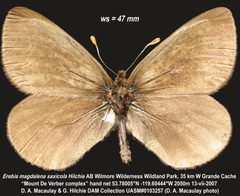
Distinguished from other Erebia by complete absence of wing patterning—most display eyespots, bands, or other markings. The uniform black wings separate it from Erebia epipsodea (common alpine) and Erebia discoidalis (red disc alpine), which show pale markings. In , may be confused with dark (Hesperiidae), but E. magdalena has clubbed without hooks. specificity to high-elevation rockslides provides additional identification context.
Images
Appearance
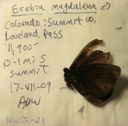
are entirely black with no wing patterning. The wings lack the eyespots or markings typical of many Erebia . The uniform black coloration provides cryptic protection against dark volcanic rocks and shadowed cliff .
Habitat
Rockslides near vegetation at high elevations. Associated with volcanic or dark rocky substrates where cryptic coloration is effective. Found on Magdalena Mountain and similar alpine terrain in the southern Rocky Mountains.
Distribution
North America: United States (Montana, Colorado, Utah, New Mexico) and Canada (Alberta—Willmore Wilderness Park; British Columbia—Stone Mountain Provincial Park and adjacent areas; Yukon—isolated nunatak in Kluane National Park and Reserve).
Behavior
have been observed flying over rockslide terrain. The ' elusive nature suggests low or highly localized occurrence. Specific behavioral details remain poorly documented.
Human Relevance
Featured in Robert Michael Pyle's 2018 novel "Magdalena Mountain," which brought attention to the among lepidopterists and conservation audiences. Specimens examined at the Bohart Museum of Entomology, UC Davis, during the 2019 Lepidopterists' Society conference. Not known to be of economic importance.
Similar Taxa
- Erebia epipsodeaCommon alpine with similar preference but displays pale wing markings and eyespots absent in E. magdalena
- Erebia discoidalisRed disc alpine with distinctive reddish-orange forewing discal patch; overlaps in range but easily distinguished by color pattern
- Trimerotropis cyaneipennisBlue-winged grasshopper shares Magdalena Mountain and rocky substrate preference; distinguished by order (Orthoptera), blue hind wings, and jumping
More Details
Conservation Status
status and specific threats not well documented; rarity and restricted alpine suggest vulnerability to climate change impacts on high-elevation
Taxonomic History
Described by Strecker in 1880; remains a valid without described
Sources and further reading
- BugGuide
- GBIF taxonomy match
- iNaturalist taxon
- NCBI Taxonomy
- Catalogue of Life
- A Gathering of Lepidopterists at UC Davis | Bug Squad
- Robert Michael Pyle: The Face of Insect Conservation | Bug Squad
- Robert Michael Pyle, Butterflies and The Dark Divide | Bug Squad
- UC Davis Evolutionary Biologist: About Those Out-of-Place Species | Bug Squad
- Nota Lepidopterologica goes advanced open access with Pensoft Publishers | Blog
- Bug Eric: Blue-winged Grasshopper