
Trimerotropis cyaneipennis
Bruner, 1889
blue-winged grasshopper, blue crackler
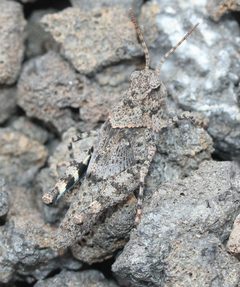
Trimerotropis cyaneipennis is a band-winged grasshopper in the Acrididae, commonly known as the blue-winged or blue crackler. It is native to western North America, with a distribution spanning from West Texas through New Mexico, Arizona, Colorado, Utah, and Nevada to southern Oregon and southern California. The is known to hybridize naturally with T. suffusa in zones of microsympatry, where their distributions and overlap.
Pronunciation
How to pronounce Trimerotropis cyaneipennis: /ˌtraɪməˈrɒtrəpɪs saɪəˈniːpɛnɪs/
These audio files are automatically generated. While they are not always 100% accurate, they are a good starting point.
Identification
As a member of the Oedipodinae (band-winged grasshoppers), T. cyaneipennis likely exhibits the characteristic enlarged hind and banded wings typical of the . The specific epithet 'cyaneipennis' (blue-winged) suggests distinctive blue coloration on the wings. Precise identification features distinguishing it from congeneric such as T. suffusa, T. pallidipennis, or T. fontana are not documented in available sources.
Images
Habitat
Occurs primarily in desert regions and areas with sparse vegetation. In the Pueblo Mountains of southeast Oregon, it has been found in microsympatry with T. suffusa in a narrow , suggesting occupancy of transitional zones between desert and woodland .
Distribution
Western North America: from West Texas through New Mexico, Arizona, Colorado, Utah, and Nevada to southern Oregon and southern California. GBIF records confirm presence in Arizona and Utah. The is predicted to occur in southwestern Wyoming but has not been documented there in systematic surveys.
Behavior
Produces (audible stridulation by wing-flicking), a characteristic of band-winged grasshoppers. The 'blue crackler' likely derives from this sound production.
Similar Taxa
- Trimerotropis suffusaOverlapping distribution in southern Oregon; ecologically isolated by preference (T. suffusa in woodlands vs. T. cyaneipennis in desert/sparse vegetation), but hybridizes in narrow ; distinguished by number and of hybrid offspring
- Trimerotropis pallidipennisCongeneric band-winged grasshopper with potentially overlapping range in western North America; specific distinguishing features not documented in available sources
- Trimerotropis fontanaCongeneric with western distribution; may occur in similar ; differentiation requires detailed morphological examination
More Details
Hybridization and Chromosomal Biology
Natural F1 hybrids between T. cyaneipennis and T. suffusa have been documented in the Pueblo Mountains of southeast Oregon. These hybrids are intermediate in , , and number. The parental differ by a fixed centric fusion, with meiotic analysis revealing irregular segregation and pairing failures that produce mostly polyploid or aneuploid sperm, indicating substantial postzygotic isolation despite hybrid formation.
Survey Detection Limitations
As a band-winged grasshopper with active characteristics, T. cyaneipennis may be underrepresented in standard sweep-net surveys. The Wyoming Distribution Atlas (1988-2019) lists it as 'probably occurring' in southwestern Wyoming based on predicted distribution, but it was not collected during systematic surveys, likely due to a combination of geographic survey toward eastern Wyoming and the ' behavioral avoidance of sweep-net sampling.
Sources and further reading
- BugGuide
- Wikipedia
- GBIF taxonomy match
- iNaturalist taxon
- NCBI Taxonomy
- Catalogue of Life
- Grasshoppers of Colorado
- Wyoming Distribution Atlas
- Grasshopper Collections and Survey
- Grasshoppers of Colorado
- Species Records and Accounts
- Grasshoppers of Colorado
- The meiotic behaviour of natural F1 hybrids between Trimerotropis suffusa Scudder and T. cyaneipennis Bruner (Orthoptera: Oedipodinae)