
Trimerotropis pallidipennis
(Burmeister, 1838)
Pallid-winged Grasshopper, Pallidwinged Grasshopper
Trimerotropis pallidipennis is a moderately-sized bandwinged with the widest distribution of any bandwinged grasshopper in the New World, ranging from southwestern Canada to Argentina. It inhabits desert and semi-desert , where occasionally irrupt to damaging numbers. The exhibits strong capabilities, including long-distance that can carry swarms into urban areas and agricultural fields. Multiple genetic lineages have been identified in South America, indicating complex diversification history associated with Andean topography and Pleistocene climatic fluctuations.
Pronunciation
How to pronounce Trimerotropis pallidipennis: /ˌtraɪmɛroʊˈtroʊpɪs ˌpælɪdɪˈpɛnɪs/
These audio files are automatically generated. While they are not always 100% accurate, they are a good starting point.
Identification
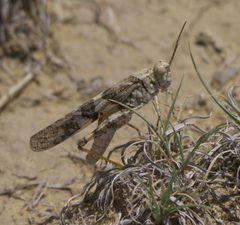
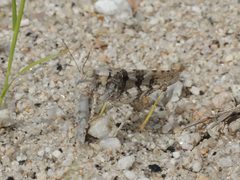
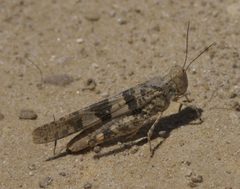
are tan to gray with two transverse dark bands crossing the full width of the tegmen and numerous brown spots at the end. The hindwing has a narrow but conspicuous black band across the center, with a white to pale yellow disk and transparent area. The carina of the pronotum is incised twice, high on the prozona and low but distinct on the metazona; the edge of the pronotal lobe is straight without a tooth. The inner medial area of the hind is black with two yellow bars. The hind tibia is yellow, and the venter is solid cream to pale yellow. Nymphs have distinct triangular foveolae on the , with the pronotal median carina feebly incised in early instars becoming more strongly elevated in later instars. Instar I has a mainly black hindleg with pale basal fourth of femur; instars III-V show pale tan hind femur with two or three black bars and yellow hind tibia.
Images
Habitat
Desert and semi-desert rangelands of western North America, characterized by shrubs, forbs, and grasses with abundant bare ground for basking and resting. Occupies sparse grassland areas in the Great Plains. Also colonizes disturbed including weedy city lots. In South America, found in Andean dry lands along altitudinal gradients.
Distribution
From southwestern Canada through western United States to Argentina; the most widely distributed bandwinged in the New World. In North America, primarily in deserts of the West including Arizona, California, New Mexico, Utah, Colorado, Wyoming, Idaho, Texas, and Nevada. South American in Peru, Chile, and Argentina represent distinct genetic lineages derived from North American ancestors that dispersed southward following closure of the Panama Isthmus.
Seasonality
Hatches early in spring from overwintered . In south-central Arizona, hatching begins late February and continues through March; in west-central Utah, hatching begins late April. In Colorado, Wyoming, and northern Arizona, appear in early June. In southern Arizona, a second begins hatching in early June, with potential for additional generations under favorable moisture conditions. Only one generation per year in northern states.
Diet
, feeding on a variety of forbs and grasses with diet shifting based on availability and quality. Early spring nymphs feed on lush grasses including downy brome (Bromus tectorum) and needle grama (Bouteloua aristidoides). As annual grasses dry, switches to green grasses and forbs. Crop content studies have identified downy brome, tumblemustard, crested wheatgrass, thickspike wheatgrass, Sandburg bluegrass, milkvetch, western salsify, big sagebrush, hoary aster, Greene rabbitbrush, gray rabbitbrush, blue grama, Cryptantha, Solanum, Iva, Croton, Gaura, Ratibida, Allionia incarnata, and Franseria deltoidea. Laboratory two-choice tests show preferences for dandelion, kochia, downy brome, crested wheatgrass, and needle-andthread.
Life Cycle
are laid in bare soil to approximately 1 inch depth in slightly curved, narrow pods (1/8 inch diameter, 1 inch long) containing an average of 34 pale yellow eggs (4.5-5 mm long). Eggs enter shortly after laying and overwinter, with rainfall critical for survival and hatching. Nymphal period ranges from 31-60 days depending on temperature, with 5-6 instars in females and usually 5 in males. Under laboratory conditions at 70-84°F, nymphal period averages 50 days; at 81-101°F, averages 31-33 days. Preoviposition period averages 43 days (minimum 26 days). longevity averages 80 days. is high, with females averaging 386 eggs; one female laid 27 pods containing 955 eggs.
Behavior
Possesses strong capabilities for and escape from deteriorating . Flushed individuals fly swiftly at 2-3 feet height, often exceeding 100 feet. Long-duration flights can carry individuals well out of sight; one observed male circled a sagebrush slope for 17 minutes. Pilots have reported swarms at 3,000-5,000 feet altitude. flight activity occurs, with swarms attracted to city lights. Males crepitate (produce snapping sounds with hindwings) during flight, which appears to initiate pair formation. Courtship involves stridulation producing trilling sounds, with males producing 1-8 trills while advancing toward females. Small- movement studies show average displacement of 27 feet per day, with low recapture rates indicating substantial flight out of study areas. Basking observed on bare ground.
Ecological Role
Herbivore in desert and semi-desert . irruptions can dramatically alter vegetation structure and composition through intensive grazing. Serves as prey for various vertebrate and . High and capability allow rapid population response to favorable conditions.
Human Relevance
Significant agricultural pest during periods. Historical outbreaks in Arizona (1958, 1998), California, New Mexico, and Utah have damaged wheat, cotton, sugarbeets, barley, milo, corn, carrots, safflower, and grapes. of 25-50 per square yard can defoliate small grains and cut off ; in cotton, 5-10 per square yard can consume seedlings to ground level. swarms attracted to urban lights create traffic hazards and nuisance conditions; in 1998, accumulations reached 2 inches deep along 50 miles of roads in Arizona. Managed with and cultural practices during outbreaks.
Similar Taxa
- Trimerotropis kiowaSimilar bandwinged in same , but T. kiowa has hindwing mainly colorless without dark band and lacks the two transverse dark bands on tegmen characteristic of T. pallidipennis; also has fringe of long hairs on hind lower carina not present in T. pallidipennis.
- Trachyrhachys kiowaFormer name for Trimerotropis kiowa; same distinguishing features apply regarding wing pattern and femoral hair fringe.
Sources and further reading
- BugGuide
- GBIF taxonomy match
- iNaturalist taxon
- NCBI Taxonomy
- Catalogue of Life
- Grasshoppers of Colorado
- Grasshoppers of Colorado
- Species Records and Accounts
- Grasshoppers of Colorado
- Pallidwinged Grasshopper
- Kiowa Grasshopper
- Effects of Temperature on Behavior of Trimerotropis pallidipennis (Orthoptera, Acrididae)
- Observations on the Life History of the Desert Grasshopper (Trimerotropis pallidipennis pallidipennis) in Laboratory and Insectary Cages1
- Mitochondrial DNA and phylogeography of the grasshopper Trimerotropis pallidipennis in relation to clinal distribution of chromosome polymorphisms
- Mitochondrial DNA and phylogeography of the grasshopper Trimerotropis pallidipennis in relation to clinal distribution of chromosome polymorphisms
- Unraveling the diversification history of grasshoppers belonging to the “Trimerotropis pallidipennis”(Oedipodinae: Acrididae) species group: a hotspot of biodiversity in the Central Andes