
Trachyrhachys kiowa
(Thomas, 1872)
Kiowa grasshopper, ash-brown grasshopper
Trachyrhachys kiowa is a medium-sized band-winged grasshopper inhabiting shortgrass and mixedgrass prairies of western North America. It feeds almost exclusively on grasses and sedges, particularly blue grama, and can become an economically damaging component of . The is known for its dispersive and intermediate hatching , emerging two to three weeks after early-hatching species like the bigheaded grasshopper.
Pronunciation
How to pronounce Trachyrhachys kiowa: /ˌtrækɪˈrækɪs ˈkaɪoʊə/
These audio files are automatically generated. While they are not always 100% accurate, they are a good starting point.
Identification
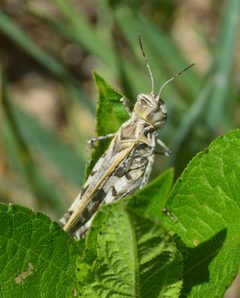
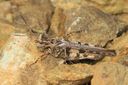
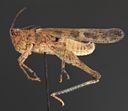
Medium-sized tan to pale green with dark brown maculations. nearly vertical; pronotum with carina cut twice, elevated higher on prozona; lateral lobe with posteroventral angle drawn acutely downward. Hindwing mainly transparent, usually without dark band. Hind with inner medial area fuscous bearing two pale yellow bands (one central, one next to knee); lower carina with dense fringe of long hairs (male 3–4 mm, female 4–5 mm). Hind tibia blue, especially on inner face, with end usually tan and spotted brown. Nymphs distinguished by fringe of hairs on hind femur lower carina and two pale bars on inner femur face.
Images
Habitat
Sparse grassland areas dominated by short grasses, especially blue grama. Largest develop in mixedgrass, shortgrass, and desert prairies. In tallgrass prairie, occupies shorter, sparser grass sites on hilltops and disturbed or overgrazed land.
Distribution
Widely distributed in North America from Canada (British Columbia, Alberta, Saskatchewan, Manitoba) through the western and central United States (Montana, Wyoming, Colorado, Nebraska, Kansas, Oklahoma, Texas, New Mexico, Arizona) to central Mexico.
Seasonality
Intermediate hatching group; hatching begins 15–17 days after bigheaded grasshopper, typically first half of June in mixedgrass and shortgrass prairies. Hatching period lasts 2–4 weeks depending on soil temperature. Nymphal development 37–53 days. present from mid-July through October.
Diet
Feeds almost exclusively on grasses and sedges. Blue grama is principal , comprising 84–100% of diet in mixedgrass and shortgrass prairies. Other substantial food plants include western wheatgrass, needle-and-thread, Kentucky bluegrass, threadleaf sedge, needle-leaf sedge, and Penn sedge. occasionally feed on lichen mats. Does not feed on bran .
Life Cycle
One annually. overwinter in soil; embryos develop to stage in summer, complete development following spring when soil temperatures reach threshold. Nymphs pass through five instars. mate on ground; males stridulate and tap female's with during courtship. Copulation lasts 25–40 minutes. Females oviposit in bare ground near vegetation, taking 40–60 minutes; egg pod 1.125–1.25 inches long contains 8–10 eggs lying loosely in soil with minimal froth. Eggs 4.4–5 mm long, two-toned brown and tan.
Behavior
Ground-dwelling with activities strongly influenced by temperature and light. Rests horizontally on ground at night without seeking thermal protection. Basks in morning by orienting side perpendicular to sun and lowering flexed hindleg to expose . Feeds primarily 9–11 a.m.; climbs vegetation to rest 0.5–1 inch above ground when soil surface exceeds 130°F. Descends to feed again when temperatures moderate. Evasive short (4–12 feet), low (6–18 inches), straight or curved with right-angle turn, softly crepitating. Known as inveterate wanderer with documented migratory swarms.
Ecological Role
Herbivore in grassland ; contributes to forage consumption in rangeland . Typically subdominant member of (1–13% representation, 0.1–2 per square yard), occasionally becoming second most abundant . Population fluctuations may influence competitive dynamics with other grass-feeding grasshoppers.
Human Relevance
Economic pest of rangeland forage. Component of causing damage to high-quality forage grasses. Maximum outbreak densities reach 2.5 per square yard. Damage potential increased by feeding preference for blue grama and other valuable forage . Not susceptible to bran applications, limiting certain control options.
Similar Taxa
- Trachyrhachys asperaFinned shares and general appearance; distinguished by hindwing with large black band often extending to apex, right-angle posteroventral pronotal angle, hind with single pale bar and high keel, and dense brush (not thin) of hairs on lower carina. T. aspera hatches ~4 weeks later.
- Metator pardalinusBluelegged similar in size and bandwinged affiliation; distinguished by blue hind tibia and , alternating blue and dark bands on inner hind , and preference for western wheatgrass .