
Trachyrhachys aspera
Scudder, 1876
Finned Grasshopper
Trachyrhachys aspera, commonly known as the finned , is a medium-sized band-winged grasshopper native to the shortgrass prairie of western North America. This exhibits strong fidelity to blue grama grass (Bouteloua gracilis) dominated grasslands, where it functions as a subdominant member of grasshopper . The species is notable for its late-season , hatching approximately four weeks after the sympatric Trachyrhachys kiowa, and for its highly specialized diet consisting almost exclusively of blue grama grass. Despite its potential economic impact as a forage competitor with livestock, have remained chronically low with no documented events.
Pronunciation
How to pronounce Trachyrhachys aspera: /trəˈkaɪrækɪs ˈæspərə/
These audio files are automatically generated. While they are not always 100% accurate, they are a good starting point.
Identification
Distinguished from sympatric Trachyrhachys kiowa by: (1) hindwing with large black band extending to apex versus mainly transparent in kiowa; (2) pronotal lateral lobe posteroventral angle right-angled versus acute and drawn down in kiowa; (3) hind inner with one light transverse bar versus two in kiowa; (4) high keel on hind femur versus low keel in kiowa; (5) thin brush of hairs on lower keel versus dense brush in kiowa. Nymphs distinguished by single pale bar on inner hind femur versus two bars in kiowa, and later .
Images
Appearance
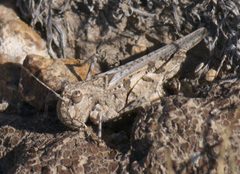
Medium-sized with brown, mottled gray and black coloration. Hindwing marked by large black band often extending to apex. Hind with high keel (fin) and thin brush of hairs on lower keel; inner chiefly black with one light transverse bar. Pronotal lateral lobe with posteroventral angle approximating right angle. Nymphs short and robust with brown body, black markings, yellow or pale tan venter; hind femur inner face mainly black with one pale yellow bar in front of knee.
Habitat
Shortgrass prairie dominated by blue grama grass; limited occurrence in desert prairie and western edge of mixedgrass prairie. Vegetation characterized by blue grama as , subdominant grasses, forbs, small shrubs, and extensive bare ground. Requires patches of blue grama for daytime activity and bare ground or ground litter under blue grama for shelter.
Distribution
Western North America from Wyoming and Nebraska south to central Mexico. Distribution spotty in northern range; widely distributed in shortgrass prairie near center of range in New Mexico. Specific records from Colorado, Wyoming, Nebraska, New Mexico, Texas (Trans-Pecos and southwest), and Mexico (Northeast and Southwest regions).
Seasonality
Hatching begins first week of July in north-central Colorado (elevation 5,400 ft), continuing 7–10 days; similar timing in Trans-Pecos, Texas, delayed in southwest Texas by spring rainfall patterns. Nymphal development July through mid-August (47–58 days, average 51 days). present mid-August through October. Males fledge one week before females.
Diet
Feeds almost exclusively on blue grama grass (Bouteloua gracilis). Crop contents of : 99–100% blue grama in Colorado shortgrass prairie; 80% blue grama and 20% hairy grama (Bouteloua hirsuta) in western Texas desert prairie. Laboratory preference tests confirm strong preference for blue grama over western wheatgrass, red threeawn, downy brome, and threadleaf sedge. Consumes green leaves from tip to base, handling detached leaf sections with front .
Host Associations
- Bouteloua gracilis - primary Blue grama grass; plant in and nearly exclusive food source
- Bouteloua hirsuta - secondary Hairy grama; minor component of diet in western Texas desert prairie
Life Cycle
. deposited in small bare areas between grama plants at depths of 1/4 to 1 1/4 inches; no pod formed, light froth coating on some eggs. Clutch size 12–18 eggs; female 1–48 eggs (average 30) in laboratory. Egg length 4.6–5.2 mm, yellow to dark brown, some two-toned. Oviposition triggered by declining of late summer; no eggs produced under 12-hour light conditions, successful oviposition under 7-hour light/17-hour dark regime.
Behavior
activity pattern: rests on bare ground under blue grama at night; emerges 2 hours after sunrise to bask for 90 minutes to 2 hours with side perpendicular to sun and hindleg lowered to expose . Thermoregulatory includes stilting and climbing vegetation to shade body when ground temperatures exceed 115°F (10:40 am to 4:30 pm). Feeding occurs after sunset when temperatures moderate. Flushed short (3–4 ft), low (4–6 in), silent. No appetitive flights observed. Courtship brief: stridulating males approach females, jump onto back from ~1/2 inch distance. Copulation observed late morning.
Ecological Role
Subdominant herbivore in shortgrass prairie ; chronically low densities (0.27–0.72 young per square yard) with stable in favorable . Contributes to cumulative forage consumption in multi- assemblages despite never achieving status. Daily adult mortality approximately 2%, allowing extended survival into late fall.
Human Relevance
Potential rangeland pest: feeds on blue grama, a primary livestock forage. Estimated forage loss of 20 pounds dry weight per acre at of one young per square yard. No documented events despite potential; remain subdominant even during regional outbreaks. No records in Cooperative Economic Insect Survey damaging reports (1951–1980). Not attracted to bran .
Similar Taxa
- Trachyrhachys kiowaSympatric sharing blue grama ; distinguished by transparent hindwing, acute pronotal lobe angle, two pale bars on hind inner , low keel, dense hair brush on lower keel, and earlier (hatches ~4 weeks earlier)
- Aulocara elliottiSimilar-sized rangeland with comparable dry weights; distinguished by different color pattern, wing , and broader diet including multiple grass
More Details
Population Ecology
Permanent occupation of favorable shortgrass prairie sites demonstrated by 30+ years of observations at Central Plains Experimental Range, Colorado. fluctuations modest compared to . Localized distribution in Wyoming suggests strong specificity. Low densities hypothesized to result from low female and high desiccation risk due to unprotected egg placement in soil during dry periods.
Laboratory Rearing Notes
Cage studies revealed critical requirement for : females failed to oviposit under 12-hour light/12-hour dark conditions with supplemental heat, but produced under 7-hour light/17-hour dark regime simulating late summer day lengths. This pattern parallels Melanoplus devastator and Cordillacris crenulata.