
Melanoplus devastator
Scudder, 1878
devastating grasshopper
Melanoplus devastator, the devastating , is a medium-sized spur-throated grasshopper to the far western United States, primarily California, with limited occurrence in Oregon and Washington. It is a major agricultural pest known for irruptive that can cause extensive damage to rangeland forage, orchards, and crops. The exhibits a unique among rangeland grasshoppers, with females entering reproductive during summer and resuming development in fall triggered by decreasing . When populations explode, nymphal bands and swarms migrate from depleted foothill rangelands into valley agricultural areas, sometimes traveling 30 miles or more.
Pronunciation
How to pronounce Melanoplus devastator: //ˌmɛləˈnɒpləs ˈdɛvəˌsteɪtər//
These audio files are automatically generated. While they are not always 100% accurate, they are a good starting point.
Identification
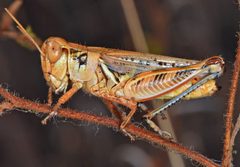
distinguished from similar () by male genitalia: elongated slender and long extending halfway on supraanal plate (versus shorter cerci and furculae in M. sanguinipes). Both sexes share pale gray-tan body with black-spotted tegmina and pale greenish yellow venter. Nymphs separated from M. sanguinipes by lacking diagonal dark bar on (present in M. sanguinipes) and by having larger ivory patches interrupting the dark stripe on hind medial area (smaller light patches in M. sanguinipes). Instar I nymphs are pale with clearly evident ivory crescent and pale yellow medial femur area with narrow dark stripe, versus dark with faint crescent and heavily fuscous-spotted femur in M. sanguinipes.
Images
Appearance
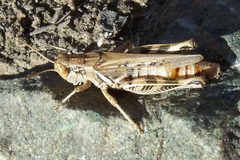
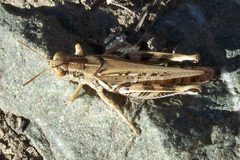
Medium-sized with long wings extending beyond the . Body color is pale gray and tan with fuscous maculations; venter of abdomen is pale greenish yellow. Tegmen marked by a row of conspicuous black spots. Medial area of hind shows pale or reddish tan and fuscous patches. Hind tibiae usually blue but may be red (3% of males and 15% of females red at Jasper Ridge, California site). Male elongated and slender; long, extending halfway on supraanal plate. Nymphs pale yellow, pale tan, or pale green with ivory crescent on gena extending onto pronotum; hind femur with narrow dark stripe in center of medial area in early instars, interrupted by wide diagonal pale tan bar in later instars.
Habitat
Inhabits semiarid rangelands dominated by forbs and grasses at elevations from near sea level to over 5,000 feet. Primary is foothill rangeland in coastal states, particularly California's coastal and Sierra Nevada foothills. Preferred oviposition sites include well-drained hillocks, ridges, slopes, and banks of ravines with gravelly soil. beds often concentrated near basal growth of forbs such as tarweeds and Russian thistle, among roots of filaree, or in small well-drained bare spots. Migrants invade valley agricultural lands including green pastures, orchards, vineyards, and crop fields.
Distribution
Limited geographic range in far western North America. Main distribution in coastal states: primarily California (coastal and Sierra Nevada foothills), minor occurrence in Oregon and Washington. Not found in interior western states or Great Plains.
Seasonality
Hatching period ranges from 50 to 103 days, starting late April and extending to late July—unusually prolonged compared to sympatric . Nymphal development extends through summer with some individuals still present in mid-October; nutritional stress appears to prolong development. present from approximately July through fall. delayed: females enter reproductive during summer, with maturation triggered by decreasing day length beginning late September. Oviposition occurs in fall coinciding with autumn rains and renewed plant growth.
Diet
, consuming grasses, forbs, shrubs, and trees. Nymphs feed preferentially on legumes, filaree (Erodium spp.), and brome and barley grasses when green and succulent. When preferred plants mature and dry, late nymphs and survive on less palatable plants including needlegrass (Stipa spp.), tarweeds (Hemizonia spp.), and wild lettuce (Lactuca spp.), feeding on of stems and leaf edges. Grass seeds, whether naturally shed or dropped by harvester ants (Messor andrei) on their mounds, are favored food items. Adults feed on stubble and ground litter. Migrants observed feeding on grape, citrus, apple, pear, cherry, peach, apricot, prune, plum, almond, avocado, cabbage, tomato, beet, beans, marigold, alfalfa, clover, timothy, corn, and barley.
Life Cycle
with . Eggs deposited in fall in pods 3/4 to 7/8 inch long, slightly curved, containing 20-31 pale yellow eggs 3.9-4.4 mm long. Embryonic development and hatching requirements not fully studied but prolonged hatching period suggests possible egg or staggered development. Nymphs pass through six instars (both sexes), with development rate highly variable depending on nutrition and temperature; precocious individuals may reach adulthood in ~70 days. Unique among rangeland grasshoppers: females undergo reproductive diapause during summer, with resuming in response to decreasing in late September. Fall rains typically coincide with breaking of diapause, providing nutritious plants for egg production.
Behavior
Highly migratory when irrupt. Older nymphs form crawling bands that migrate downhill toward succulent vegetation, following ravines and drainages toward crops, often moving 5 miles or more. are strong fliers; swarms may migrate 15 or more miles in a single day, with observed distances of at least 30 miles. Non-migratory adults when flushed fly 3-6 feet at heights of 4-12 inches in straight silent ; (wing-snapping sound) rarely heard. Daily activity pattern: bask in morning sun for approximately two hours, feed during cooler morning and late afternoon periods, climb vegetation to escape ground temperatures exceeding 130°F during midday heat. Courtship not specifically studied; presumed similar to with male stridulation and mounting attempts.
Ecological Role
Primary consumer in semiarid rangeland . During phases, can become member of , coexisting with Oedaleonotus enigma, Camnula pellucida, Dissosteira pictipennis, and others. crashes associated with fungal (Entomophaga grylli), which can reduce populations by 90%. Migrants that invade valley agricultural fail to establish breeding populations, reasons unknown.
Human Relevance
Major agricultural pest in California, minor pest in Oregon and Washington. Historical records of destructive date to 1722 (Spanish settlement era). Severe in 1855 affected California, Oregon, and Washington. Most recent general outbreak 1955-1961 with of 580,000 to 4,523,000 acres; over 3 million acres infested in 1957, over 4.5 million in 1958. Damage includes destruction of rangeland forage, defoliation of orchards and vineyards, destruction of grain fields (barley, corn), vegetable crops, and gardens; bark of young fruit trees and grape vines gnawed and consumed, killing terminals. Post-1961 irruptions have remained below 500,000 acres annually. Control efforts historically significant; modern management integrated with broader programs.
Similar Taxa
- Melanoplus sanguinipesClosely related member of mexicanus group with which M. devastator was historically confused; genetic studies suggest possible conspecificity or relationship, but maintained as separate based on structural, , and geographic differences. Distinguished by male and shape, nymphal markings, and hind pattern.
- Oedaleonotus enigmaCo-occurs in California rangeland and may dominate in valley and low foothill where M. devastator is less successful; both can contribute to damage but have different habitat preferences and seasonal cycles.
- Camnula pellucidaSympatric in California foothills, often co- in ; C. pellucida dominates in montane grasslands while M. devastator dominates in lower elevation foothill rangelands. Differentiated by (clear wings in C. pellucida) and .
More Details
Population Dynamics
persist perennially in foothill rangelands with dramatic fluctuations. Pre- increases observed: 220,000 acres infested in 1954 expanded to 1,264,000 acres in 1955 (5.7-fold increase). Outbreaks can develop from noneconomic levels to 100 individuals per square yard in three years. Population crashes associated with Entomophaga grylli fungal and subsequent drought.
Reproductive Diapause
Unique among western rangeland grasshoppers in exhibiting obligate reproductive in females. Laboratory experiments by Middlekauff (1964) demonstrated that decreasing day length triggers and maturation. This synchronizes production with autumn rains and renewed plant growth, but creates summer nutritional bottleneck when females must survive on less palatable forage.
Taxonomic Controversy
Molecular and morphological evidence (Orr et al. 1994) indicates hybridization between M. devastator and M. sanguinipes in California, with suggestions that the two may represent single or . However, clear differences in (M. sanguinipes breeds in irrigated alfalfa/pastures, M. devastator in foothill rangelands), (reproductive in M. devastator), and geographic range maintain their recognition as separate species.