
Melanoplus sanguinipes
(Fabricius, 1798)
migratory grasshopper, lesser migratory grasshopper, red-legged grasshopper
is a medium-sized spur-throated grasshopper and one of the most economically important pests in North America. It is widely distributed across the continent, inhabiting diverse grassland from native prairies to agricultural fields and disturbed areas. The exhibits remarkable ecological flexibility, feeding on both grasses and forbs, and displays migratory at high densities. Under favorable conditions, populations can increase exponentially and form swarms that travel hundreds of miles, causing extensive damage to crops and rangeland. The species has been extensively studied for its , plant relationships, and .
Pronunciation
How to pronounce Melanoplus sanguinipes: /mɛˈleɪnəˌplʌs sænˈɡwɪnɪˌpiz/
These audio files are automatically generated. While they are not always 100% accurate, they are a good starting point.
Identification
males identified by broad, apically rounded and notch of subgenital plate with abruptly elevated, thickened margin. Node or bump present on mesosternum. Hind tibia color highly variable but typically red, orange, or pink. Nymphs identifiable by: with many light spots and narrow brown bar across middle; narrow pale yellow crescent on gena below continuing onto pronotal lobe; hind with black stripe cut in middle by light bar; hind tibia of first instar fuscous with pale basal ring, other instars pale blue-green or reddish without pale ring. Distinguished from Melanoplus devastator by broader cerci in males, shorter , and different nymphal color patterns (M. devastator nymphs paler with more prominent ivory crescent, different hind femur markings).
Images
Appearance
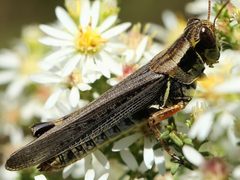
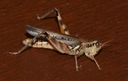
Medium-sized , 15–30 mm in length, with females larger than males. Body color dark grayish-brown, often tinged with reddish-brown. Broad black band extends from behind along lateral lobes of prozona. Hind tibiae usually bright red, orange, or pink, occasionally blue, green, or dull brown—this color variation is a key identification feature. Tegmina extend 2–3 mm beyond hind , brown with dark spots, slender and tapering. Wings colorless. Hind femora light yellow to sulfur brown with two oblique, broad dark-brown bands. broad, apically rounded, about twice as long as broad. small, slender, diverging, one-fourth to one-third length of supraanal plate.
Habitat
Occurs in a multitude of including native grasslands, meadows, prairies, and agricultural lands. Thrives in disturbed habitats: weedy rangeland, crop borders, roadside strips, abandoned cropland, and overgrazed pastures. Favors areas with compact sandy loam soils suitable for oviposition and abundant forbs or mixed vegetation. Adapted to western agriculture; inadvertent weed introduction, plowing of sandy soils creating wind-blown drifts, and overgrazing create especially favorable conditions.
Distribution
Widely distributed across North America from southern Canada and the Yukon River south to tropical lowlands of Mexico. Present throughout the United States except peninsular Florida and California west of the Sierra Nevada Mountains. Also found in the Caribbean. In western states, occurs from plains to montane elevations. Four recognized with somewhat different geographic ranges: M. s. sanguinipes (widespread), M. s. atlanis, M. s. defectus, and M. s. vulturnus.
Seasonality
Early-hatching . Nymphs appear from late spring through summer depending on location and elevation; in northern Colorado, nymphs occur June through August. emerge from first part of summer through early fall; in northern Colorado, adults present August through October. Hatching begins first on open south slopes, fields with little cover, and sandy soils; duration ranges from 3 weeks under uniform warm conditions to 6 weeks with variable soils, vegetation, or cool temperatures. In warmer areas (e.g., Kansas), may produce partial second .
Diet
mixed feeder consuming both grasses and forbs. Preferred foods include dandelion, tumble mustard, wild mustard, pepperweed, western ragweed, downy brome, Kentucky bluegrass, barley, and wheat. Also feeds on many native grasses including blue grama, western wheatgrass, bluegrasses, sand dropseed, squirreltail, and stinkgrass. Nymphs and ingest dry materials on ground surface including plant litter, cattle manure, and bran flakes. Laboratory studies demonstrate that mixed diet provides better nutrition than single-plant diet.
Life Cycle
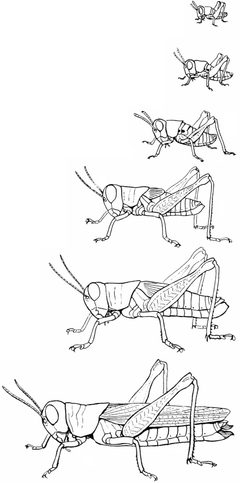
laid in pods 1 inch long, curved, containing 5–18 eggs arranged in two columns. Eggs banana-shaped, 4.5–4.8 mm long, pale yellow to cream colored. Pods deposited 1–2 inches below soil surface, often among roots of grasses or around base of wheat stubble and alfalfa. Embryonic development requires 527 above 50°F threshold; 80% of development occurs in summer of deposition, 20% following spring. Nymphal stage with 5–6 instars (females usually require 6), completed in 35–55 days depending on temperature. Preoviposition period 2–3 weeks. Females may produce up to 20 pods and 400 eggs under laboratory conditions; average in nature unknown but likely lower.
Behavior
with distinct daily activity pattern. Spends night resting horizontally on ground or vertically on vegetation. Basks in morning sun by turning side perpendicular to rays and lowering hindleg to expose ; basking lasts 2–3 hours. Becomes active, feeding and , as temperatures rise. Mating and oviposition occur later in day. When soil temperatures exceed 130°F, climbs vegetation to rest in shade. Second period of activity occurs in late afternoon with feeding, mating, and oviposition. Exhibits temperature preference of approximately 38°C. Migratory inherent and regularly displayed, though variable among . Nymphal bands may migrate up to 10 miles (usually less than 5) at 0.1 mph. highly migratory in prereproductive stage; swarming occurs on clear days near 80°F with gentle winds. designated low (≤25 ft) or high (>25 ft); swarms observed up to 13,000 ft elevation. Adults can travel 30+ miles in a day; longest recorded 575 miles. Courtship involves male waving and vibrating hind before copulatory leap; visual stimuli primary for locating females, with possible chemical cues for distinguishing mature/virgin females. Multiple matings common; most active individuals mate 40–50+ times.
Ecological Role
Primary consumer in grassland ; significant herbivore of both native vegetation and agricultural crops. Serves as for dipterous and ( EPV). irruptions can dramatically alter vegetation structure and reduce forage availability for livestock and wildlife. Contributes to nutrient cycling through consumption and ; ingestion of plant litter and manure may influence soil processes.
Human Relevance
Most economically damaging in the United States. Causes more crop damage than any other North American grasshopper. Attacks wheat, barley, oats, alfalfa, clover, corn, vegetables, ornamentals, vines, bushes, and trees—feeding on foliage, fruit, and bark. Damage mechanisms include destruction of germinating seedlings, gradual defoliation reducing kernel weight, clipping of wheat, and consumption of winter wheat seedlings. Rangeland deplete forage for livestock and wildlife. Mass extend damage across regions. Subject of extensive research; control methods include clean culture, elimination of weedy fence rows, judicious herbicide and use, planting dense grass stands in idle cropland, rangeland restoration, and monitoring.
Similar Taxa
- Melanoplus devastatorClosely related member of mexicanus group; males distinguished by elongated slender versus broad rounded cerci in M. sanguinipes, and longer extending halfway on supraanal plate. Nymphs paler with more prominent ivory crescent and different hind markings. Geographic range primarily coastal California and Pacific Northwest versus broader continental distribution of M. sanguinipes.
- Melanoplus bivittatus (twostriped grasshopper)Larger with distinctive paired light yellow stripes running dorsally from through pronotum and tegmina; hind tibia green or buff with black spine tips versus typically red in M. sanguinipes. shape different in males.
- Melanoplus femurrubrum (red-legged grasshopper)Shares confusion; distinguished by different pronotal shape, hind coloration patterns, and male genitalia structure.
Misconceptions
The 'red-legged grasshopper' is also applied to Melanoplus femurrubrum, causing confusion; M. sanguinipes is properly called or lesser migratory grasshopper. The gregarious migratory phase was formerly described as separate Melanoplus spretus (Rocky Mountain locust), now extinct; this phase is no longer observed in modern .
Sources and further reading
- BugGuide
- Wikipedia
- GBIF taxonomy match
- iNaturalist taxon
- NCBI Taxonomy
- Catalogue of Life
- Migratory Grasshopper
- Grasshoppers of Colorado
- List of Species Fact Sheets| Grasshoppers of Wyoming and the West
- Grasshoppers of Colorado
- Twostriped Grasshopper
- Devastating Grasshopper
- The Genome of Melanoplus sanguinipes Entomopoxvirus
- Errata: Effects of Dipterous Parasitoids on Reproduction of Melanoplus sanguinipes (Orthoptera: Acrididae)
- Behavioral and olfactory responses of grasshopper hatchlings, Melanoplus sanguinipes, to plant odours and volatile compounds
- COURTSHIP BEHAVIOR OF THE MIGRATORY GRASSHOPPER,MELANOPLUS SANGUINIPES(ORTHOPTERA: ACRIDIDAE)
- THE TEMPERATURE PREFERENCE OF THE GRASSHOPPER MELANOPLUS SANGUINIPES (ORTHOPTERA: ACRIDIDAE)
- Costs and Benefits of Behavioral Fever in Melanoplus sanguinipes Infected by Nosema acridophagus
- Effects of Dipterous Parasitoids on Reproduction of Melanoplus sanguinipes (Orthoptera: Acrididae)
- COUPLING BEHAVIOUR OF THE MIGRATORY GRASSHOPPER, MELANOPLUS SANGUINIPES (ORTHOPTERA: ACRIDIDAE)