
Schistocerca americana
(Drury, 1773)
American grasshopper, American bird grasshopper
is a large native to eastern North America, Mexico, and the Bahamas. reach 4.5–5.5 cm in length, with yellow-brown bodies and pale wings marked with large brown spots. The exhibits temperature-dependent color in nymphs, producing green, yellow, or red forms with black patterning influenced by thermal conditions. Two occur annually, with adults rather than . Though occasionally called a 'locust' during localized , it lacks the true swarming morph of its S. gregaria.
Pronunciation
How to pronounce Schistocerca americana: /skɪstəˈsɜrkə ˌæmɛrɪˈkæna/
These audio files are automatically generated. While they are not always 100% accurate, they are a good starting point.
Identification
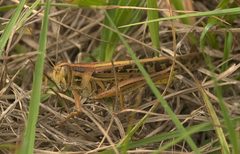
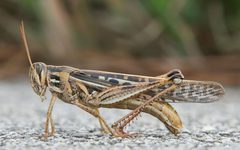
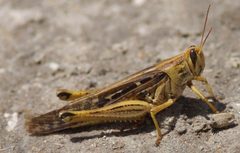
Distinguished from similar large grasshoppers by combination of size, yellow-brown coloration, and pale wings with prominent brown spots. Nymphs identifiable by temperature-responsive color (red/green/yellow with black markings). Differs from true locusts in lacking a distinct gregarious morph with enlarged wings and pronounced swarming . Separated from S. gregaria () by geographic range and absence of true locust phase polymorphism. Wing spots help distinguish from uniformly colored or differently patterned grasshoppers.
Images
Habitat
Occurs in open, grassy areas including prairies, fields, and disturbed . Associated with agricultural landscapes where it can become a pest. Nymphs feed in groups, becoming less gregarious as they develop. Overwinters as rather than in stage.
Distribution
Eastern United States, Mexico, and the Bahamas. Records from Alabama, Florida, Georgia, Illinois, and Honduras. Occasionally migrates beyond usual range.
Seasonality
Two per year. present year-round in warmer parts of range due to habit. Nymphs emerge 3–4 weeks after deposition. Activity peaks in warmer months; adults seek sun-exposed surfaces in autumn.
Diet
herbivore. Feeds on citrus, corn, cotton, oats, peanut, rye, sugarcane, tobacco, vegetable crops, and ornamentals. Also consumes native and ornamental grasses including bahiagrass, bermudagrass, and crabgrass. Known to feed on trees including dogwood, hickory, and palm. Will consume non-plant materials including window screens and garments during .
Life Cycle
Two annually. Female deposits up to three clutches per season. laid in frothy masses 60–80 per clutch, 7–8 mm long, orange, buried up to 3 cm deep. Nymphs emerge in 3–4 weeks, dig to surface, feed gregariously initially. Six instars typical (five possible at low densities). overwinter, unlike many grasshoppers that overwinter as eggs.
Behavior
Nymphs exhibit group feeding , becoming less gregarious with development. capable of and occasional beyond normal range. Temperature-dependent nymphal color : crowding induces darker black markings but has minimal effect on background color. Exhibits food aversion learning—can learn to avoid specific plants associated with negative post-ingestive consequences. Regurgitates when attacked; regurgitant contains caeliferins that induce plant volatile release.
Ecological Role
Significant herbivore in native grasslands, described as chief grazers of prairie with impact exceeding livestock and native ungulates. Serves as prey for birds, reptiles, and other . Subject to natural by fungi including Entomophaga grylli. Regurgitant chemistry (caeliferins) triggers plant defense responses that may attract of the .
Human Relevance
Agricultural pest of moderate economic importance, considered most destructive in Florida particularly for citrus. Causes defoliation of trees and consumption of crops to ground level during localized . Damage reported to corn, cotton, oats, peanut, rye, sugarcane, tobacco, vegetables, and ornamentals. Chewing damage to building materials including window screens. Source of caeliferins, a novel class of compounds with potential research applications. Occasionally referred to as 'locust' during outbreaks though this is taxonomically imprecise.
Similar Taxa
- Schistocerca gregariaTrue with distinct gregarious morph and massive swarming ; S. americana lacks true locust phase and has more restricted .
- Schistocerca piceifronsClosely related tropical swarming locust with which S. americana can be hybridized in laboratory; distinguished by geographic range and swarming capacity.
- Melanoplus differentialisAnother large North , but with different color pattern (often yellow and black) and without wing spots characteristic of S. americana.
Misconceptions
Frequently called a 'locust' during , but this is misleading. True locusts exhibit -dependent phase producing a distinct gregarious morph with enlarged wings and swarming . S. americana lacks this true locust form; its outbreaks represent simple population increases rather than phase . The name 'American bird ' refers to its large size and capability, not avian associations.
More Details
Chemical ecology
Source of caeliferins, chains in regurgitant that induce plants to release volatile organic compounds—potentially attracting of the .
Neurobiology
Sensory coding studies demonstrate specialized deterrent in tibial responding to alkaloids, phenolic glycosides, and other feeding deterrents. Mechanosensory show temperature-dependent firing patterns correlated with behavioral .
Research significance
Important model organism for studies of feeding , sensory physiology, phase mechanisms, and nitrogen economy during insect development.
Sources and further reading
- BugGuide
- Wikipedia
- GBIF taxonomy match
- iNaturalist taxon
- NCBI Taxonomy
- Catalogue of Life
- Grasshoppers of Colorado
- Field Guide Selected References
- Bug Eric: Grand Finale
- Bug Eric: Grasshopper or Locust?
- Bug Eric: 2017
- Hymenoptera | Beetles In The Bush | Page 4
- Host-Plant Selection by Schistocerca americana (Orthoptera: Acrididae)
- Food aversion learning in the polyphagous grasshopper Schistocerca americana
- Octopamine distribution in solitarious and gregarious forms of the locust, Schistocerca Americana gregaria
- The Effects Of Behaviourally Relevant Temperatures On Mechanosensory Neurones Of The Grasshopper, Schistocerca Americana
- Behavioral Responses of Schistocerca americana (Orthoptera: Acrididae) to Azadirex (Neem)-Treated Host Plants
- Cuticular and Exuvial Biomass and Nitrogen Economy During Assimilation and Growth of the American Grasshopper, Schistocerca americana
- Ontogeny of locomotory behaviour in the American locust, Schistocerca americana: from marathoner to broad jumper
- Sensory Coding for Feeding Deterrence in the Grasshopper Schistocerca Americana