
Melanoplus differentialis
(Thomas, 1865)
Differential Grasshopper
is a large, highly mobile native to North America that has expanded from wet meadows into agricultural landscapes. It is a severe crop pest, particularly damaging to corn, alfalfa, soybeans, cotton, and small grains, with dense swarms capable of destroying young cornfields in three to four days. The exhibits phase , with crowded individuals developing darker pigmentation and different body proportions compared to isolated individuals. It has one annually and is better adapted to warmer climates than related species, with concentrated in the central United States between the Rocky Mountains and Mississippi River.


Pronunciation
How to pronounce Melanoplus differentialis: //ˌmɛləˈnoʊpləs ˌdɪfəˈrɛnʃiˌælɪs//
These audio files are automatically generated. While they are not always 100% accurate, they are a good starting point.
Identification
distinguished by black chevron markings on hind and male shape. Nymphs identified by combination of: brown with light tan spots and no transverse band; pale yellow stripe at top of pronotal lobe continuous with genal band; black stripe or chevrons on hind femur; light green or gray hind tibia. Differs from Melanoplus femurrubrum (redlegged ) by lacking bright red hind tibia and having yellow rather than bright yellow underside. Differs from Melanoplus bivittatus (twostriped grasshopper) by hind femur pattern (chevrons vs. stripes) and male cercus shape.
Images
Appearance
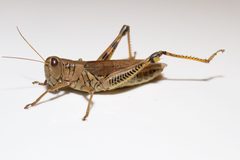
Large yellow with distinctive black markings. typically show bright yellow ground color with black patterning. Diagnostic features include chevron-like black markings on the hind and characteristic shape of the male . Some individuals exhibit melanism (entirely black coloration) through nymphal and adult stages. Nymphs display brown with light tan spots (no transverse dark band), green/yellow/tan front often with dark spots, pale yellow horizontal stripe at top of pronotal lobe, and black stripe on hind femur in early instars developing into chevrons in later instars. Hind tibia light green to gray.
Habitat
Originally restricted to tall herbaceous vegetation in wet meadows, swales, and creek bottomlands. Following agricultural development, expanded into weedy vegetation of crop borders, roadsides, and field reversions. Large develop in extensive cropland areas, particularly between the Rocky Mountains and Mississippi River. Favors areas with abundant forbs, especially members of Compositae.
Distribution
Widely distributed in North America from northern Mexico through the central United States to southern Ontario, Canada. Core range lies between the Rocky Mountains and Mississippi River; east and west of these landmarks are spotty and discontinuous. Present in Colorado, Illinois, Vermont, and throughout the central plains and Midwest.
Seasonality
begin hatching in late spring, approximately two weeks after Melanoplus sanguinipes and three weeks after Melanoplus bivittatus. Nymphal development requires about 32 days under warm conditions. present from mid-summer through fall. Oviposition occurs in late summer and early fall. One annually.
Diet
, feeding on both grasses and forbs. Crop content analysis shows greater consumption of forbs than grasses. Laboratory studies demonstrate faster development, larger size, and higher on forb diets compared to grass diets. Known plants include giant ragweed, blood ragweed, common sunflower, prickly lettuce, soybean, wheat, and various crop plants. Shows preference for wilted or damaged sunflower, likely due to increased sugars and in stressed tissues. Does not perform well on alfalfa as sole diet.
Life Cycle
stage: eggs deposited in curved pods 1.5 inches long, 0.25 inch diameter, containing 45-194 olive-colored eggs 4.4-5.1 mm long. Embryonic development begins at deposition, reaches 54% development by fall, through winter, resumes in spring. Hatching concentrated in two-week period in late spring. Nymphal stage: five to six instars, development synchronized, emerge over short period. Adult stage: pre-oviposition feeding period, mating pairs form in morning and may remain coupled 20-24 hours, females oviposit in sod or rank weeds. One annually.
Behavior
Highly mobile in both nymphal and stages. Third instar and older nymphs move as cohesive bands into fields by crawling and hopping. Adults display strong , moving upwind in short flights of 10-100 yards toward green food, beginning around 9 a.m. and peaking at 81°F. Flight used for escape from temperatures above 86°F. Documented of 130 miles by successive short flights in 1939; individuals recovered 20 miles from release point within two days. Daily activity: inactive at night, resting high on vegetation; nymphs descend to bask when temperatures reach 65°F; feeding begins at 68°F, general feeding at 75°F; seek shade when soil surface reaches 112°F. Under cloudy conditions, nymphs remain inactive regardless of temperature.
Ecological Role
Herbivore consuming significant plant ; during , reach densities capable of regionally altering vegetation composition. Serves as prey for birds, mammals, and other . High allows rapid population increases under favorable warm, dry conditions.
Human Relevance
Major agricultural pest causing severe damage to small grains, corn, alfalfa, soybeans, cotton, vegetables, and deciduous fruit trees. Dense swarms destroy young cornfields in 3-4 days. historically documented since 1930s, with severe Missouri outbreak 1936-1937. Subject to management and control programs. Used as model organism in cytogenetic and embryological research.
Similar Taxa
- Melanoplus femurrubrumSimilar size and general appearance; distinguished by bright red hind tibia (vs. green/gray in M. differentialis), bright yellow underside, and different male shape
- Melanoplus bivittatusOverlapping range and ; distinguished by two pale stripes running length of body, striped rather than chevron pattern on hind , and different male shape
- Melanoplus sanguinipesEarlier hatching and different preferences; distinguished by more slender body, different hind markings, and different male shape
More Details
Phase polymorphism
Individuals raised in crowded conditions develop extensive black pigmentation, smaller size, and different body proportions compared to isolated individuals. Crowded show maturational color changes absent in isolated individuals. This -dependent resembles locust phase change but without full gregarious behavioral .
Temperature requirements
Requires more heat units for development and tolerates higher temperatures than Melanoplus bivittatus, explaining its more southern distribution and greater frequency in warm, dry years.
Fecundity variation
production highly dependent on diet quality; females fed common sunflower averaged 591 eggs each vs. 305 on soybean, with maximum recorded 645 eggs from one female on soybean diet.
Sources and further reading
- BugGuide
- GBIF taxonomy match
- iNaturalist taxon
- NCBI Taxonomy
- Catalogue of Life
- Differential Grasshopper
- List of Species Fact Sheets| Grasshoppers of Wyoming and the West
- Grasshoppers of Colorado
- Redlegged Grasshopper
- Grasshoppers of Colorado
- Species Records and Accounts
- Synaptonemal complex karyotyping in Melanoplus Differentialis
- Phase Polymorphism in the Grasshopper Melanoplus differentialis
- Quantitative Study of Distribution of Sulfhydryl Groups in the Developing Grasshopper (Melanoplus differentialis) Embryo
- Changes in Distribution of Sulfur-Containing Amino Acids in Developing Grasshopper Egg (Melanoplus differentialis)
- Changes in the Distribution of Phosphorus in the Developing Grasshopper (Melanoplus differentialis) Embryo
- Life cycle, sex differentiation, and testis development in Melanoplus differentialis (Acrididae, Orthoptera)
- NITROGEN CONTENT AND DISTRIBUTION IN EGGS OF MELANOPLUS DIFFERENTIALIS DURING EMBRYONIC DEVELOPMENT