
Cyrtacanthacridinae
Kirby, 1910
Bird Grasshoppers, bird locusts, criquets voyageurs, Knarrschrecken
Genus Guides
2- Anacridium(tree locusts)
- Schistocerca(bird grasshoppers)
Cyrtacanthacridinae is a of short-horned grasshoppers (Acrididae) commonly known as bird grasshoppers or bird locusts. The subfamily includes some of the world's most economically important locust , including the () and the red locust (Nomadacris septemfasciata), which undergo -dependent phase . Members are characterized by a prominent peg or between the forelegs. The subfamily has a worldwide distribution concentrated in tropical and subtropical regions.
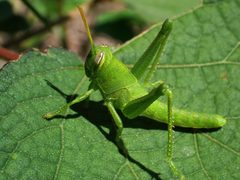
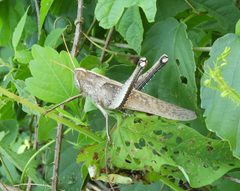
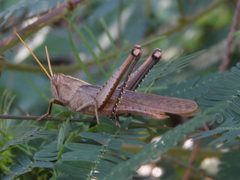
Pronunciation
How to pronounce Cyrtacanthacridinae: //sɪrˌtækænˈθækrɪdiːniː//
These audio files are automatically generated. While they are not always 100% accurate, they are a good starting point.
Identification
Distinguished from other Acrididae by the presence of a prominent prosternal peg or between the forelegs. Differs from Melanoplinae (spur-throated grasshoppers) in genitalic structure and wing venation. Locust within the subfamily are identified by their capacity for -dependent phase , though this requires rearing or observation rather than single-specimen examination. Species-level identification relies on male genitalia (, , ) and wing patterns.
Images
Habitat
Primarily tropical and subtropical grasslands, savannas, and agricultural regions. Many inhabit semi-arid and arid zones. Locust species occupy broad breeding areas that may span multiple countries, with recession zones in remote semi-desert or desert areas where persist at low densities between .
Distribution
Worldwide distribution with concentration in tropical and subtropical regions. Particularly diverse and economically significant in sub-Saharan Africa, South Asia, Australia, and the Americas. The tribe Cyrtacanthacridini has worldwide distribution; other lineages show more restricted ranges.
Seasonality
Activity patterns vary by and climate. In temperate regions, present in summer months. In tropical regions, activity may be year-round with peaks during rainy seasons. Locust species show dynamics with unpredictable surges rather than fixed seasonal patterns.
Diet
Herbivorous, feeding on grasses and forbs. Specific plant associations vary by and locality. Many species are , with diet composition shifting based on vegetation availability. Some species show feeding discrimination in laboratory conditions.
Life Cycle
Hemimetabolous development with , nymph (typically 5-6 instars), and stages. Egg pods deposited in soil contain multiple eggs. Nymphal development duration varies with temperature, typically 30-60 days under favorable conditions. One annually in temperate regions; multiple generations possible in tropical regions. Locust exhibit phase where high- conditions trigger developmental and behavioral changes producing gregarious, migratory morphs.
Behavior
Most are sedentary with limited . Locust species exhibit extreme -dependent behavioral plasticity: solitary individuals are cryptic and avoid conspecifics, while gregarious individuals aggregate, march in bands (nymphs) or fly in swarms (), and migrate long distances. Evasive in non-locust species is typically short, low, and silent. Basking observed in some species for .
Ecological Role
Primary consumers in grassland and agricultural . can dramatically alter vegetation structure and nutrient cycling. Serve as prey for birds, reptiles, and mammals. Locust swarms represent massive transfers of across landscapes and can impact at regional .
Human Relevance
Among the most economically important insect pests globally. The , red locust, and related cause devastating agricultural damage during , threatening food security in Africa, the Middle East, and South Asia. Control programs have historically involved extensive application; modern approaches (e.g., RAATs—Reduced Agent and Area Treatments) aim to reduce economic and environmental costs. Some species are consumed as food in certain cultures.
Similar Taxa
- MelanoplinaeAlso called 'spur-throated grasshoppers' but lack the prominent prosternal peg characteristic of Cyrtacanthacridinae; distinguished by different male genitalic structure and wing venation patterns.
- CatantopinaeAustralian region with some convergent morphologies; nymphs can be confused but distinguished by genitalic and wing characters.
- OedipodinaeBand-winged grasshoppers with different wing coloration patterns and stridulatory mechanisms; hind wings typically brightly colored.
More Details
Phase Polyphenism Evolution
Phylogenetic analysis indicates locust phase evolved multiple times within Cyrtacanthacridinae, with some lineages secondarily losing this trait. The physiological mechanisms underlying -dependent color plasticity appear to be ancestral for the , though the full behavioral of locust phase polyphenism is not universally expressed.
Taxonomic Note
The includes the tribe Cyrtacanthacridini (Kirby, 1910) with worldwide distribution, plus additional currently unassigned to tribe. The genus Schistocerca has been subject to extensive taxonomic revision due to its economic importance and .
Sources and further reading
- BugGuide
- Wikipedia
- iNaturalist taxon
- NCBI Taxonomy
- Catalogue of Life
- Field Guide Selected References
- Glossary
- Grasshoppers of Wyoming and the West
- Grasshoppers of Wyoming and the West
- Species Records and Accounts
- Little Spurthroated Grasshopper
- Phylogeny of bird‐grasshopper subfamily Cyrtacanthacridinae (Orthoptera: Acrididae) and the evolution of locust phase polyphenism
- Description of Schistocerca cohni n. sp. and redescription of S. socorro (Dirsh) (Orthoptera: Acrididae: Cyrtacanthacridinae) from Mexico
- The life history of the grasshopperOrnithacris turbida(Walker) (Orthoptera; Acrididae; Cyrtacanthacridinae) in the laboratory
- Laboratory studies on the effect of crowding on phase and the life history ofSchistocerca pallens(Thunberg) (Orthoptera: Acrididae: Cyrtacanthacridinae)
- Chromosome study in Schistocerca (Orthoptera-Acrididae-Cyrtacanthacridinae): karyotypes and distribution patterns of constitutive heterochromatin and nucleolus organizer regions (NORs)
- Some behavioral and biological traits under rearing conditions of Bryophyma debilis (Karsch) (Orthoptera, Acrididae, Cyrtacanthacridinae), a grasshopper from Burkina Faso