
Euphilotes pallescens
(Tilden & Downey, 1955)
Pallid Blue, Pale Blue, Pallid Dotted Blue
Species Guides
1- Euphilotes pallescens calneva(Honey Lake Blue)
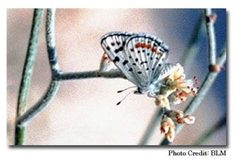
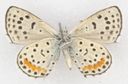
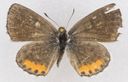
Euphilotes pallescens is a small lycaenid to the Great Basin region of western North America. exhibit significant genetic and morphological differentiation among isolated mountain ranges, reflecting long-term isolation in sky-island . The has a complex evolutionary history involving periods of divergence and potential reticulation. Its restricted distribution and habitat specificity make it a valuable model for studying phylogeography in arid mountain systems.
Pronunciation
How to pronounce Euphilotes pallescens: //juːˈfaɪloʊtiːz pəˈlesɛnz//
These audio files are automatically generated. While they are not always 100% accurate, they are a good starting point.
Images
Habitat
Low-elevation across the Great Basin; isolated dune systems and sky-island mountain ranges. are geographically restricted to discrete habitat patches with limited connectivity between mountain ranges.
Distribution
Western North America: southeastern California, Nevada, southern Utah, and northern Arizona. are disjunct, occurring in isolated mountain ranges throughout the Great Basin.
More Details
Genetic Differentiation
Phylogeographic analysis reveals moderate genetic isolation among , consistent with restricted between isolated dune . Nuclear and mitochondrial gene genealogies show discordance, suggesting a complex evolutionary history potentially involving alternating periods of reticulation and divergence in isolation.
Evolutionary Significance
Euphilotes pallescens serves as a model organism for understanding phylogeographic patterns in North American cold deserts. The demonstrates that gene genealogies often do not perfectly match species trees, supporting contemporary paradigms in phylogenetic reconstruction.