
Euphilotes
Mattoni, 1878
American Dotted Blues
Species Guides
11- Euphilotes ancilla(Rocky Mountain dotted blue)
- Euphilotes battoides(square-spotted blue)
- Euphilotes bernardino(Bernardino blue)
- Euphilotes centralis(Central Blue)
- Euphilotes columbiae(Columbian Blue)
- Euphilotes enoptes(dotted blue)
- Euphilotes glaucon(Glaucon Blue)
- Euphilotes mojave(Mojave dotted blue)
- Euphilotes pallescens(Pallid Blue)
Euphilotes is a of small butterflies in the Lycaenidae, commonly known as the American Dotted Blues. The genus contains approximately 16 described distributed across western North America, with many species exhibiting narrow geographic ranges and strong plant associations. Several species, including the federally endangered Smith's blue (Euphilotes enoptes smithi), are of significant conservation concern due to loss and fragmentation. The genus has served as a model system for studying with host plants, seasonal , and genetic isolation in patchy habitats.
Pronunciation
How to pronounce Euphilotes: //juːˈfɪloʊtiːz//
These audio files are automatically generated. While they are not always 100% accurate, they are a good starting point.
Identification
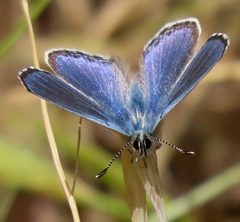
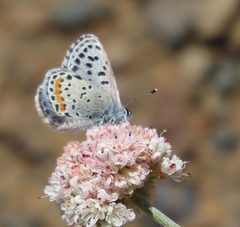
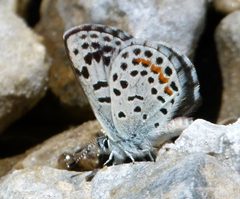
Members of Euphilotes are small butterflies with wingspans typically under 3 cm. They are characterized by blue or grayish wing surfaces with distinctive dark spotting patterns, particularly on the hindwings. The undersides are generally pale with fine spotting. -level identification often requires examination of genitalia, precise spot patterns, and geographic location. Many species are extremely similar in appearance and are best distinguished by their association with specific plant species and their discrete geographic distributions.
Images
Habitat
occupy diverse across western North America, including coastal dunes, sagebrush steppe, pinyon-juniper woodlands, alpine meadows, and desert scrub. Many species are tightly associated with specific substrates: for example, Euphilotes pallescens is largely restricted to low-elevation dune habitats in the Great Basin, while Euphilotes enoptes smithi inhabits coastal sand dunes in central California. Habitat specificity is strongly linked to plant distribution.
Distribution
Western North America, from southern British Columbia and Alberta south through the western United States to Baja California. The shows highest diversity in California and the Intermountain West, with many exhibiting extremely restricted ranges. Some species are to single mountain ranges or coastal dune systems.
Seasonality
periods vary by and elevation, with most species active during summer months. Many species exhibit single tied to plant . intensity correlates with host bloom period and elevation, with higher-elevation generally showing stronger diapause responses.
Diet
Larvae feed exclusively on of Eriogonum (Polygonaceae), commonly known as wild buckwheat. This strict oligophagy is a defining feature of the . butterflies nectar on a variety of flowers, though specific preferences vary by species and locality.
Host Associations
- Eriogonum - larval Strict association; all Euphilotes use Eriogonum species as larval . Host specificity at the species level drives much of the 's diversification.
Life Cycle
Complete with , larva, pupa, and stages. Eggs are laid on plant flowers or buds. Larvae feed on host flowers and fruits, with development timed to coincide with host bloom period. occurs in ground litter or soil. Many exhibit facultative , with the intensity of diapause varying by elevation and local climate conditions.
Behavior
are relatively sedentary and closely associated with plant patches. Males perch on host plants to await females. Courtship and mating occur on or near host plants. Limited capacity contributes to genetic isolation among and strong population structure.
Ecological Role
As herbivores, larvae influence Eriogonum reproductive output through flower and fruit consumption. serve as of plants and other co-occurring flowering . The represents a classic example of insect-plant coevolutionary dynamics and serves as an indicator of quality in western North American .
Human Relevance
Several are of conservation concern. Euphilotes enoptes smithi (Smith's blue ) is federally endangered in the United States, with restoration efforts focused on coastal dune . Euphilotes allyni (El Segundo blue) and Euphilotes battoides allyni are also imperiled. The is frequently used in ecological research on -race formation, seasonal , and conservation genetics. Military installations and public lands have implemented gardens specifically to support these butterflies.
Similar Taxa
- PhilotiellaAlso small Lycaenidae with spotted blue-gray coloration and Eriogonum associations. Distinguished by wing pattern details and genitalic ; Euphilotes typically shows more pronounced spotting and different antennal club proportions.
- IcariciaOverlapping geographic range and similar size. Distinguished by plant associations (Icaricia uses varied hosts including legumes and buckwheats but not exclusively Eriogonum) and wing pattern; Euphilotes shows more irregular spot arrangement on hindwing underside.
- PlebejusSimilar blue coloration and preferences. Distinguished by association with different plant (typically Fabaceae or Ericaceae) and more uniform wing undersides with less contrasting spotting.
More Details
Evolutionary significance
Euphilotes is a prominent model system for studying sequential evolution, where diversification tracks plant diversification. Research has demonstrated that both host shifts and seasonal shifts have driven speciation in this . Discordance between nuclear and mitochondrial gene genealogies in some suggests complex evolutionary histories involving reticulation and divergence.
Conservation status
Multiple significant threats from destruction, plants, and climate change. The narrow specificity and limited of many species make them particularly vulnerable to habitat fragmentation. Conservation efforts emphasize protection of Eriogonum host plant and maintenance of disturbance regimes that sustain early-successional habitat.
Sources and further reading
- BugGuide
- Wikipedia
- GBIF taxonomy match
- iNaturalist taxon
- NCBI Taxonomy
- Catalogue of Life
- Evolution of Euphilotes (Lepidoptera: Lycaenidae) by seasonal and host shifts
- Evolution of Euphilotes (Lepidoptera: Lycaenidae) by seasonal and host shifts
- Sequential evolution of Euphilotes (Lycaenidae: Scolitantidini) on their plant host Eriogonum (Polygonaceae: Eriogonoideae)
- The phenetics and comparative biology of Euphilotes enoptes (Boisduval) (Lycaenidae) from the San Bernardino Mountains
- A Gis-Based Species Distribution Model for the Endangered Smith's Blue Butterfly, Euphilotes enoptes smithi (Lycaenidae)
- Correlations of Diapause Intensities of Euphilotes spp. and Philotiella speciosa (Lepidoptera: Lycaenidae) to Host Bloom Period and Elevation
- Pollinator garden playbook : supporting the western North American population of Monarch butterfly (Danaus plexippus) and the endangered Smith’s blue butterfly (Euphilotes enoptes smithi) on military landsOak Ridge Institute for Science and Education
- Complex evolutionary history of the pallid dotted‐blue butterfly (Lycaenidae: Euphilotes pallescens) in the Great Basin of western North America