
Euphilotes battoides
(Behr, 1867)
square-spotted blue, buckwheat blue
Species Guides
1- Euphilotes battoides allyni(El Segundo Blue Butterfly)
Euphilotes battoides is a small in the Lycaenidae, commonly known as the square-spotted blue or buckwheat blue. It is native to western North America and exhibits strong ecological dependence on Eriogonum (buckwheat) . The species comprises multiple recognized with restricted geographic ranges. are active from spring through summer and feed primarily on buckwheat flower nectar.


Pronunciation
How to pronounce Euphilotes battoides: /juːˈfaɪloʊtiːz ˈbætoʊaɪdiːz/
These audio files are automatically generated. While they are not always 100% accurate, they are a good starting point.
Identification
Distinguished from other Euphilotes by the square-shaped (rather than round) dark spots on the wing surfaces. Smaller than most related blues. The combination of small size, specific spot shape, and association with Eriogonum plants helps separate it from Euphilotes enoptes (dotted blue) and other . identification requires examination of precise spot patterns and geographic location.
Images
Appearance
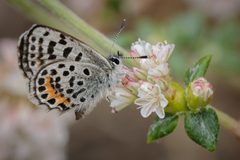
Small with wingspan of 16–17 mm. Upper wing surfaces are blue with dark borders and square-shaped dark spots on the undersides, giving the its . Undersides are grayish with a pattern of black spots. Sexes are similar, though females may have broader dark borders.
Habitat
Arid and semi-arid regions including sagebrush steppe, pinyon-juniper woodlands, chaparral, and dry rocky slopes. Strongly associated with stands of native Eriogonum (buckwheat) , which serve as both nectar source and larval . Elevation range varies by , from low coastal areas to montane zones.
Distribution
Western North America: California, Baja California Norte, southern Colorado, and New Mexico. Occurrence in Oregon and Washington requires verification. Disjunct correspond to recognized with restricted ranges.
Seasonality
active from mid-April to August. (one per year). period varies with elevation and latitude, with lower elevations peaking earlier.
Diet
feed on flower nectar, predominantly from Eriogonum . Larval diet consists of Eriogonum flowers and possibly seeds; specific plant relationships vary among .
Host Associations
- Eriogonum - primary nectar source and larval -level association; specific vary by and locality
Life Cycle
. laid on Eriogonum flowers or inflorescences. Larvae feed on developing flowers and seeds. occurs in soil or leaf litter. emerge the following spring. Detailed descriptions of egg, larval, and pupal stages are not well documented in available sources.
Behavior
remain close to plant patches. Males perch on or near Eriogonum to await females. is low and fluttering, typical of small lycaenids. Adults are not known to migrate.
Ecological Role
of Eriogonum . Larval feeding on buckwheat flowers and seeds represents a specialized herbivore-plant interaction. Serves as prey for birds, spiders, and predatory insects.
Human Relevance
No significant direct economic importance. Subject of conservation concern for some due to loss and fragmentation. The related Euphilotes allyni (formerly considered a subspecies) is federally listed as endangered, highlighting vulnerability of this group to development and plants.
Similar Taxa
- Euphilotes enoptesSimilar size and coloration, but has round rather than square spots; ranges overlap in some areas
- Euphilotes allyniFormerly considered a (E. b. allyni), now recognized as distinct ; restricted to coastal dunes in southern California
- Plebejus speciesOther small blue butterflies; differ in spot patterns and lack strong Eriogonum association
Misconceptions
Formerly treated as a single widespread with many , but some (particularly E. allyni) are now recognized as distinct species based on ecological and genetic differences. The full species boundaries within the E. battoides complex remain under study.
More Details
Subspecies complexity
Eight currently recognized (battoides, comstocki, centralis, argocyanea, fusimaculata, mazourka, panamintensis, vernalis) with restricted, often distributions. Several former subspecies have been synonymized or elevated to status.
Taxonomic instability
boundaries within Euphilotes are actively revised based on molecular and ecological data. The rank of 'complex' used by some databases reflects ongoing uncertainty about species limits.