
Euphilotes battoides allyni
(Shields, 1975)
El Segundo Blue Butterfly
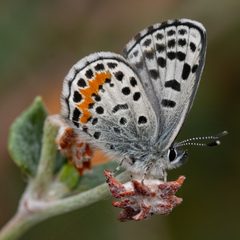
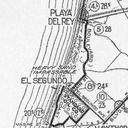
Euphilotes battoides allyni is a federally endangered of blue to coastal sand dunes in southwestern Los Angeles County, California. The subspecies has an extremely restricted range, historically occurring only between El Segundo and San Pedro. It is one of the most geographically localized butterfly in North America, with all known confined to areas supporting its obligate larval plant, Eriogonum parvifolium (coastal buckwheat).
Pronunciation
How to pronounce Euphilotes battoides allyni: /juːˈfaɪloʊtiːz ˈbætoʊaɪdz ˈælaɪnaɪ/
These audio files are automatically generated. While they are not always 100% accurate, they are a good starting point.
Identification
Euphilotes battoides allyni can be distinguished from other Euphilotes battoides by its coastal dune and geographic isolation. are small butterflies with blue wing surfaces and gray-brown surfaces with black spots. The subspecies is not reliably separable from other E. battoides subspecies by wing pattern alone; identification requires knowledge of collection locality.
Images
Habitat
Coastal sand dunes and backdune scrub, specifically areas supporting stands of Eriogonum parvifolium. The is characterized by loose, sandy substrates with sparse vegetation dominated by coastal buckwheat and associated dune scrub plants.
Distribution
to coastal southwestern Los Angeles County, California, USA. Historical range extended from El Segundo south to San Pedro. Current are restricted to a few fragmented sites near Los Angeles International Airport and the Palos Verdes Peninsula.
Seasonality
fly from late June through August, with peak typically in July. The period corresponds with the blooming period of the larval plant.
Diet
Larvae feed exclusively on flowers and developing seeds of Eriogonum parvifolium (coastal buckwheat). feed on nectar from E. parvifolium flowers and have been observed nectaring at other coastal buckwheat where ranges overlap.
Host Associations
- Eriogonum parvifolium - obligate larval plantLarvae feed on flowers and developing seeds; oviposition occurs on flower buds and inflorescences. No other plants are known.
Life Cycle
Complete with one per year (). are deposited on flower buds of Eriogonum parvifolium. Larvae feed on flowers and seeds, developing through four instars. occurs in the sand at the base of plants. emerge the following summer. The pupal stage is the primary stage.
Behavior
exhibit strong fidelity to plant patches, with limited between fragments. Males patrol host plant stands in search of females. Females oviposit selectively on developing flower buds. Both sexes spend most of adult life in close association with flowering Eriogonum parvifolium.
Ecological Role
Specialized herbivore dependent on a single plant . Serves as a local indicator of intact coastal dune function. The extreme specificity makes this vulnerable to host plant loss but reduces competitive interactions with other herbivores.
Human Relevance
Federally listed as Endangered (1976) and one of the first insects protected under the U.S. Act. Subject of intensive conservation management including restoration, captive propagation, and efforts. Airport expansion and urban development have eliminated most historical habitat. Current management focuses on maintaining plant at remaining sites.
Similar Taxa
- Euphilotes battoides battoidesOverlaps in general wing pattern and ; distinguished by inland montane distribution and use of different Eriogonum .
- Euphilotes enoptesSimilar size and blue coloration; distinguished by different spot patterns and different plant associations.