
Melanoplus spretus
(Walsh, 1866)
Rocky Mountain Locust
Melanoplus spretus, the Rocky Mountain Locust, was a of locust that ranged through the western United States and parts of Canada until the late 19th century. It was one of the most destructive agricultural pests in North American history, forming swarms of unprecedented size—one 1875 swarm was estimated at 198,000 square miles. The species is now extinct, last observed in the early 1900s. It is considered by some authorities to represent a gregarious, migratory phase of rather than a distinct species.
Pronunciation
How to pronounce Melanoplus spretus: //ˌmɛləˈnoʊpləs ˈsprɛtəs//
These audio files are automatically generated. While they are not always 100% accurate, they are a good starting point.
Identification
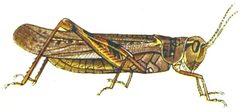
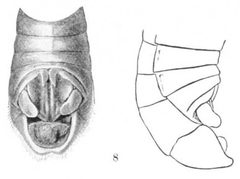
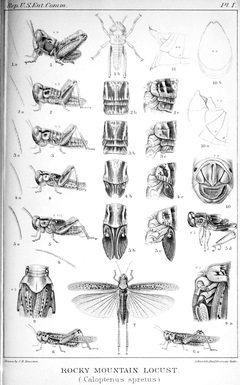
Difficult to distinguish from . Historical accounts suggest M. spretus had longer wings and a more expanded pronotum. Coloration in the migratory phase was reportedly lighter grayish-brown compared to the darker grayish-brown of solitary M. sanguinipes. are compressed, about twice as long as broad, obliquely rounded. small, slender, diverging, one-fourth to one-third the length of the supraanal plate. No living specimens exist for direct comparison; identification relies on historical specimens and descriptions.
Images
Habitat
Open grasslands, prairies, and agricultural areas of the western United States. Oviposition sites included light sandy loam along fence rows, around wheat stubble and alfalfa bases, field edges, and crowns of wheat, alfalfa, or grass plants. Favored cropland and barren land over rangeland for deposition during swarm events.
Distribution
Historically ranged through the western half of the United States and western portions of Canada. Reported from Kansas and throughout the Great Plains and Rocky Mountain regions. Now extinct; last confirmed observations in early 1900s. Wyoming Distribution Atlas lists as "reported extirpated, early 1900s."
Seasonality
Nymphs present June through August; August through October in northern Colorado. Swarm activity associated with hot, dry weather conditions.
Diet
with preference for forbs. Documented food plants include dandelion, tansy mustard, nuttall violet, Sandberg bluegrass, needleleaf sedge, wheat, alfalfa, sweet clover, fanweed, carrot, potato, leadplant, blue grama grass, stork's bill, cheatgrass brome, smooth brome, Medicago lupulina, cudweed, western ragweed, corn, shepherd's purse, pepper grass, blue grass, rabbitbrush, western wheatgrass, and needlegrass.
Life Cycle
Overwintered as . Eggs deposited 1–2 inches below ground surface in pods containing 5–18 eggs. Embryonic development arrested at 80–90% completion until spring, when temperature and moisture stimulated . Five nymphal instars. capable of long-distance in swarms. Nymphs from swarm-deposited eggs demonstrated greater gregarious tendencies and band-forming .
Behavior
Exhibited facultative phase , transitioning between solitary and gregarious forms. Swarms formed during hot, dry periods, flying with prevailing winds at speeds up to 66 miles per day, settling 200–300 miles from origin. Swarm densities increased from 1–5 to 32+ per square yard, occasionally reaching several hundred per square yard. Females became unreceptive to further copulation after sperm packet absorption. Males approached females stealthily and mounted from behind.
Ecological Role
As a major herbivore, consumed approximately half its body weight in green forage daily. Swarms caused massive vegetation destruction, altering plant composition and agricultural landscapes. Served as prey for numerous including birds, rodents, and insects. crashes likely provided nutrient pulses to . Extinction removed a significant disturbance regime from western North American ecosystems.
Human Relevance
One of the most destructive agricultural pests in North American history. Caused severe hardship for settlers in 1864 (northeastern Colorado) and 1873 (Fort Collins). Led to creation of the U.S. Entomological Commission in 1877. Contributed to homestead abandonment and economic collapse in affected regions. Extinction likely resulted from destruction of riparian oviposition through agricultural development and livestock grazing. Historical specimens preserved in museums; no modern observations possible.
Similar Taxa
- Melanoplus sanguinipesConsidered by many authorities to be the same , with M. spretus representing a gregarious, migratory phase. Morphological differences in wing length, pronotum shape, and coloration historically used to distinguish them, but these may represent phase rather than species-level divergence.
More Details
Extinction
The disappeared abruptly in the early 1900s. The last confirmed specimen was collected in 1902 in Canada. The rapid extinction is attributed to destruction of riparian breeding through plowing, irrigation, and livestock grazing in the Rocky Mountain valleys where swarms originated. The species' reliance on specific oviposition sites in river valleys made it vulnerable to habitat modification.
Taxonomic Status
The relationship between M. spretus and M. sanguinipes remains debated. Some authorities treat M. spretus as a distinct extinct ; others consider it a migratory phase of M. sanguinipes. Genetic analysis of museum specimens could potentially resolve this question.