
Oedaleonotus enigma
(Scudder, 1876)
Valley Grasshopper
Oedaleonotus enigma, the valley , is a large, colorful spur-throated grasshopper native to western North America. It is a significant rangeland pest capable of reaching densities exceeding 20 per square yard. The exhibits wing dimorphism, with both short-winged (brachypterous) and long-winged () forms occurring in . It is notable for early spring hatching and a relatively long nymphal period of 42-50 days due to cool temperatures and six instars rather than the typical five.

Pronunciation
How to pronounce Oedaleonotus enigma: /ˌiː.dæ.lɪˈɒ.nə.təs ɛˈnɪɡ.mə/
These audio files are automatically generated. While they are not always 100% accurate, they are a good starting point.
Identification
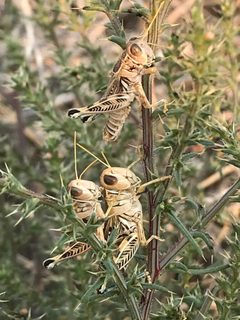
distinguished from other Oedaleonotus by tegmina equal to or longer than pronotum (other seven species have tegmina shorter than pronotum). The white/cream pronotal band is distinctive. Wing dimorphism present: short-winged forms have nonfunctional hindwings, long-winged forms have functional wings. Nymphs identifiable by cream-colored stripe extending from through pronotum to , and broken fuscous chevrons on hind . Six nymphal instars rather than typical five.
Images
Habitat
Sagebrush-grass and semiarid rangeland associations of the western United States. Favors abandoned farmland, Conservation Reserve Program (CRP) land, and foothills of California coastal and Sierra Nevada ranges. Native plants include springparsley, balsamroot, big sagebrush, and rabbitbrush. Thrives in areas with introduced weeds such as redstem filaree, flixweed, and downy brome.
Distribution
Western North America: California, Nevada, Idaho, and surrounding states. Present in sagebrush-grass and semiarid rangelands.
Seasonality
Early hatching . overwinter in advanced embryonic stage and hatch in early spring, beginning as early as April in California, Nevada, and Idaho, continuing for a month or longer. Hatching typically occurs in morning when air temperatures are 45-90°F and soil temperatures 76-98°F. appear in late spring to early summer; first adults observed 22 May in north-central Nevada in 1954. occurs in fall, triggered by decreasing day length and coinciding with fall rains.
Diet
Primarily forb and shrub feeder, with some grass consumption. Native : springparsley, balsamroot, big sagebrush, rabbitbrush. Favors introduced weeds: redstem filaree, tumble mustard, draba mustard, pepperweed, downy brome. Heavy lichen feeder. Big sagebrush becomes important host when weeds dry. Will feed on ground litter and dead grasshoppers under drought conditions. Observed to feed on seven forb , four shrubs, two grasses, one sedge, and one lichen. Does not substantially feed on Russianthistle (Chenopodiaceae) despite using it for roosting.
Host Associations
- springparsley - foodnative
- balsamroot - foodnative
- big sagebrush - foodimportant summer when weeds dry
- rabbitbrush - foodnative
- redstem filaree - foodintroduced weed, favored food
- tumble mustard - foodintroduced weed, favored food
- draba mustard - foodintroduced weed
- pepperweed - foodintroduced weed
- downy brome - foodintroduced weed, favored food
- lichen - foodheavy feeding observed
- Russianthistle - roostingused for shelter, not substantially eaten
Life Cycle
in advanced embryonic stage (stage 23, post-blastokinesis) hatch early spring. breaks during winter; warming spring temperatures complete embryonic development. Six nymphal instars (vs. typical five), with nymphal period lasting 42-50 days due to cool spring temperatures. reproduce in fall; eggs begin development upon laying, reach advanced stage by fall, then enter winter diapause. Females oviposit in bare ground adjacent to shrub/weed bases, under low forbs, or around rocks. Pods placed horizontally 1/8-1/4 inch below soil surface. Nymphs emerge from side of pod rather than through end.
Behavior
with bimodal activity pattern. Spends night roosting -up on vegetation (primarily Russianthistle) or on ground. Basks in morning by turning side perpendicular to sun and lowering hindleg to expose ; second basking period in late afternoon. Feeding periods in morning (starting ~8:30 a.m.) and late afternoon when temperatures moderate. Avoids high ground temperatures (>110°F) by stilting (raising on legs) or climbing vegetation to rest in shade at 4-7 inch heights. Evasive of long-winged straight, silent, 4-8 feet distance at 4-10 inch heights; brachypterous adults jump 2-8 feet. Slow of nymphs and adults occurs almost daily; concentrated band of 20-30 per square yard during . adults disperse from deteriorating .
Ecological Role
Herbivore in sagebrush-grass . At low densities, may provide benefit by preferentially feeding on weeds, reducing competition with forage plants. Serves as prey for digger wasps (Tachysphex spp.) and flies (Neorhynchocephalus sackenii). crashes during drought or from fungal and can affect dynamics.
Human Relevance
Major rangeland pest causing severe forage injury at high densities (>20/sq yard), particularly damaging to young grasses and legumes in reseeded rangeland. Nymphs and migrate from rangeland into alfalfa, cotton, grains, and vegetables causing serious crop damage. Subject to programs. No quantitative damage assessment studies completed. Potential target through conservation.
Similar Taxa
- Melanoplus sanguinipesSimilar spur-throated grasshopper in same ; distinguished by different nymphal color patterns, five instars vs. six, and different morphological characters
- Phoetaliotes nebrascensisLarge-headed grasshopper, next in ; distinguished by very large relative to body, slanted , and primarily grass-feeding habit vs. forb/shrub feeding of O. enigma
- Other Oedaleonotus speciesSeven other in , mainly California-distributed, distinguished by tegmina shorter than pronotum and usually narrow, widely separated
More Details
Wing dimorphism and environmental influence
Laboratory tests indicate temperature influences proportion of long-winged vs. short-winged . Cooler developmental temperatures (constant 80°F) produce greater proportions of long-winged adults; warmer temperatures (constant 100°F) produce more short-winged adults. In field , proportion of adults ranges from 0% to over 50% depending on year and conditions.
Population dynamics knowledge gaps
No studied for more than three years, insufficient for understanding duration, low- persistence, or growth rates from low to high numbers. Key questions for integrated management remain unanswered.
Oviposition behavior
Unique among grasshoppers: nymphs emerge from side of pod rather than through the end. Pod structure: slightly curved, short, wide, 1/2-5/8 inch long, 1/8-3/16 inch diameter, 16-22 eggs.