
Phoetaliotes nebrascensis
(Thomas, 1872)
large-headed grasshopper, largeheaded grasshopper, red-nosed grasshopper, big head, large-headed locust
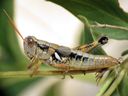
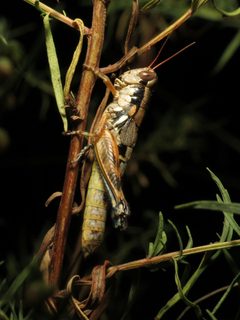
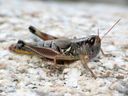
Phoetaliotes nebrascensis is a medium-sized, slim spur-throated grasshopper distinguished by its disproportionately large relative to body size. It is a in North American tallgrass prairie and common in lush patches of mixedgrass prairie. The exhibits wing dimorphism: most have short, non-functional wings, while a small percentage possess long wings enabling . It feeds almost exclusively on grasses, an unusual trait among spur-throated grasshoppers.
Pronunciation
How to pronounce Phoetaliotes nebrascensis: //ˌfiː.tə.liˈoʊ.tiːz nɛ.brəˈsɛn.sɪs//
These audio files are automatically generated. While they are not always 100% accurate, they are a good starting point.
Identification
Distinguished from similar grasshoppers by the disproportionately large and slanted . The combination of short wings (in most individuals), blue hind tibia, and brown stripe on hind that extends into the half of the medial area is diagnostic. Nymphs identifiable by large head with fuscous vertical stripe below and horizontal stripe behind , contrasting with light gray head; pronotal disk with fuscous wedge-shaped stripe; hind femur with pronounced dorsal stripe extending into medial area; hind tibia pale yellow with front fuscous in instars I–III, blue in instars IV–V.
Images
Habitat
Tall, lush grasslands. in tallgrass prairie; common in taller types of mixedgrass prairie. In shorter grasslands, occurs locally in patches of tall grass in swales, ravines, stream corridors, and roadsides. Requires vegetation height for perching .
Distribution
North American grasslands. Center of distribution in Flint Hills tallgrass prairie (eastern Kansas into Oklahoma and Nebraska). Extends west through mixedgrass prairie to shortgrass prairie (rare), bunchgrass prairie of west-central Idaho, and desert grasslands of southern Arizona. Recorded from California, Massachusetts, Nebraska, and Mexico (Northeast and Southwest).
Seasonality
Late-developing . Hatching begins approximately one month after Ageneotettix deorum: as early as May 22 in eastern Kansas tallgrass prairie, June 8 in southeastern Montana, and June 13 in southeastern Wyoming. Hatching continues for four weeks or longer. appear mid to late July in Kansas, early August in southeastern Wyoming.
Diet
Feeds almost exclusively on grasses, unusual for a spur-throated grasshopper. In tallgrass prairie: little bluestem, big bluestem, Kentucky bluegrass. In mixedgrass prairie: principally western wheatgrass. In bunchgrass prairie: bluebunch wheatgrass, sand dropseed. Laboratory tests indicate preference for downy brome, Scribner panicum, barnyardgrass, witchgrass, junegrass, foxtail barley, and forbs including dandelion, meadow salsify, skeletonweed—though these forbs are rarely consumed in nature.
Life Cycle
stage: eggs deposited in soil pods 1–1.25 inches long, slightly curved, containing 28 eggs (short-winged females) or 20–24 eggs (long-winged females). Eggs olive to brownish yellow, 4.1–4.4 mm long, located relatively deep in soil (one inch or more). Nymphal stage: five instars required; nymphal period approximately 55 days from first instar to . Extended development attributed to perching on tall grasses in cooler microclimate. Adult stage: short-winged adults remain in natal area; long-winged adults capable of and .
Behavior
Phytophilous: spends most of day and night perched vertically -up on grass stems and leaves at heights of 6–12 inches. Feeds by eating leaf edges, creating long gouges along one side while leaving narrow edge intact; may feed head-up or head-down, turning to resume head-up position after feeding. Basks in morning 2–3 hours after sunrise by turning side perpendicular to sun and lowering associated hindleg; second basking period in late afternoon. On cold nights, moves lower on grass or under litter. Short-winged disperse by crawling and hopping; observed moving 15 feet in 30 minutes on ground. When dries, moves to adjacent green vegetation; documented moving 30–90 feet to winter wheat fields. Long-winged adults capable of .
Ecological Role
herbivore in tallgrass prairie ; densities regularly 3–4 young per square yard, reaching 12 per square yard in favorable mixedgrass prairie swales. Contributes to grassland nutrient cycling through herbivory and deposition. Serves as prey for vertebrate and . Wing dimorphism provides -level : short-winged individuals maintain local populations while long-winged individuals enable of new .
Human Relevance
Minor to moderate pest of rangeland. In tallgrass prairie, damage visible but economically insignificant. In mixedgrass prairie during droughts, aggregates in swales and consumes forage needed by livestock and wildlife. occasionally invade winter wheat fields in fall, consuming seedlings to ground level. Laboratory feeding tests suggest potential for damage to additional grass crops if shift preferences.
Similar Taxa
- Oedaleonotus enigmaSimilar (Melanoplinae) and prairie ; distinguished by P. nebrascensis having much larger relative to body, blue hind tibia (vs. different coloration in O. enigma), and different wing proportions.
- Melanoplus speciesMany Melanoplus grasshoppers share spur-throated and prairie ; P. nebrascensis distinguished by exceptionally large , slanted , and nearly exclusive grass diet versus broader plant preferences in most Melanoplus.
More Details
Fire response
In newly burned tallgrass prairie, hatch approximately two weeks earlier than in unburned prairie due to faster soil warming from reduced litter cover.
Wing dimorphism ecology
Short-winged morphs sacrifice ability for higher (28 vs. 20–24 per pod); long-winged morphs divert resources to muscles and wing production. This trade-off likely maintains both morphs in .
Mark-recapture data
Short-winged in Nebraska sand prairie showed net displacement of 3–13 feet per day; maximum recorded movement 135 feet over 14 days.
Sources and further reading
- BugGuide
- Wikipedia
- GBIF taxonomy match
- iNaturalist taxon
- NCBI Taxonomy
- Catalogue of Life
- Grasshoppers of Colorado
- Grasshoppers of Colorado
- Grasshoppers of Colorado
- Largeheaded Grasshopper
- Species Records and Accounts
- List of Species Fact Sheets| Grasshoppers of Wyoming and the West
- Food Preference as a Factor in Distribution and Abundance of Phoetaliotes nebrascensis1,2