
Oedaleonotus
Scudder, 1897
Species Guides
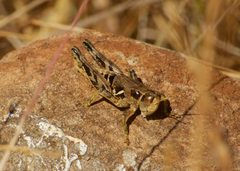
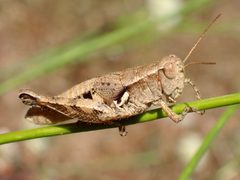
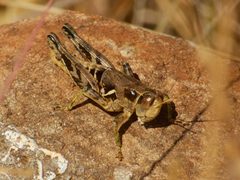
7Oedaleonotus is a of spur-throated grasshoppers in the Acrididae, Melanoplinae. The genus contains approximately nine described distributed primarily in western North America. The best-known species, Oedaleonotus enigma (valley ), is a significant rangeland pest known for its migratory and capacity to reach densities. Members of this genus are characterized by variable wing development, with some species having fully functional long wings and others having reduced or short wings.
Pronunciation
How to pronounce Oedaleonotus: /ˌɛdəliˈoʊnətəs/
These audio files are automatically generated. While they are not always 100% accurate, they are a good starting point.
Identification
of Oedaleonotus enigma, the most thoroughly documented , are large, colorful spur-throated grasshoppers. The edge of the pronotum has a narrow, conspicuously white to cream-colored band. The medial area of the hind is marked with fuscous chevrons separated by light tan lines, with orange coloration at the end of the inner medial area and lower marginal area. Hind tibiae are blue. The male is broad basally with apex abruptly narrowed and fingerlike. Seven species in the possess tegmina shorter than the pronotum, which are usually narrow and widely separated; O. enigma is distinguished by having tegmina ranging from short to long, with long-winged individuals having functional wings. Nymphs are identifiable by a fuscous band down the middle of the vertex and occiput divided by a narrow cream-colored line, a longitudinal cream-colored band down the middle of the pronotal disk, and fuscous chevrons on the medial area of the hind femur that are broken in the middle at the proximal half.
Images
Habitat
of Oedaleonotus inhabit semiarid rangelands, including sagebrush-grass associations and foothill environments. Oedaleonotus enigma specifically inhabits abandoned farmland, Conservation Reserve Program land, and foothills of the California coastal and Sierra Nevada ranges. Native plants include springparsley, balsamroot, big sagebrush, and rabbitbrush. The increase in introduced weeds such as redstem filaree, flixweed, and downy brome has created favorable conditions for .
Distribution
The Oedaleonotus is distributed in western North America. Distribution records indicate presence in California, Nevada, and Utah. Oedaleonotus enigma has a continental distribution centered in the western states, with documented in Idaho, Nevada, and California. Seven are distributed mainly in California.
Seasonality
Oedaleonotus enigma hatches early in spring, with hatching beginning in early April in California, Nevada, and Idaho and continuing for a month or longer. Hatching usually occurs in the morning when air temperatures are between 45° and 90°F. Nymphal development requires approximately 42 to 50 days, with appearing from late May through summer. The has six nymphal instars rather than the typical five, contributing to its relatively long nymphal period. occurs in late summer and fall, with entering in an advanced embryonic stage and hatching the following spring.
Diet
Oedaleonotus enigma is primarily a forb and shrub feeder that also feeds to some extent on grasses. Documented food plants include springparsley, balsamroot, big sagebrush, rabbitbrush, redstem filaree, tumble mustard, draba mustard, pepperweed, downy brome, and lichen. Russianthistle is used for roosting but not consumed. Under drought conditions, individuals resort to feeding on ground litter and dead or dying grasshoppers. Laboratory observations confirm feeding on leaf edges of forbs such as miniature rose and spearmint.
Host Associations
- springparsley - food plant
- balsamroot - food plant
- big sagebrush - food plantimportant plant in summer when weeds have dried
- rabbitbrush - food plant
- redstem filaree - food plantintroduced weed
- tumble mustard - food plantintroduced weed
- draba mustard - food plantintroduced weed
- pepperweed - food plantintroduced weed
- downy brome - food plantintroduced weed
- lichen - food plant
- Russianthistle - roosting siteused for shelter but not consumed
Life Cycle
Oedaleonotus enigma overwinters as in an advanced embryonic stage (stage 23, after blastokinesis). Eggs enter in fall; diapause breaks during winter, and warming spring temperatures enable completion of embryonic development. Hatching occurs early in spring. Nymphs develop through six instars, becoming in 42 to 50 days. Adults may be short-winged (brachypterous) or long-winged (); wing dimorphism is influenced by temperature during development, with cooler temperatures producing higher proportions of long-winged adults. Females oviposit in bare ground adjacent to shrub bases, under low-growing forbs, and around rocks. Pods are placed horizontally 3-6 mm below the soil surface, slightly curved, 12-16 mm long and 3-5 mm in diameter, containing 16-22 eggs each. Eggs are olive tan and 4.8-5.2 mm long. Nymphs emerge from the side of the pod rather than through the end.
Behavior
Oedaleonotus enigma exhibits basking in morning and late afternoon, turning perpendicular to sun rays and lowering the hindleg to expose the . During hot midday periods, individuals climb vegetation to 10-18 cm heights and rest vertically -up in shade. Daily activity includes two foraging periods: morning (beginning around 8:30 a.m.) and late afternoon. Feeding occurs on leaf edges, with individuals either standing on the ground or holding onto plants with midlegs and hindlegs while using front to direct leaves to mouthparts. Slow occurs almost daily; during , nymphs migrate in concentrated bands following draws with greener vegetation. Long-winged can fly from deteriorating to more favorable areas. Evasive are straight, silent, and short (1.2-2.4 m distance, 10-25 cm height). Brachypterous adults evade threats by jumping 0.6-2.4 m. Males attend ovipositing females.
Ecological Role
At low densities, Oedaleonotus enigma may provide benefits by preferentially feeding on weeds, thereby reducing competition with valuable forage plants. At high densities, it becomes a destructive pest, consuming rangeland forage and migrating into crops. The serves as prey for digger wasps (Tachysphex spp.) and is parasitized by the tangle-veined fly Neorhynchocephalus sackenii. may be terminated by drought or .
Human Relevance
Oedaleonotus enigma is a significant agricultural pest. High densities on rangeland cause severe injury to forage plants and are particularly damaging to young grasses and legumes in newly reseeded rangeland. migrate into alfalfa, cotton, grains, and vegetables, causing serious damage. The has high reproductive capacity, with densities reaching 20 or more per square yard. No quantitative study of damage has been made. The species was involved in major outbreaks in California rangelands during 1955-1961, contributing to covering millions of acres alongside Melanoplus devastator and Camnula pellucida.
Similar Taxa
- MelanoplusBoth are spur-throated grasshoppers in Melanoplinae. Oedaleonotus can be distinguished by the white to cream-colored pronotal band and specific hind color patterns; male shape also differs.
- Phoetaliotes nebrascensisBoth are large Melanoplinae grasshoppers with some wing dimorphism. Phoetaliotes has a very large relative to body size and feeds almost exclusively on grasses, whereas Oedaleonotus has a more proportional head and is primarily a forb feeder.
- Other Oedaleonotus speciesSeven other Oedaleonotus have tegmina shorter than the pronotum, usually narrow and widely separated, whereas O. enigma has variable tegmina length from short to long.
More Details
Wing dimorphism
Oedaleonotus enigma exhibits environmentally influenced wing dimorphism. Laboratory tests indicate that cooler developmental temperatures (constant 27°C) result in greater proportions of long-winged () , while warmer temperatures (constant 38°C) produce more short-winged (brachypterous) adults. Field show variable ratios, ranging from all short-winged to over 50% long-winged in different years.
Historical outbreaks
The valley was a major contributor to California rangeland from 1955-1961, with ranging from 580,000 to over 4.5 million acres. persisted at high densities for multiple years before declining due to fungal (Entomophaga grylli) and drought.
Species diversity
The contains approximately nine described : O. borckii, O. enigma, O. orientis, O. pacificus, O. phryneicus, O. pinctus, O. tenuipennis, O. truncatus, and O. werneri. Most species are poorly known compared to O. enigma, with seven species having restricted distributions mainly in California and characterized by short, separated tegmina.