
Tachysphex
Kohl, 1883
square-headed wasps, digger wasps
Species Guides
4- Tachysphe pechumani(Antenna-waving Wasp)
- Tachysphex pompiliformis
- Tachysphex similis(square-headed wasp)
- Tachysphex terminatus
Tachysphex is a large of solitary in the Crabronidae, comprising over 450 described worldwide. These diminutive insects, typically 6–10 mm in length, are ground-nesting that provision their nests with paralyzed orthopteran prey. The genus exhibits remarkable diversity across multiple continents, with species groups showing distinct ecological preferences and associations.
Pronunciation
How to pronounce Tachysphex: /ˌtækɪˈsfɛks/
These audio files are automatically generated. While they are not always 100% accurate, they are a good starting point.
Identification
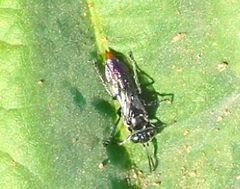
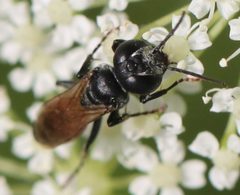
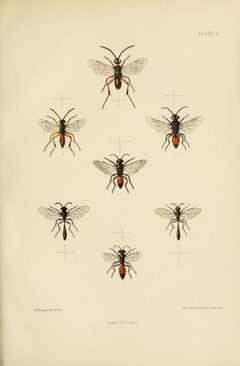
Tachysphex are generally small (6–10 mm), with compact bodies and often distinctive coloration including entirely or partially red . The abdomen terminates in a pointed . are proportionally shorter than in the related Liris and held in a more typical position rather than parallel and straight out from the . The genus is smaller and more compact than Liris, and less stocky than Tachytes. Species-level identification requires examination of male genitalia, female pygidium structure, and antennal sensory areas, often necessitating microscopic or electron microscopy examination.
Images
Habitat
Open sandy or loose soil including road shoulders, arroyos, abandoned fields, and rangeland. Nests are excavated in sand or soil substrates; asphalt and compacted surfaces impede nesting attempts.
Distribution
distribution with highest diversity in temperate regions. North America: approximately 43 ranging across the entire continent including Northwest Territories and Yukon. Palearctic: extensive fauna including 46 species in Iran and 11 species in Azerbaijan. Neotropical: documented in Brazil. Australian region: multiple species recorded. Afrotropical and Oriental regions: represented by species with wider distributions.
Seasonality
activity begins early in spring, with females emerging and initiating nest construction shortly after . In temperate regions, activity continues through summer. Females overwinter as adults in burrows dug for hibernation.
Host Associations
Life Cycle
Females construct shallow burrows in suitable substrate, creating underground . One to eight or more paralyzed prey items are placed in each cell depending on prey size. A single is laid on the underside of the of the last prey item placed. Larvae develop through multiple instars; the last instar larva shows distinctive features including minute spines on annulets of abdominal segments and characteristic setal patterns on prothorax and . occurs within the nest cell.
Behavior
Females are highly active and rapid-moving, rarely remaining still. They excavate nest burrows, hunt for prey, and transport paralyzed victims by grasping in their jaws while cradling with legs. Prey may be flown back to the nest or hauled overland when too heavy for . Males of at least some exhibit , aggregating on elevated terrain for mate location. Both sexes have been observed taking water from damp soil and seeking nectar or honeydew from scale insects and flowers including thistle, sunflower, wild carrot, and goldenrod.
Ecological Role
Significant agents of orthopteran . Documented population reduction of pests from 25 to 3 per square yard within a single season. Parasitized by satellite flies (Miltogramminae), bee flies (Bombyliidae), velvet ants (Mutillidae), and cuckoo wasps (Chrysididae including Hedychridium).
Human Relevance
Beneficial insects for natural pest management in rangeland and agricultural systems. Potential for integration into programs.
Similar Taxa
Sources and further reading
- BugGuide
- Wikipedia
- GBIF taxonomy match
- iNaturalist taxon
- NCBI Taxonomy
- Catalogue of Life
- Valley Grasshopper
- Bug Eric: Wasp Wednesday: Tachysphex
- Bug Eric: Wasp Wednesday: Liris
- II. Nesting Behavior of Tachysphex pechumani (Hymenoptera: Crabronidae)
- The Nesting Biology of Tachysphex puncticeps Cameron, 1903 (Hymenoptera: Crabronidae)
- I. Geographic Distribution and Paleobiogeography of Tachysphex pechumani (Hymenoptera: Crabronidae)
- Hilltopping behavior by males of Tachysphex menkei Pulawski (Hymenoptera, Crabronidae)
- Nesting behaviour of three species ofTachysphexfrom Spain, with a description of the mature larva ofTachysphex tarsinus(Hymenoptera Sphecidae)
- Nesting Behavior of theTachysphex terminatusSpecies Group (Hymenoptera: Crabronidae)
- Figure 1 from: Alcock J (2011) Hilltopping behavior by males of Tachysphex menkei Pulawski (Hymenoptera, Crabronidae). Journal of Hymenoptera Research 21: 65-70. https://doi.org/10.3897/jhr.21.876
- An annotated catalogue of the genus Tachysphex Kohl, 1883 of Iran (Hymenoptera, Apoidea, Crabronidae)
- Description of the last instar larva of Tachysphex inconspicuus (Kirby) (Hymenoptera, Crabronidae) from Brazil
- Comparative study of the nesting behaviour of Tachysphex inconspicuus (Kirby) (Hymenoptera: Crabronidae) in two locations in southeast Brazil
- The fauna and ecology of wasps of the genus Tachysphex Kohl, 1883 (Hymenoptera: Apoidea: Crabronidae) in Nakhchivan Autonomous Republic of Azerbaijan
- NOTES ON THE REPRODUCTIVE BEHAVIOUR OF SOME AUSTRALIAN SOLITARY WASPS (HYMENOPTERA: SPHECIDAE, TACHYSPHEX AND EXEIRUS)