
Liris
Fabricius, 1804
Species Guides
3- Liris apicipennis
- Liris argentatus(Square-headed Wasp)
- Liris partitus
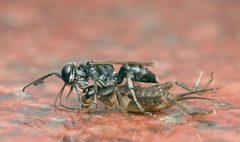
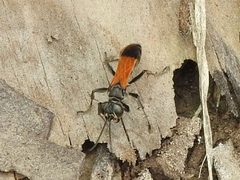
Liris is a large of solitary, ground-nesting in the Crabronidae, tribe Larrini, containing over 260 worldwide with greatest diversity in the tropics. These wasps are among the earliest emerging solitary wasps in spring because females overwinter as . They are medium-sized, silvery-black wasps that hunt crickets as prey for their larvae. Only two species, L. argentatus and L. beata, occur consistently north of the extreme southern United States.

Pronunciation
How to pronounce Liris: //ˈlaɪ.rɪs//
These audio files are automatically generated. While they are not always 100% accurate, they are a good starting point.
Identification
Liris can be distinguished from related in tribe Larrini by several characters: are proportionately longer than in Tachytes and Tachysphex and are frequently held parallel and straight out from the . Tachysphex is usually considerably smaller, often with entirely or partially red , and terminates in a very pointed . Tachytes has bright green , a stockier build, and is extremely active, rarely sitting still, whereas Liris moves more slowly. Liris has only a single mid-ocellus, with lateral ocelli reduced to longitudinal scars (unlike Lyroda which has three distinct ocelli). identification requires examination of male genitalia, female pygidium shape, and antennal sensory areas visible only under electron microscopy.
Images
Habitat
Open, dry including urban trails, arroyos, and sandy areas. Females have been observed taking water from damp soil in otherwise dry arroyos. Nests are constructed in soil, with females sometimes cleaning out pre-existing tunnels rather than excavating new burrows.
Distribution
Worldwide with greatest diversity in the tropics. In North America, L. argentatus ranges from southern Ontario and Massachusetts west to southeast Washington state, south to Panama. L. beata also occurs in the southern U.S. The is poorly known in the New World tropics and Asia, suggesting actual is substantially higher than currently recorded.
Seasonality
Females overwinter as and are among the first solitary active in spring, emerging during unseasonably warm periods as early as late February to March in temperate regions. Activity continues through summer. Late-season wasps mate before winter; only females survive the cold months.
Diet
feed on honeydew from scale insects and nectar from flowers including thistle, sunflower, wild carrot, and goldenrod. Larvae are provisioned with crickets ( Gryllidae), including both adults and nymphs.
Life Cycle
Females construct underground nest burrows 10-14 cm deep, terminating in 1-3 (rarely up to 10). They provision cells with 1-4 paralyzed crickets, laying an on the last victim. Prey is only partially paralyzed, retaining weak or jumping ability. Cells are sealed with soil particles, dry vegetation fragments, small pebbles, and debris; entrances are hidden by kicking sand over them. Spring nests experience low rates; summer nests are parasitized by satellite flies and velvet ants. Late-season individuals mate before winter; females dig hibernation burrows and survive as through cold months.
Behavior
Newly emerged females prioritize finding water, observed visiting damp soil at midday. Females transport bulky prey by grasping the base of the and lugging it overland; transport has not been documented. Nests are left open during prey foraging. Females may reuse pre-existing tunnels rather than dig new burrows, lacking strong rakes of tarsal spines on front legs.
Ecological Role
of crickets (Gryllidae), potentially regulating orthopteran . Serves as for satellite flies (Miltogramminae) and velvet ants (Mutillidae), particularly in summer nests.
Human Relevance
L. argentatus is one of the most abundant and well-studied North American , contributing to scientific understanding of solitary . Early spring activity makes these wasps conspicuous to observers and photographers. No documented negative impacts; non-aggressive solitary wasps.
Similar Taxa
- TachysphexSmaller size, often red , very pointed , shorter not held parallel to .
- TachytesBright green , stockier build, extremely rapid movement, shorter .
- LyrodaNearly identical appearance but has three distinct ocelli (vs. one in Liris) and very large on last tarsal segment (petite feet in Liris).