
Lyroda
Say, 1837
square-headed wasps, cricket hunters
Species Guides
1- Lyroda subita(square-headed wasp)
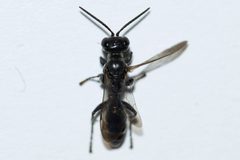
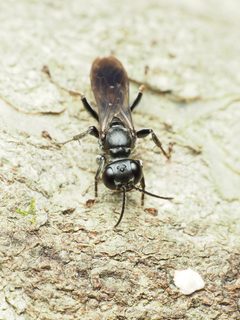
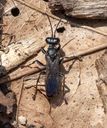
Lyroda is a of solitary, square-headed wasps in the Crabronidae. The genus contains at least 26 described , with most diversity occurring in Southeast Asia, Africa, Australia, and South America; one species, L. subita, is widespread in North America. Females are specialized hunters of crickets and related orthopterans, provisioning underground nests with paralyzed prey for their larvae.
Pronunciation
How to pronounce Lyroda: //laɪˈroʊdə//
These audio files are automatically generated. While they are not always 100% accurate, they are a good starting point.
Identification
Distinguished from the similar Liris by the presence of large (adhesive foot pads) on the ; Liris has small, inconspicuous foot pads. Lyroda possesses three well-developed ocelli, whereas Liris has only a single mid-ocellus with the lateral ocelli reduced to longitudinal scars. The square shape separates both genera from other crabronid .
Images
Appearance
Medium-sized with a distinctive square or rectangular shape. Body typically slate gray with silver highlights, sometimes appearing banded on the in certain lighting. Ocelli present as three simple on the crown of the head between the . bear notably large (adhesive pads) on the final segment, a diagnostic feature distinguishing Lyroda from similar such as Liris. Females of L. subita range 10–13 mm in body length, males 6–10 mm.
Habitat
Found in diverse terrestrial including yards, fields, and stream banks. Nests are constructed in soil, typically 15–30 cm below the surface. Some occupy damp situations near water where pygmy mole crickets or pygmy grasshoppers occur.
Distribution
Widespread globally: L. subita occurs throughout most of the United States (excluding Washington, Oregon, and southwestern states), southern Canada, northern Mexico, Cuba, and Hispaniola. The majority of (21+) are distributed in Southeast Asia, with additional species in Africa, Australia, and South America. Records also exist from Vermont.
Diet
are not described; larvae are provisioned with paralyzed Orthoptera. L. subita primarily hunts crickets ( Gryllidae), including both adults and nymphs. At least one observation documents use of pygmy mole crickets (Tridactylidae), and other Lyroda are known to use pygmy grasshoppers (Tetrigidae).
Host Associations
- Gryllidae - primary prey and nymphs paralyzed and provisioned in nests
- Tridactylidae - occasional preyDocumented in at least one nest of L. subita in upstate New York
- Tetrigidae - preyUsed by other Lyroda outside North America
Life Cycle
Solitary nesting with underground burrows containing one or two . Females provision each cell with multiple paralyzed crickets, lay a single on the final prey item, and seal the cell. Developmental stages include egg, larva, pupa, and , though specific timing is undocumented.
Behavior
Females are solitary nest builders. Nest construction method is debated: some individuals excavate burrows themselves, while others have been observed using abandoned burrows of other solitary . Hunting involves subduing prey with a paralyzing sting to nerve centers. Transport of bulky crickets is accomplished by grasping the in the and slinging the prey beneath the body; the wasp can run, glide, or fly while carrying prey. Multiple crickets are stored per before oviposition.
Ecological Role
of crickets and related orthopterans; control of these insects. Serves as prey for potential nest , though specific are not documented.
Human Relevance
Not considered economically significant. May contribute to of in residential and agricultural settings. Stings are not reported as a concern.
Similar Taxa
More Details
Nest site flexibility
The degree to which Lyroda excavates its own burrows versus usurps existing cavities remains unresolved and may vary by individual or locality.
Host switching
The use of pygmy mole crickets (Tridactylidae) by L. subita and pygmy grasshoppers (Tetrigidae) by other Lyroda suggests potential flexibility in selection based on availability, though crickets remain the primary prey.