
Tridactylidae
Brullé, 1835
Pygmy Mole Crickets, Pygmy Sand Crickets, Pygmy Mole Grasshoppers
Genus Guides
2- Ellipes(pygmy mole crickets)
- Neotridactylus(Pygmy mole crickets)
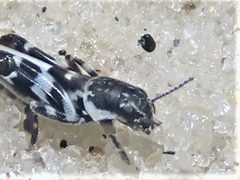
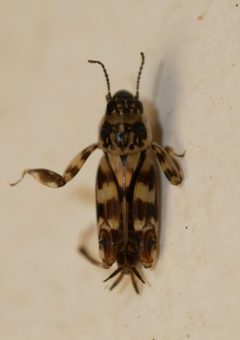
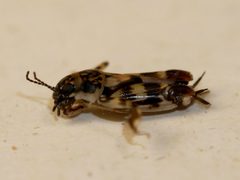
are a of minute orthopterans commonly called pygmy mole crickets, though they are not closely related to true mole crickets (Gryllotalpidae). typically measure 5–10 mm, with some reaching 20 mm. They inhabit moist sandy soils near water bodies, where they construct shallow burrows 2–3 cm deep. The family is distinguished by extraordinary jumping abilities powered by enlarged hind , and by unique natatory on the hind tibiae that function as swimming paddles. Some species can jump from water surfaces and even dive. Despite their , they are basal grasshoppers (Caelifera), not crickets.
Pronunciation
How to pronounce Tridactylidae: /traɪˈdæktɪlɪˌdeɪ/
These audio files are automatically generated. While they are not always 100% accurate, they are a good starting point.
Identification
Distinguished from true mole crickets (Gryllotalpidae) by reduced tegmina without stridulatory organs, enlarged hind adapted for jumping rather than digging, and presence of natatory on hind tibiae. Separated from Tetrigidae (pygmy grasshoppers) by lack of extended pronotum covering . Hind tibial spurs longer than hind (when present) and used for digging—unusual among orthopterans. Ovipositor variable: in some , well-developed and Acrididae-like in others.
Images
Habitat
Moist sandy or gravelly soils near water bodies including streams, rivers, ponds, lakes, and sometimes coastal areas. Some Florida occupy xeric sandhill and scrub with bare sand patches. Construct shallow burrows 2–3 cm below surface, sometimes with chambers at bottom.
Distribution
All continents except Antarctica. Most tropical. North America: two widespread species (Neotridactylus apicalis across eastern and central US to California; Ellipes monticolus in southwestern Sky Islands region), plus several Florida endemics with restricted ranges. China: multiple Xya species including two recently described from Yunnan. Slovenia: recently confirmed Xya variegata. Prehistoric distribution includes Cretaceous deposits in Myanmar, Russia, UK, and Mongolia.
Seasonality
Active year-round in suitable ; observed March through June in temperate regions (e.g., Slovenia records in March and June).
Diet
Feeds on organic detritus, plant material, and —particularly microscopic algae coating sand grains. Ingests sand particles with adhering organic matter.
Life Cycle
laid either in batches of a few dozen within tunnels (some ) or singly in moist soil by species with well-developed ovipositors. Subterranean burrows serve as living chambers and chambers. Developmental details poorly documented for most species.
Behavior
Constructs and inhabits shallow burrows in sandy substrates. Capable of powerful jumping (take-off velocities up to 5.4 m s⁻¹, accelerations of 306 g, heights to 700 mm, distances to 1420 mm). Jumps powered by extension of hind tibiae at angular velocities of 68,000 deg s⁻¹ in 2.2 ms; can use both hind legs synchronously or asynchronously, and sometimes single-leg jumps. Swimming ability exceptional due to natatory on hind tibiae; can dive and swim underwater, jump from water surface, and scrabble across water. Moves slowly when not jumping. Tolerant of close approach before explosive escape response.
Ecological Role
Human Relevance
Of no economic importance in agriculture. Subject of biomechanical research due to extraordinary jumping performance. Some narrowly Florida have conservation implications due to restricted ranges and specialization.
Similar Taxa
- Gryllotalpidae (true mole crickets)Convergent burrowing lifestyle and appearance, but have enlarged hind for jumping (vs. enlarged forelegs for digging in Gryllotalpidae), reduced tegmina without stridulatory organs, and natatory absent in true mole crickets.
- Tetrigidae (pygmy grasshoppers)Similar small size and ground-dwelling habit, but Tetrigidae have extended pronotum covering like a shield, and lack the natatory and extreme hind femoral enlargement of .
Misconceptions
'pygmy mole crickets' is misleading: they are not closely related to true mole crickets (Gryllotalpidae, suborder Ensifera), but are instead basal grasshoppers in suborder Caelifera. The resemblance to mole crickets is for burrowing lifestyle.
More Details
Jumping biomechanics
Among the most powerful jumpers relative to body size in Orthoptera, with accelerations exceeding 300 g. The physics of their water-surface jumping is remarkable and has been studied using high-speed photography at 5000 frames per second.
Taxonomic history
Originally classified as Tridactylinae within Gryllidae (true crickets), later recognized as convergent with Gryllotalpidae. Genitalia studies suggested affinity with Acrididae (grasshoppers). Now placed in superfamily with Cylindrachetidae; Ripipterygidae (mud crickets) was split from based on ovipositor structure.
Conservation status
Most poorly known. At least two-thirds of Florida species are narrowly to small ranges within the state, restricted to xeric sandhill or scrub . Xya variegata in Europe is considered threatened and ecologically highly specialized.
Sources and further reading
- BugGuide
- Wikipedia
- GBIF taxonomy match
- iNaturalist taxon
- NCBI Taxonomy
- Catalogue of Life
- Grasshoppers of Wyoming and the West
- Bug Eric: Wasp Wednesday: Another Cricket Hunter, Lyroda subita
- Bug Eric: Pygmy Mole Crickets
- Bug Eric: Green-eyed Wasps, Tachytes
- Bug Eric: December 2010
- First confirmation of variegated molehopper <i>Xya variegata</i> (Latreille, 1809) (Orthoptera: Tridactylidae) occuring in Slovenia Prva potrditev pojavljanja pisane krtovke Xya variegata (Latreille, 1809) (Orthoptera: Tridactylidae) v Sloveniji
- First natural history observations of the canyon pygmy mole cricket, Ellipes monticolus (Orthoptera: Tridactylidae)
- The pygmy mole crickets (Orthoptera: Tridactylidae) of Florida, USA, with descriptions of three new species
- Jumping mechanisms and performance of pygmy mole crickets (Orthoptera, Tridactylidae)
- Two new species of the genus Xya Latreille, 1809 (Orthoptera, Tridactyloidea, Tridactylidae) from Yunnan with a key to all Xya species in China
- A new species of pygmy mole cricket (Orthoptera: Tridactylidae) from the Lake Wales ridge of Florida and new records of Ellipes eisneri from the northern Brooksville ridge