
Chlorion
Latreille, 1802
cricket hunter wasps, steel-blue cricket hunters
Species Guides
2- Chlorion aerarium(steel-blue cricket hunter)
- Chlorion cyaneum(purplish-blue cricket hunter)
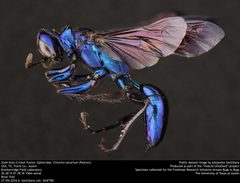
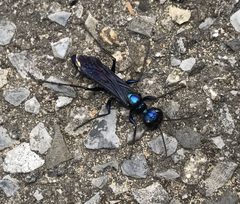
Chlorion is a of solitary sphecid distributed across the Americas, Africa, and tropical Asia through Java. The genus contains approximately 20 described , including the well-known Steel-blue Cricket Hunter Wasp (Chlorion aerarium). Females construct underground burrows provisioned with paralyzed orthopteran prey—primarily crickets for most species, though Chlorion cyaneum preys on . The genus is characterized by metallic blue to violet coloration, large size, and distinctive nesting often associated with hard-packed soil .

Pronunciation
How to pronounce Chlorion: /ˈklɔːr.i.ˌɒn/
These audio files are automatically generated. While they are not always 100% accurate, they are a good starting point.
Identification
Chlorion are large, robust sphecid with striking metallic blue to violet coloration. They are frequently confused with the Blue Mud Dauber (Chalybion californicum), but can be distinguished by several features: Chlorion is generally larger and brighter in color with less hair; the originate lower on the ; and the has a single tooth (Chalybion has a simple mandible). Males are smaller than females and may be particularly difficult to distinguish from Chalybion males in the field.
Images
Habitat
Hard-packed soil areas suitable for burrow construction. Nesting occur in open ground, often in association with existing burrows of larger such as cicada killers. Some utilize pre-existing cavities like hollow stems partitioned with mud. In the southwestern United States, frequently congregate on Desert Broom (Baccharis sarothroides) and other plants exuding fermenting sap.
Distribution
Recorded from the Americas, Africa, and tropical Asia through to Java. In North America, Chlorion aerarium occurs across most of the United States and adjacent southern Canada, with particular abundance in the southwestern states including Arizona. Distribution varies by ; Chlorion maxillosum is known as the African cricket hunter .
Diet
feed primarily on fermenting plant sap oozing from wounded shrubs rather than nectar. Females hunt orthopteran insects as larval provisions—specifically crickets ( Gryllidae) for most , though Chlorion cyaneum preys on (family ).
Host Associations
- Gryllidae - preyprimary prey for most Chlorion ; crickets are paralyzed and provisioned in nest
- Polyphagidae - preyprey of Chlorion cyaneum; rather than crickets
Life Cycle
Females construct underground burrows with multiple , each provisioned with 4-9 paralyzed crickets. An is laid on the last placed in each cell. The larva hatches in approximately one day, consumes its natal , then feeds on the remaining crickets over the course of about a week. After completing feeding, the larva spins a papery silken cocoon and pupates. Development completes with from the pupal case, chewing through the cell closure to exit.
Behavior
Solitary females hunt actively, searching ground surfaces and crevices for crickets. Upon locating prey, they sting to induce paralysis, then transport victims to nest burrows by flying or carrying. Multiple foraging trips provision each . Burrow entrances are closed with soil, stones, and debris after provisioning is complete. Some nest in . Males do not participate in nest construction or provisioning; they congregate on vegetation to feed on sap and seek mates.
Ecological Role
/ of crickets and ; contributes to regulation of orthopteran . serve as minor through incidental contact while feeding on sap. The provides services in both natural and anthropogenic .
Human Relevance
Generally beneficial due to ; not aggressive toward humans. Solitary sting only if physically grabbed or stepped upon. Chlorion aerarium is commonly encountered in residential areas of the southwestern United States, where its presence often prompts identification requests. Some may nest in in open ground, occasionally causing concern, but they pose minimal sting risk compared to social wasps.
Similar Taxa
- Chalybion californicumBlue Mud Dauber; nearly identical metallic blue coloration and size range, but constructs mud nests rather than burrows, preys on spiders rather than crickets, and has simple and higher antennal insertion
- SphexRelated sphecid ; some similar in size and ground-nesting , but typically have different color patterns (often black and yellow) and prey on different orthopterans such as grasshoppers or katydids
More Details
Nesting Associations
Chlorion aerarium frequently utilizes existing burrows of the cicada killer (Sphecius speciosus) as starting points for its own smaller tunnels, constructing that branch off from the larger wasp's main shaft.
Color Variation
Chlorion aerarium exhibits significant geographic color variation, ranging from bright metallic teal in western to deep violet-blue in eastern North America. This variation has historically contributed to confusion with Chalybion californicum.
Sources and further reading
- BugGuide
- Wikipedia
- GBIF taxonomy match
- iNaturalist taxon
- NCBI Taxonomy
- Catalogue of Life
- Bug Eric: Wasp Wednesday: Chlorion aerarium
- Steel-blue cricket-hunters steal lives: Steel-blue cricket-hunters, Chlorion aerarium — Bug of the Week
- Bug Eric: Year-end Wrap-up
- Bug Eric: Wasp Wednesday: Blue Mud Dauber
- Bug Eric: December 2011
- pleasing fungus beetles | Beetles In The Bush
- Nesting Behavior of Chlorion aerarium1
- Nesting Behavior of Chlorion cyaneum (Hymenoptera: Sphecidae), a Predator of Cockroaches (Blattaria: Polyphagidae)
- Scanning Tunneling Microscopy Investigations of Colloidal Silver: Surface Structure and Aggregation Behavior Induced by Chlorion