
Lyroda subita
Say, 1837
square-headed wasp, cricket hunter
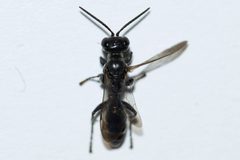
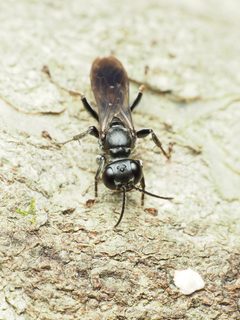
Lyroda subita is a solitary, medium-sized square-headed in the Crabronidae. Females construct underground nests and provision them with paralyzed crickets as food for their larvae. The is distinguished from similar by its large (tarsal foot pads) and three functional ocelli. It occurs across much of North America and has been documented using both typical and, in at least one case, pygmy mole crickets.
Pronunciation
How to pronounce Lyroda subita: /laɪˈroʊdə ˈsuːbɪtə/
These audio files are automatically generated. While they are not always 100% accurate, they are a good starting point.
Identification
Distinguished from the similar Liris by two key features: (1) Lyroda subita possesses large, prominent on the last tarsal segment of each foot, whereas Liris has small, reduced foot pads; (2) L. subita has three functional ocelli (simple on the crown), while Liris has only one mid-ocellus with the lateral ocelli reduced to longitudinal scars. The combination of slate gray coloration with silver abdominal highlights and medium size further supports identification.
Images
Appearance
Medium-sized with slate gray coloration and silver highlights, especially on the ; in certain light the abdomen appears banded in dark gray and white. Females measure 10–13 mm in body length, males 6–10 mm. bears three functional ocelli arranged between the . Most distinctive feature is the large (plural arolia) on the last tarsal segment of each foot—markedly larger than the small foot pads of the similar Liris.
Habitat
Open ground supporting of crickets ( Gryllidae). Nests are constructed in soil, with tunnels 15–30 cm below the surface. In eastern Kansas, has been observed in residential yards with abundant field crickets (Gryllus) and ground crickets ( Nemobiinae). Pygmy records suggest use of damp or wet situations along stream banks where alternative occur.
Distribution
Most of the United States (absent from Washington, Oregon, and southwestern states), southern Canada, northern Mexico, Cuba, and Hispaniola. Specific Canadian records include Alberta.
Diet
are predatory; larvae are fed paralyzed orthopteran prey. Females hunt almost exclusively crickets ( Gryllidae), including both adults and nymphs. At least one documented case of using pygmy mole crickets (family Tridactylidae) exists, representing an unusual record.
Host Associations
- Gryllidae (crickets) - primary Typical and abundant ; both and nymphs used
- Tridactylidae (pygmy mole crickets) - documented alternative Single record from upstate New York; ecological basis unexplained
Life Cycle
Solitary nesting. Female constructs underground burrow 15–30 cm deep, containing one or two . Each cell is provisioned with multiple paralyzed crickets; an is laid on the last placed, after which the cell is sealed. Developmental stages (egg, larva, pupa) occur within the sealed cell. Nest may be self-excavated or may occupy abandoned burrows of other solitary .
Behavior
Females hunt crickets by delivering a paralyzing sting to a nerve center, rendering prey limp. Transport of prey involves grasping the 's in the and carrying it slung beneath the body; the can run over ground or fly/glide while carrying the bulky prey. Nest provisioning is progressive: multiple crickets are accumulated per before oviposition and sealing. Males and females both observed.
Ecological Role
and of orthopterans, particularly crickets. Acts as a control agent for populations in open ground . Serves as prey for other organisms (not documented in sources).
Human Relevance
Generally harmless to humans; sting used only to subdue prey. May be noticed in residential areas where crickets are abundant. No documented economic impact or applications.
Similar Taxa
- LirisNearly identical in general appearance and also hunts crickets; distinguished by small reduced (vs. large in Lyroda) and single mid-ocellus with lateral ocelli reduced to scars (vs. three functional ocelli in Lyroda)
- Chlorion aerarium (Steel Blue Cricket Hunter)Also a -hunting sphecid ; larger, metallic blue-green coloration, different
More Details
Nesting behavior debate
Whether females excavate their own burrows or usurp abandoned burrows of other solitary remains unresolved; observations support both possibilities.
Host flexibility
The single Tridactylidae record and related Lyroda using Tetrigidae (pygmy grasshoppers) suggest potential ecological plasticity in use when typical crickets are scarce or in specific microhabitats.