
Miltogramminae
Satellite Flies
Genus Guides
10- Amobia
- Eumacronychia
- Euphyto
- Gymnoprosopa
- Macronychia(satellite flies)
- Metopia(satellite flies)
- Phrosinella
- Senotainia(satellite flies)
- Sphenometopa
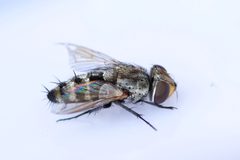
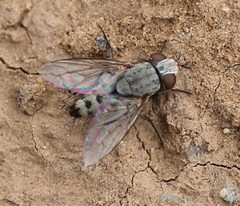
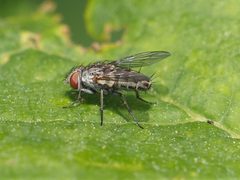
Miltogramminae is a of flesh flies (Sarcophagidae) commonly known as satellite flies. They are obligate kleptoparasites that exploit the prey provisions of solitary bees and , depositing their larvae on or near -captured prey items. The subfamily has a global distribution with notable diversity in the Afrotropical, Palearctic, and Nearctic regions. Their derives from the of females 'orbiting' host wasps to locate nests.
Pronunciation
How to pronounce Miltogramminae: /ˌmɪltəˈɡræmɪnaɪ/
These audio files are automatically generated. While they are not always 100% accurate, they are a good starting point.
Images
Habitat
Found in diverse terrestrial including sandy areas, watercourses, lake beaches, shrubby areas, and human-modified environments such as trails, roads, parks, and meadows. In China, have been collected from ecologically distinctive zones including the Turpan-Hami Basin and Kalamaili region. Some species are psammophilous, occurring in sandy habitats near water sources.
Distribution
Global distribution with records from all major biogeographic regions. In the Afrotropical region, include Hoplacephala, Lamprometopia, and Phylloteles. In China, eight of Taxigramma are documented from Xinjiang, Neimenggu, Sichuan, and Hainan provinces. In South America, the occurs in southern Andean landscapes including the Valdivian forest and Patagonian steppe ecoregions. Australian fauna includes three species of Amobia. The subfamily is also documented from Japan, India, and North America.
Host Associations
- solitary bees - kleptoparasiteLarvae develop in nests, feeding on -provisioned pollen and nectar stores
- solitary wasps - kleptoparasiteLarvae deposited on paralyzed prey items carried by female to nest burrows
- Anterhynchium flavomarginatum - kleptoparasite is a solitary tube-renting eumenine ; documented for Amobia quatei and Amobia distorta
- Anterhynchium gibbifrons - kleptoparasitePotentially non-native in Japan parasitized by Amobia distorta
- Stictia carolina - kleptoparasiteHorse Guard sand wasp; satellite flies deposit larvae on prey carried to nest
- Ammophila aberti - kleptoparasiteThread-waisted wasp; nests subject to satellite fly
- Ammophila procera - kleptoparasiteDocumented include Senotainia vigilans and Metopia laterallis
- Prionyx thomae - kleptoparasite-hunting sphecid ; satellite flies orbit prey-laden females
- Steniolia elegans - kleptoparasiteSand wasp hunting bee flies and flower flies; subject to satellite fly
Life Cycle
Females deposit first-instar larvae (maggots) rather than , typically on or near prey items being transported by or at nest entrances. Larvae enter host nests and feed on the paralyzed prey intended for host offspring. Development occurs within the host nest, with larvae consuming host provisions. In some , larvae may consume prey leftovers rather than directly attacking host larvae. occurs within the host nest or in the soil. Early instar larvae exhibit substantial morphological diversity; first instars of Hoplacephala possess armored with cuticular and modified body papillae, while Phylloteles picifrons has a unique bladder-like structure on the first thoracic segment. The absence of a bridge of the cephaloskeleton in first instars indicates parasitic or .
Behavior
females exhibit 'satellite' , closely following as they hunt and return to nests with prey. This orbiting behavior allows females to locate host nest entrances and time larval deposition. When host wasps approach nests with prey, satellite flies attempt to deposit larvae at the burrow entrance. Host wasps exhibit defensive behaviors when approached by flies, including evasive maneuvers and aggressive responses. Some show preferences: Taxigramma albina is psammophilous and associated with water sources. Species composition and abundance vary between natural and human-modified habitats, with some species like Opsidia intonsa being in anthropogenic environments.
Ecological Role
Kleptoparasites that reduce the reproductive success of solitary and by usurping prey provisions. They function as a population control mechanism for and contribute to nutrient cycling through the consumption of paralyzed prey. Their presence indicates healthy populations of host Hymenoptera. The serves as a model system for studying host- and the ecological impacts of anthropogenic modification on parasitic insect .
Human Relevance
Occasionally referenced in contexts due to their association with pestiferous horse flies (through of horse fly like Stictia carolina). Human landscape modification affects their diversity and abundance: richness is higher in natural sites, while some proliferate in human-modified . No direct economic importance as pests or beneficial organisms, though they may incidentally affect of beneficial solitary and predators.
Similar Taxa
- SarcophaginaeOther of Sarcophagidae; differs in being primarily necrophagous rather than kleptoparasitic, with different larval and
- ParamacronychiinaeThird of Sarcophagidae; some members are of but with different associations and larval
More Details
Morphological diversity in larvae
First instar larvae show unexpected morphological diversity across . Hoplacephala larvae possess a massive cephaloskeleton and armored by cuticular . Phylloteles picifrons has a large bladder-like structure of unknown function on the first thoracic segment. Metopia exhibit unique features including a serrated surface of the mouth-hook tip and lateral arm-like extensions at the base of the mouth-hook. These larval characters have phylogenetic significance and can aid in species identification where are difficult to separate.
Molecular systematics
Phylogenetic studies using COI, ND4, CYTB, and EF1α loci support the monophyly of Australian Amobia and their sister relationship to Senotainia. COI sequences have been obtained for Taxigramma albina, T. pluriseta, and T. pluton, enabling genetic divergence analysis among species.
Conservation implications
Studies in southern South American Andean landscapes demonstrate that slight modifications of natural areas, such as proliferation of trails or isolated houses, significantly affect kleptoparasitic fly diversity. Natural sites support higher , while human-modified favor dominance by like Opsidia intonsa. Conservation efforts for solitary and indirectly benefit Miltogramminae diversity.
Sources and further reading
- BugGuide
- Wikipedia
- iNaturalist taxon
- NCBI Taxonomy
- Catalogue of Life
- Bug Eric: Wasp Wednesday: Prionyx thomae
- Bug Eric: Wasp Wednesday: Ammophila aberti
- Bug Eric: Wasp Wednesday: The "Horse Guard"
- Super Crop Challenge #4 | Beetles In The Bush
- Bug Eric: Wasp Wednesday: Steniolia elegans
- Bug Eric: Wasp Wednesday: Ammophila procera
- Taxonomic Review of the Genus Taxigramma (Diptera, Sarcophagidae, Miltogramminae) from China
- First data on early instar Afrotropical Miltogramminae (Diptera: Sarcophagidae) reveal unexpected morphological diversity
- Parasitic behavior of Amobia distorta (Diptera: Miltogramminae) and defensive behavior of its hosts, Anterhynchium spp. (Hymenoptera: Vespidae: Eumeninae)
- Occurrence of kleptoparasitic sarcophagid flies (Diptera: Sarcophagidae: Miltogramminae) in natural and human modified sites in Southern South American Andean landscapes
- Comparative morphology of the first instar of three species of Metopia Meigen (Diptera: Sarcophagidae, Miltogramminae)
- Taxonomic revision of Australian Amobia Robineau-Desvoidy, 1830 (Sarcophagidae: Miltogramminae): integrating morphology and genetics finds a new species and tackles old problems
- First record of Amobia quatei (Diptera: Sarcophagidae: Miltogramminae) from the Indian subcontinent as kleptoparasite of Anterhynchium flavomarginatum (Hymenoptera: Vespidae: Eumeninae)
- New record of Phylloteles hyalipennis (Baranov, 1934) (Diptera: Miltogramminae) from North India, with morphology, life cycle and SEM study of immature stages