
Stictia carolina
(Fabricius, 1793)
Horse Guard Wasp, Horse Guard, Cowfly Tiger, Insecto Policia
Stictia carolina, commonly known as the Horse Guard , is a large, colorful sand wasp native to eastern and central North America. This solitary wasp is a of horse flies (Tabanidae), hunting around livestock and humans to capture its prey. Females excavate burrows in sandy soil where they provision a single with 15-35 flies for their larval offspring. Despite its intimidating appearance and persistent hovering around horses, it is not aggressive toward humans and provides valuable of biting flies.
Pronunciation
How to pronounce Stictia carolina: //ˈstɪktiə ˌkærəˈlaɪnə//
These audio files are automatically generated. While they are not always 100% accurate, they are a good starting point.
Identification
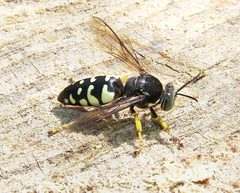
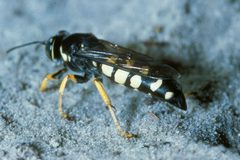
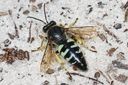
Distinguished from similar by its large size, distinctive black and white abdominal pattern, and of hovering persistently around horses and livestock. The Bald-faced Hornet (Dolichovespula maculata) has similar coloration but less extensive white markings on the and builds paper nests rather than nesting in soil. Male Horse Guards have white markings only on the half of the abdomen, while females have markings across most of the abdomen. The can be confused with other Stictia species in the southern U.S., but S. carolina is the only member of the ranging into the northeastern states.
Images
Appearance
Large, robust with striking black and white coloration. The has bold white markings that extend across most of the surface in females, while males have white markings confined to the front half of the abdomen. Body length approximately 20-25 mm, making it one of the largest North American sand wasps. Wings are dark with iridescent sheen. The overall appearance is wasp-like but more elongated than typical yellowjackets, with a distinct thread-waisted profile characteristic of sphecid wasps.
Habitat
Open sandy areas including blowouts, dunes, sandy roadsides, and disturbed ground with sparse vegetation. Requires well-drained sandy or loose soil for nesting burrows. Often found in agricultural settings, pastures, and areas frequented by horses or cattle where horse flies are abundant. The shows a strong association with bare ground patches within grassland or weedy environments.
Distribution
Eastern and central North America, from New Jersey and Pennsylvania south to Florida, and west to Illinois, Kansas, and New Mexico. Most abundant in the southern Great Plains. The northern range limit extends to Cape May, New Jersey and possibly southern New England. Absent from the Pacific Northwest and most of the Rocky Mountain region except eastern foothills.
Seasonality
active primarily from late spring through autumn. Males emerge and are active earlier in the season than females. In New Jersey, observed persisting into early October. Females take 22-30 hours to complete nest excavation, with digging activity concentrated in morning and late afternoon hours. Males perform territorial patrol primarily during morning hours.
Diet
are predatory, specializing on horse flies ( Tabanidae) including Tabanus and related . Prey is captured in , often around horses or cattle. Larvae are fed progressively with 15-35 horse flies during development. Adults may also visit flowers for nectar; observed feeding on pear nectar in New Jersey.
Host Associations
- Tabanidae - of horse flies; captures in around livestock
Life Cycle
Solitary nesting with . Females excavate diagonal burrows 35-51 cm long to depths of 18-24 cm in sandy soil, terminating in a single . An is deposited in the cell, then the female hunts horse flies to feed the larva. The burrow is sealed with both inner and outer closures between provisioning visits. Development includes egg, larval, and pupal stages within the burrow. time appears to be with emerging in late spring to early summer.
Behavior
Females hunt by flying around horses and cattle, inspecting legs and bodies for horse flies. Capable of flying backwards in front of moving horses. Males perform territorial "sun dances"—level in circles, figure eights, or sinuous patterns near nesting areas, occasionally perching on low vegetation, , stones, or bare ground. Males actively chase rivals and harass other large insects entering their territories. Both sexes are strong, fast fliers. are wary and flush readily when approached.
Ecological Role
Important agent of horse flies and deer flies, reducing nuisance and potential transmission to livestock and humans. The ' hunting around equines provides incidental protection to domestic animals. As a solitary , it contributes to soil aeration through burrowing activities. Serves as prey for velvet ants (Dasymutilla occidentalis) and for satellite flies (Sarcophagidae: Miltogramminae), which are kleptoparasites on provisioned prey.
Human Relevance
Highly beneficial to livestock operations due to specialized on horse flies. Frequently misunderstood by ranch hands and riders as aggressive "" due to persistent hovering around horses, but poses no sting threat to humans or animals. No commercial availability exists despite interest from horse owners for biological fly control. can be encouraged by preserving sandy nesting and avoiding use. Occasionally attracted to electric lights at night.
Similar Taxa
- Bald-faced Hornet (Dolichovespula maculata)Similar black and white coloration, but less extensive white markings, social nesting in paper nests, and broader body shape
- Bicyrtes speciesSimilar size and sand wasp habits, but different color patterns (often with yellow markings) and prey on stink bugs rather than flies; common in northeastern states where Horse Guards are rare
- Sphecius speciosus (Eastern Cicada Killer)Similar large size and ground-nesting , but rusty or brown coloration with yellow markings, and specializes on cicadas rather than flies
Misconceptions
Frequently mistaken for aggressive or yellowjackets due to its bold black and white pattern and persistent hovering around horses. The hovering is actually hunting directed at horse flies, not aggression toward the horse or rider. The is solitary and does not defend a colony; females are focused on provisioning nests and will sting only if handled. The "Horse Guard" accurately reflects its beneficial role, not a guarding or aggressive temperament.
More Details
Nesting Biology
Nests are excavated in sandy soil with specific physical properties affecting burrow dimensions. Females close the tunnel with both inner and outer seals between provisioning visits, an effective defense against . The double closure system reduces opportunities for satellite flies (Miltogramminae) to deposit larvae on prey, though some still occurs.
Historical Observations
Pupae received from Mississippi at the Cincinnati Zoo in 1988 yielded both expected and velvet ant (Dasymutilla occidentalis), documenting occasional by mutillids. This remains one of the few recorded instances of Horse Guard parasitism.
Conservation Status
Not formally assessed by IUCN. appear stable where suitable sandy persists. Threats include habitat destruction through development, road improvements that eliminate sandy shoulders, and agricultural practices that reduce bare ground patches. The ' association with disturbed habitats provides some , but specific nesting requirements limit ability.
Sources and further reading
- BugGuide
- GBIF taxonomy match
- iNaturalist taxon
- Catalogue of Life
- Bembicid Holdings | Entomology Research Museum
- Carolina Grasshopper
- Bug Eric: Wasp Wednesday: The "Horse Guard"
- Bug Eric: Services
- Death of a lanternfly, Part 2: Lanternfly on the Thanksgiving menu for a gal called Carolina – Carolina mantis, Stagmomantis carolina — Bug of the Week
- Surviving winter, Part III: Egg cases of the Praying mantis, Mantis religiosa, Chinese mantis, Tenodera sinensis, and Carolina mantis, Stagmomantis carolina — Bug of the Week