
Dolichovespula maculata
(Linnaeus, 1763)
Bald-faced Hornet, Bald Hornet, White-faced Hornet, White-tailed Hornet, Spruce Wasp, Blackjacket, Bull Wasp
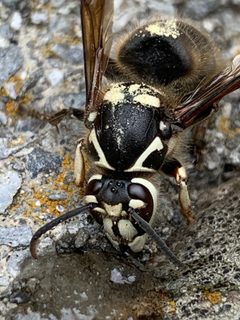
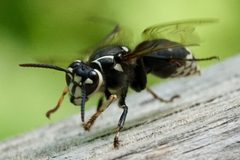
Dolichovespula maculata is a social native to North America, commonly known as the bald-faced despite being a yellowjacket rather than a true hornet ( Vespa). It constructs large, enclosed paper nests suspended from branches or structures, with colonies reaching 400–700 —the largest recorded in its genus. The is immediately recognizable by its black body with white facial markings and white banding at the tip. Workers are aggressively defensive of their nests and can spray venom toward intruders.
Pronunciation
How to pronounce Dolichovespula maculata: //ˌdɒlɪkoʊˈvɛspjʊlə ˌmækjʊˈleɪtə//
These audio files are automatically generated. While they are not always 100% accurate, they are a good starting point.
Identification
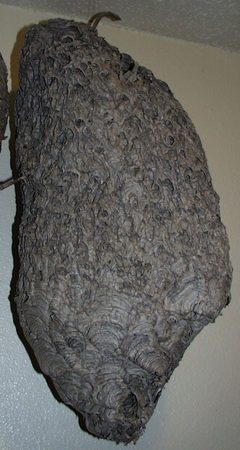
Distinguished from other yellowjackets (Vespula and Dolichovespula ) by its black-and-white coloration rather than black-and-yellow patterning. Larger than most . The enclosed, football-shaped paper nest suspended from branches or structures differs from the exposed combs of Polistes paper wasps and the subterranean nests of Vespula yellowjackets. From true hornets (Vespa), it differs in smaller size, nest architecture, and geographic range (Vespa species are not native to North America except the introduced European hornet).
Images
Appearance
are predominantly black with striking white markings: a white or pale "bald" , white patches at the base of , and three white stripes at the terminal abdominal segments. Adults average approximately 19 mm in length, notably larger than . Queens and share similar coloration; queens are always larger than workers within the same colony, though size ranges can overlap between colonies. The wings are dark tinted.
Habitat
Found in forested areas and urban vegetation. Nests are constructed in trees, shrubs, and blackberry canes; occasionally under rock overhangs or attached to building sides. Nest heights range from 0.3 m to 20 m above ground. Requires sources of wood fiber for nest construction and abundant insect prey.
Distribution
Throughout the United States and southern Canada; most abundant in the Southeastern United States. Present in the Rocky Mountains, western coastal states, and eastern North America. Absent from true (Vespa) ranges in Europe and Asia.
Seasonality
Colonies are , active from spring through autumn. Nest initiation occurs mid-April to late May depending on latitude; emerge by mid-June. Reproductive phase begins mid-July to mid-August. Colonies terminate mid-September to mid-October, with queens to found new colonies the following spring. Longer colony cycles occur at lower latitudes.
Diet
are , consuming nectar, tree sap, and fruit pulp (particularly apples). capture and macerate flies, caterpillars, , spiders, and other arthropods to feed larvae. They scavenge raw meat and carrion. The has been observed preying on other yellowjacket species and may raid hives for adults, larvae, pollen, and honey, particularly when other food sources are scarce.
Life Cycle
colony cycle with three stages: founding, ergonomic, and reproductive. The single overwintered initiates the nest, rears the first alone over 23–24 days (: 6 days; larva: 8 days; pupa to : 9–10 days). Workers assume all duties except egg-laying. In late summer, the queen produces haploid males and new queens in large . After mating, new queens seek hibernal shelter under bark, in logs, or other protected locations. The original colony perishes by winter; nests are not reused.
Behavior
aggressively defend nests through repeated stinging and by spraying venom from the stinger into the of vertebrate intruders, causing temporary blindness and eye watering. Nest construction involves chewing wood and plant fibers into papery pulp with saliva, forming layered hexagonal combs enclosed in a mottled gray envelope. Workers expand nests continuously, removing outer envelope sections to accommodate growth. Nestmate recognition occurs through colony-specific cuticular hydrocarbons. Workers in queenless colonies may produce male offspring from unfertilized ; matricide by workers has been inferred but not directly observed.
Ecological Role
Significant of pest insects including flies, caterpillars, and spiders. Contributes to pollination through nectar feeding. Serves as prey for birds and other predators. Nest cavities abandoned after colony death may be used by other organisms. Parasitized by the bee moth Aphomia sociella, whose larvae consume unprotected .
Human Relevance
Considered beneficial for garden pest control but poses sting hazard when nests are near human activity. Stings are painful and can cause allergic reactions requiring medical attention. Nests attached to buildings or in high-traffic areas often require professional removal. Not a scavenger at human food sources unlike some Vespula yellowjackets. Venom extracts are used in immunotherapy for hypersensitive individuals. Misidentification as a true causes undue concern.
Similar Taxa
- Vespula species (yellowjackets)Share black-and-yellow coloration (not black-and-white), smaller size, and typically nest underground rather than aerially
- Polistes species (paper wasps)Build exposed, unenclosed paper combs rather than enclosed nests; generally less aggressive; different body proportions with longer legs
- Vespa crabro (European hornet)True introduced to eastern North America; larger (25–35 mm), brown and yellow coloration, different nest architecture
- Dolichovespula arenaria (aerial yellowjacket)Smaller with black-and-yellow banding; builds similar aerial nests but with smaller colonies
Misconceptions
Commonly called a "" but is technically a yellowjacket, not a true hornet ( Vespa). Nests are often assumed to be and reused, but colonies are and nests are abandoned after one season. Despite aggressive nest defense, the is not a scavenger at picnics or garbage unlike some yellowjackets.
More Details
Nest architecture
Nests reach up to 360 mm in diameter and 580 mm in length, constructed of layered hexagonal combs covered by a mottled gray paper envelope. The papery material is produced by chewing wood fibers mixed with saliva.
Genetic system
Haplodiploid: males are haploid, females are . Queens mate with a single male, resulting in -worker relatedness of 0.75. Worker of males occurs in about 20.9% of cases in sampled colonies.
Venom defense
Unique among North American social in ability to spray venom from the stinger toward threats, particularly targeting of vertebrate .
Sources and further reading
- BugGuide
- Wikipedia
- GBIF taxonomy match
- iNaturalist taxon
- NCBI Taxonomy
- Catalogue of Life
- Yellowjackets: A Look at Opportunistic Raiders of Honey Bee Hives
- Bug Eric: Makin' Paper
- Bug Eric: The Wasp Wall
- Bug Eric: Life in a Paper Palace
- Be careful around baldfaced hornets, Dolichovespula maculata — Bug of the Week
- An inside look at baldfaced hornets, Dolichovespula maculata — Bug of the Week
- Nestmate Recognition in the Bald‐faced Hornet, Dolichovespula maculata (Hymenoptera: Vespidae)