
Dolichovespula arenaria
(Fabricius, 1775)
common aerial yellowjacket, sandhills hornet, common yellow hornet
Dolichovespula arenaria is a social native to North America, known for constructing exposed aerial paper nests in trees, shrubs, and on buildings. The is distinguished by interrupted yellow bands on the first and second abdominal tergites and a predominantly yellow ocular sinus lacking black markings. Colonies are , initiated by a single in spring and declining after reproductive individuals emerge in late summer. are predatory, capturing live arthropods to feed larvae, and the species exhibits a unique venom-spraying defense mechanism.

Pronunciation
How to pronounce Dolichovespula arenaria: /ˌdɒlɪkoʊˈvɛspjʊlə ˌærɪˈnɛəriə/
These audio files are automatically generated. While they are not always 100% accurate, they are a good starting point.
Identification
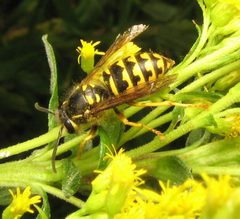
D. arenaria can be identified by medially interrupted or incised fasciae on 1 and 2. The ocular sinus is yellow without black markings, unlike D. adulterina which has black markings in this area. Queens display large black discal spots on terga 4 and 5, with smaller spots on terga 2 and 3. Males possess larger , spots on basal bands of terga 4 and 5, and a flat terminal ("fuzzy butt") rather than a pointed stinger. Nests consist of 1-6 combs of dull grey paper.
Images
Habitat
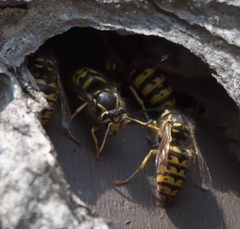
Nests are constructed in arboreal to subterranean , though primarily aerial. In natural settings, nests occur in trees and shrubs. In urban environments, nests are frequently found on building eaves and structures.
Distribution
Widely distributed across North America from northcentral Alaska to New Mexico and Arizona. Common throughout Canada and the United States, particularly abundant in eastern North America.
Seasonality
colony cycle with queens initiating nests in spring. Colonies peak in summer and decline as winter approaches. active during warmer months. New queens and males emerge in late summer and early fall for mating .
Diet
prey primarily on live arthropods including grasshoppers, crickets, caterpillars, spiders, flies, lacewings, and lady beetles. They also prey on fall webworm larvae and young hummingbirds. Unlike Vespula , they are generally not attracted to protein baits. Occasional carrion feeding has been observed on dog, pig, and snake carcasses.
Life Cycle
colony cycle. initiates colony in spring by constructing a small paper nest and laying . First develops into , which assume foraging and nest maintenance duties. Colony expands through summer, peaking in worker numbers before producing new queens and males in late summer. Mated queens overwinter in sheltered locations; workers and males perish with onset of winter.
Behavior
forage in trees 2-4 meters above ground. Smaller colonies exhibit less aggressive colony defense than larger colonies; defense in small colonies described as unpredictable and erratic. Unique venom-spraying behavior observed in workers from large colonies, involving contraction of venom muscles to eject venom and release .
Ecological Role
controlling of various arthropods. Serves as for social including Dolichovespula arctica and Vespula squamosa. Nests subject to by birds, other , skunks, opossums, raccoons, and bears. Parasitized by ichneumonid Sphecophaga vesparum burra and invaded by bee moth Aphomia sociella.
Human Relevance
Nests on buildings can create conflicts with humans. Stings possible when nests are disturbed. generally not attracted to human food or protein baits, reducing picnic and garbage-related encounters compared to other yellowjacket .
Similar Taxa
- Dolichovespula adulterinaSimilar yellow coloration, but D. adulterina has black markings in the ocular sinus which D. arenaria lacks
- Dolichovespula maculataBoth aerial nesters, but D. maculata is black and white rather than yellow and black
- Vespula speciesSimilar yellow and black patterning, but Vespula typically nest underground and are attracted to protein baits and human food
- Vespula pensylvanicaSimilar appearance but nests subterraneously and scavenges at human food sources, unlike D. arenaria
Sources and further reading
- BugGuide
- Wikipedia
- GBIF taxonomy match
- iNaturalist taxon
- NCBI Taxonomy
- Catalogue of Life
- What You Need to Know About That Invasive Giant Hornet | Bug Squad
- Bug Eric: One of These is Not Like the Others....
- Bug Eric: Grape is Blooming
- A Coast-to-Coast Tour Lands One Entomologist on the Home Team
- Bug Eric: July 2011
- Bug Eric: Life in a Paper Palace
- Dolichovespula arenaria (Fab.), a New Host for Vespula squamosa (Drury) (Hymenoptera: Vespidae)