
Sphecophaga vesparum
(Curtis, 1828)
Sphecophaga vesparum is an ichneumonid ectoparasitoid of vespid , primarily targeting Vespula vulgaris and Vespula germanica. The exhibits remarkable developmental plasticity with two female morphs: large winged females and small brachypterous females, each emerging from distinct cocoon types. It has been introduced to New Zealand and Australia as a agent for social wasps. The species is facultatively deuterotokous, producing mostly parthenogenetic females with occasional males.
Pronunciation
How to pronounce Sphecophaga vesparum: //sfɛˈkɒfəɡə ˈvɛspərəm//
These audio files are automatically generated. While they are not always 100% accurate, they are a good starting point.
Identification
Distinguished from other ichneumonids by its specialized association with vespid nests and the presence of two female morphs (winged and brachypterous). The three cocoon types (white, weak yellow, thick yellow) are diagnostic. identification requires color character analysis; morphological characters alone do not reliably separate S. v. vesparum from S. v. burra.
Images
Appearance
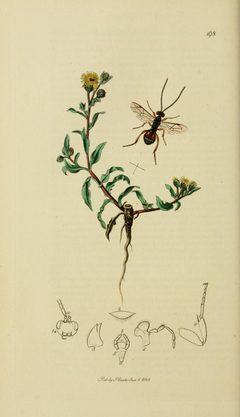
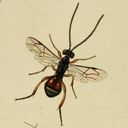
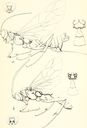
occur in two distinct female morphs. Large winged females are fully . Small brachypterous females have reduced wings. Cocoons show three color and texture variants: soft white cocoons, weak-walled yellow cocoons, and rigid thick yellow cocoons used for . S. v. vesparum and S. v. burra are morphologically indistinguishable but can be separated by color characters with >98% for females and 100% for males.
Habitat
Exclusively associated with nests of social vespid , particularly Vespula . Found within the capped of colonies where wasps are present.
Distribution
Native to Europe (Belgium, United Kingdom, Denmark, Norway, Flemish Region). Introduced to New Zealand (established at Pelorus Bridge, Marlborough and Ashley Forest, Canterbury) and Australia (released in Victoria).
Seasonality
Winged emerge from yellow cocoons after 1–4 years of dormancy and may live up to 3 weeks. Brachypterous females emerge from white cocoons within approximately 13 days. Multiple can occur within a single year in active nests.
Diet
Ectoparasitic larvae feed on , specifically newly pupated forms within capped of nests.
Host Associations
- Vespula vulgaris - primary Common ; main in introduced range
- Vespula germanica - primary German wasp; main in introduced range
Life Cycle
Ectoparasitic on pupae within capped . Females oviposit preferentially into cells where has most recently occurred. Three /cocoon types determine phenotype: white cocoons produce brachypterous females in ~13 days; weak yellow cocoons produce winged females (and possibly males) in ~15 days; thick yellow cocoons are , producing winged adults after 1–4 years. Many may originate from one winged female in one year.
Behavior
Females preferentially oviposit on immatures that have recently spun pupal caps. Winged may live up to 3 weeks. The exhibits partial chemical mimicry of host cuticular hydrocarbons, particularly linear alkanes, likely through passive recycling of prey hydrocarbons to avoid host detection. of at least 2.37 km per year has been documented in New Zealand.
Ecological Role
Ectoparasitoid that regulates of social vespid . Functions as a agent for Vespula in New Zealand and Australia. Has established self-sustaining populations at limited sites in New Zealand with rates averaging 8.5% of nests annually at Pelorus Bridge.
Human Relevance
Introduced as a agent for German and common in New Zealand (releases 1985–1987, 1987–ongoing) and Australia (approved 1989, released in Victoria). Establishment has been limited and localized; no significant reduction in wasp nest has been demonstrated despite increased rates over time. Further releases of S. v. vesparum not recommended; S. v. burra considered for re-release.
Similar Taxa
- Sphecophaga vesparum burraNorth American morphologically indistinguishable but separable by color characters; failed to establish in New Zealand field releases
- Other IchneumonidaeLack specialized vespid nest association, two female morphs, and three cocoon types
More Details
Chemical ecology
Hydrocarbon profiles differ across larval, pupal, and stages. Partial mimicry of V. vulgaris and V. germanica occurs through matching of linear alkanes, likely via recycling of prey cuticular hydrocarbons rather than active biosynthesis.
Reproductive biology
Facultative deuterotokous : females and males can be produced without , with females predominating and males rare. Mating can occur but is not required for .
Cocoon determination
Cocoon type is principally determined by age at oviposition: yellow cocoons from laid soon after pupal cap spinning; white cocoons from eggs laid on more developed pupae. Temperature indirectly influences cocoon type by affecting relative development rates of host and .
Natural enemies
In native range: Dimmockia incongrua, Melittobia acasta (Eulophidae), Dibrachys vesparum, possibly D. boarmiae (Pteromalidae), and one unidentified chalcid. In New Zealand: mice and spiders reported as field enemies; hyperparasitoids appear relatively unimportant.
Sources and further reading
- BugGuide
- GBIF taxonomy match
- iNaturalist taxon
- NCBI Taxonomy
- Catalogue of Life
- Invasion success of the wasp parasitoid Sphecophaga vesparum vesparum (Curtis) in New Zealand
- Hydrocarbon Signatures of the Ectoparasitoid Sphecophaga vesparum Shows Wasp Host Dependency
- Factors influencing reproductive strategies of the vespid parasitoid Sphecophaga vesparum vesparum (Hymenoptera: Ichneumonidae)
- Release and recovery of the introduced wasp parasitoid, Sphecophaga vesparum vesparum (Curtis) (Hymenoptera: Ichneumonidae) in New Zealand
- Morphological and colour differences between subspecies of Sphecophaga vesparum (Hymenoptera: Ichneumonidae)
- Establishment of the wasp parasitoid, Sphecophaga vesparum (Hymenoptera: Ichneumonidae), in New Zealand
- Mortality and Emergence Pattern of Overwintering Cocoons of the Wasp ParasitoidSphecophaga vesparum vesparum(Hymenoptera: Ichneumonidae) in New Zealand
- Life cycle of Sphecophaga vesparum (Curtis) (Hymenoptera: Ichneumonidae), a parasitoid of some vespid wasps
- Rearing and distribution of the introduced wasp parasitoid <i>Sphecophaga vesparum</i> throughout New Zealand
- Potential enemies of the introduced wasp parasitoid Sphecophaga vesparum (Hymenoptera: Ichneumonidae) in New Zealand
- Can the wasp parasitoid Sphecophaga vesparum significantly reduce the density of Vespula wasps?
- Attempted biological control of social wasps, Vespula spp., (Hymenoptera: Vespidae) with Sphecophaga vesparum (Curtis) (Hymenoptera : Ichneumonidae) in New Zealand
- No evidence for establishment of the wasp parasitoid, Sphecophaga vesparum burra (Cresson) (Hymenoptera: Ichneumonidae) at two sites in New Zealand
- Host specificity of the parasitoid, Sphecophaga vesparum (Curtis) (Hymenoptera: Ichneumonidae), a potential biological control agent of the social wasps, Vespula germanica (Fabricius) and V. vulgaris (Linnaeus) (Hymenoptera: Vespidae) in Australia