
Vespula squamosa
(Drury, 1770)
southern yellowjacket
Vespula squamosa, the southern yellowjacket, is a social native to eastern North America, ranging from the Great Lakes to the Atlantic coast and south through Mexico to Guatemala. The exhibits remarkable social plasticity: most colonies are and headed by a single , but in warmer climates colonies may become , persisting multiple years and reaching extreme sizes with multiple reproductive queens (). Approximately 85% of colonies begin through facultative social , with V. squamosa queens usurping nests of V. maculifrons (eastern yellowjacket) or V. vidua (widow yellowjacket). are approximately 13 mm long with black and yellow striping; queens are larger and more orange in coloration. The species is expanding its range northward and is now common in the Mid-Atlantic region.
Pronunciation
How to pronounce Vespula squamosa: //ˈvɛspjʊlə skwəˈmoʊsə//
These audio files are automatically generated. While they are not always 100% accurate, they are a good starting point.
Identification
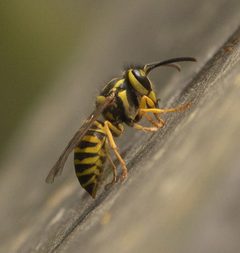
and males display black and yellow striping over the entire body with clear wings and hairless bodies. Queens are distinguished by larger size (approximately 4 mm longer than workers), reduced black markings, and more orange/brown coloration. Both V. squamosa and V. sulphurea possess two stripes on their , differentiating them from other yellowjacket . Fore wing length of workers ranges 9.5–11.0 mm; males measure approximately 12.5 mm.
Images
Habitat
Found in diverse environments including yards, parks, roadsides, and pine forests. Nests are typically subterranean but may be aerial or located in wall voids; in urban and suburban areas, colonies often occupy disturbed and artificial structures. Parasitic relationships with V. maculifrons can result in colony formation in hardwood forests.
Distribution
Eastern North America from Iowa, Kansas, and eastern Texas eastward to the Atlantic coast; historically southern but expanding northward into New England, upstate New York, and upper Michigan. Range extends south through Mexico to Guatemala.
Seasonality
colonies initiate in late May or early June when queens emerge from hibernation; major colony growth occurs July–August, with maximum comb numbers October–December. colonies persist year-round in southern coastal areas.
Diet
Predatory; feeds on live insects and animal carcasses. Prey includes arthropods such as spiders and caterpillars. provision larvae with captured prey. Does not produce honey.
Host Associations
- Vespula maculifrons - social Approximately 85% of V. squamosa colonies begin by queens usurping V. maculifrons nests; are eventually replaced by V. squamosa workers
- Vespula vidua - social Documented for nest usurpation
- Dolichovespula arenaria - social Recorded as
- Apis mellifera - Nuisance of honey bees; attacks individual bees at hive entrances and raids weak colonies for larvae, pollen, and honey
Life Cycle
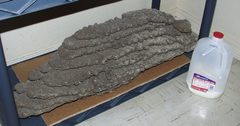
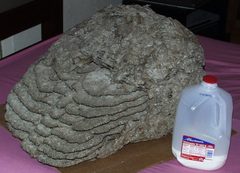
form: overwinters, initiates colony by constructing queen and laying ; larvae pupate after approximately one month; emerge late July to early August and construct smaller cells (4.0–5.0 mm) while queens build larger queen cells (7.0 mm); colony produces new queens and males that mate, then entire colony dies in winter except hibernating queen. form: in favorable conditions (high temperatures, adequate food), colonies persist multiple years, grow exponentially, and can reach 50–60 liters in volume with 60,000+ cells and 6–100+ reproductive queens; continuous reproductive production through winter.
Behavior
Exhibits facultative social : queens may independently found nests or usurp colonies through violent takeover, often killing or evicting resident queens. Multiple V. squamosa queens may compete for control of host or polygynous nests, evidenced by dead queens found in nests. use to coordinate defensive attacks; are emitted from venom glands in the stomach and , and may be applied by . Queens produce sexual attractant pheromones. Defensive aggression increases in late summer and autumn when colony are largest.
Ecological Role
Major ; colonies can consume extraordinary quantities of prey (one documented colony estimated at ~215 kg or ~5,000,000 prey items). Provides natural pest control by preying on caterpillars, grasshoppers, flies, and other insects. Serves as food source for various predators.
Human Relevance
Considered a pest due to painful, venomous stings and defensive nest protection. Stings can be life-threatening to allergic individuals; medical attention required for including shortness of breath, difficulty breathing or swallowing, hives, or disorientation. Colonies in urban areas create hazards in yards, parks, and structures. Expanding northward with climate warming, increasing encounters in previously unoccupied regions.
Similar Taxa
- Vespula maculifronsEastern yellowjacket; primary for social ; similar appearance but smaller; nests typically in rodent burrows; V. squamosa queens larger and more orange
- Vespula sulphureaShares two scutal stripes with V. squamosa, distinguishing both from other yellowjackets
- Dolichovespula maculataBaldfaced ; often confused with yellowjackets but has white facial markings and builds aerial paper nests; not a true hornet despite
- Milesia virginiensisYellowjacket hover fly; syrphid fly that mimics V. squamosa in coloration and size; harmless flower fly with single pair of wings versus two pairs in
Sources and further reading
- BugGuide
- Wikipedia
- GBIF taxonomy match
- iNaturalist taxon
- NCBI Taxonomy
- Catalogue of Life
- The Wonderful World of Wasps | Bug Squad
- Fierce Southern Stingers in the DMV: Southern Yellowjackets, Vespula squamosa — Bug of the Week
- Bug Eric: Wasp Wednesday: Southern Yellowjacket
- Yellowjackets: A Look at Opportunistic Raiders of Honey Bee Hives
- Bug Eric: The "News Bee"
- Archive — Bug of the Week
- Alarm Pheromone Behavior of Vespula squamosa (Hymenoptera: Vespidae)
- Social structure of perennialVespula squamosawasp colonies
- Vespula squamosa : A Yellow Jacket Wasp Evolving Toward Parasitism
- Dolichovespula arenaria (Fab.), a New Host for Vespula squamosa (Drury) (Hymenoptera: Vespidae)