
Vespula maculifrons
(Buysson, 1905)
Eastern yellowjacket, Eastern yellow jacket
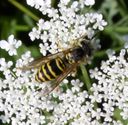
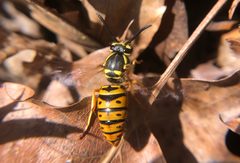
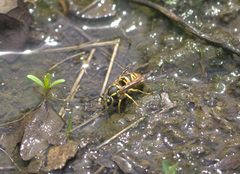
Vespula maculifrons is a social native to eastern North America, commonly known as the Eastern yellowjacket. It is among the most aggressive stinging insects in its range, known for vigorously defending nests and delivering painful stings with minimal provocation. Colonies are typically founded by a single in spring and can grow to contain thousands of by late summer. The is polyandrous, with females mating with multiple males, and exhibits cooperative colony dynamics without significant reproductive conflict among patrilines.
Pronunciation
How to pronounce Vespula maculifrons: /vɛsˈpuːla mæˌkjuːlɪˈfrɒnz/
These audio files are automatically generated. While they are not always 100% accurate, they are a good starting point.
Identification
Eastern yellowjackets can be distinguished from the sympatric German yellowjacket (Vespula germanica) by subtle morphological differences and nesting ; V. maculifrons typically nests in the ground while V. germanica more frequently uses structural voids. They display inverse foraging behavior to V. germanica at resource patches, avoiding areas with high rather than aggregating. The responds synergistically to combinations of chemical attractants, particularly blends associated with feeding (acetic acid/isobutanol) and insect prey foraging (hexenal/α-terpineol or linalool), which can be used in trap design.
Images
Habitat
Nests are constructed in underground cavities, within wall voids or man-made structures such as sheds and abandoned vehicles, or in dense shrubs and vegetation. Subterranean nests are enlarged by removing balls of soil. Nests consist of papery combs enclosed in an outer paper shell, lacking the honey and pollen stores found in nests.
Distribution
Eastern North America, with records from the mid-Atlantic region including Maryland, and extending north to Vermont. The is native to this region and is one of several Vespula species found sympatrically with the introduced Vespula germanica.
Seasonality
Queens overwinter in protected outdoor locations and initiate new colonies in spring. build through summer, with colonies reaching peak size by late summer and early autumn. New queens and males are produced in late summer and autumn; queens disperse to seek sites while the colony declines.
Diet
Larvae are fed meat and -rich foods gathered by , including caterpillars, beetles, grasshoppers, crickets, katydids, , butterflies, flies, earthworms, lanternflies, , smaller , small spiders, and cicadas. Workers also collect honeydew from scale insects and scavenge for proteins and sweets at human food sources including sandwiches, fruit, and soft drinks.
Life Cycle
colony cycle: solitary overwinters, initiates nest in spring, rears first , colony expands through summer with worker production, transition to queen and male production in late summer, colony in autumn with new queens dispersing to overwinter. Under extraordinary circumstances, some nests may persist for more than one year and reach very large sizes.
Behavior
Highly aggressive nest defense with releasing when attacking, inciting coordinated defensive stinging. Capable of multiple stings but possesses barbed stingers that can become lodged, resulting in evisceration and death during defense. Foraging workers exhibit social facilitation inversely to V. germanica, avoiding rather than aggregating at resource patches with high . Visual cues rather than olfactory cues mediate this foraging distribution. Workers become increasingly manic in foraging activity during late summer and autumn as they attempt to provision developing queens.
Ecological Role
of soft-bodied insects and other arthropods, providing natural pest control in gardens and landscapes by killing caterpillars and beetles. Serves as food source for mammals including skunks, raccoons, foxes, and bears, which excavate nests to consume .
Human Relevance
Frequently encountered as a pest due to nesting in recreational areas and buildings. are attracted to human food at picnics, barbecues, and outdoor eateries, and commonly enter soft drink cans, creating risk of accidental ingestion and stings. Stings are painful and can cause severe allergic reactions requiring immediate medical attention; therapy is available for allergic individuals. Nests in high-traffic areas may require professional or homeowner-initiated control, best conducted at night or evening when workers are less active.
Similar Taxa
- Vespula germanicaGerman yellowjacket is non-native, sympatric in range, and differs in typical nesting substrate (structural voids vs. ground), though both can use varied sites. V. germanica exhibits social facilitation at resource patches while V. maculifrons avoids high- patches.
- Vespula pensylvanicaWestern yellowjacket occupies different geographic range (western North America) and is a serious scavenger, whereas V. maculifrons is primarily a of live insects.
Misconceptions
Contrary to common belief, yellowjackets possess barbed stingers and can lose their stingers and internal organs during stinging, sacrificing their life in colony defense rather than being capable of unlimited stings.
More Details
Mating biology
Females are polyandrous, mating with multiple males. Mating success is influenced by female body size—specifically length, third length, antennal length, and total length—with longer females experiencing mating advantages. Colony of origin also significantly affects mating success, with individuals from particular colonies displaying greater mating activity. No evidence of nestmate avoidance during mating has been detected.
Colony genetic structure
Despite and potential for reproductive competition, V. maculifrons exhibits no significant conflict during production. Male contributions to and new queens do not vary within colonies, and male reproductive skew does not differ between . No patriline reversal occurs, suggesting colony-level selection maintains cooperation over individual selfish .
Chemical ecology
Synergistic attraction to combinations of volatile compounds associated with different foraging contexts ( feeding vs. prey foraging) suggests integrated chemical signaling mediates resource location.
Sources and further reading
- BugGuide
- GBIF taxonomy match
- iNaturalist taxon
- NCBI Taxonomy
- Catalogue of Life
- The Wonderful World of Wasps | Bug Squad
- Summer stingers – Eastern yellowjackets, Vespula maculifrons — Bug of the Week
- Be careful around yellowjackets: Eastern yellowjackets, Vespula maculifrons — Bug of the Week
- Feeling yellow - Yellow Jackets, Vespula maculifrons — Bug of the Week
- Surprise visit by a queen: German yellowjacket, Vespula germanica — Bug of the Week
- Beware of zesty drinks: Yellowjackets, Vespula, bumble bees, Bombus, and honey bees, Apis, can really spice up soft drinks — Bug of the Week
- Mating Success in the Polyandrous Social Wasp Vespula maculifrons
- Density, Distribution and Reproductive Success in Vespula maculifrons (Hymenoptera: Vespidae)
- Synergistic Chemical Attraction of the Eastern Yellowjacket, Vespula maculifrons (Hymenoptera: Vespidae)
- Lack of conflict during queen production in the social waspVespula maculifrons
- Contrasting foraging related behaviours in two sympatric wasps ( Vespula maculifrons and V. germanica )