
Danaus
Kluk, 1802
tiger milkweed butterflies, tigers, milkweeds, monarchs, wanderers, queens
Species Guides
3- Danaus eresimus(Soldier)
- Danaus gilippus(Queen)
- Danaus plexippus(Monarch)
Danaus is a of butterflies in the tiger tribe (Danaini), commonly known as tiger , monarchs, wanderers, and . The genus includes some of the most recognizable butterflies worldwide, notably the migratory (). in this genus are characterized by their association with milkweed plants (Asclepias spp.), from which larvae sequester cardiac glycosides for chemical defense. The genus has a global distribution spanning North America, South America, Africa, Asia, Indonesia, and Australia, and serves as an important model system for studying , plant-insect , and evolution.
Pronunciation
How to pronounce Danaus: /ˈdænaʊs/
These audio files are automatically generated. While they are not always 100% accurate, they are a good starting point.
Identification
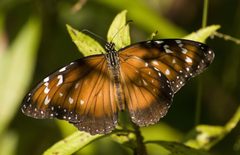
Danaus butterflies are distinguished from similar orange-and-black butterflies by their specific wing venation patterns and, in many , the presence of white spots on a dark wing border. They differ from the related Parantica (also called tigers) by subtle morphological features. Within Danaus, species identification relies on wing pattern details: D. plexippus (monarch) has thick black wing on an orange background with white spots on the black border; D. gilippus () has similar coloration but with reduced wing venation and is generally smaller; D. chrysippus (plain tiger/African monarch) shows variable patterning across its African and Asian range. The white morph of D. plexippus found only in Hawaii represents a rare color variant with white replacing orange wing .
Images
Habitat
in the Danaus inhabit diverse environments united by the presence of milkweed plants. These include open meadows, agricultural landscapes, roadsides, gardens, and tropical forests. In North America, breeding centers on milkweed patches in Midwest agricultural regions and southern U.S. migratory corridors. Hawaiian occupy introduced tropical milkweed in disturbed habitats including parking lots and landscape plantings. African and Asian species occupy savanna, grassland, and forest edge habitats where milkweeds and related Apocynaceae occur.
Distribution
The Danaus has a worldwide distribution. occurs across North America with migratory extending from Canada to Mexico, and has colonized Hawaii (arriving 1841-1852), the Azores, and occasionally reaches Europe. Danaus gilippus ranges from Brazil northward through Central America and the Caribbean to the southern United States (Florida, Texas, Arizona). Danaus chrysippus is distributed across Africa, southern Europe, and Asia through to Australia. Other occupy Southeast Asian and Indonesian archipelagos. The genus is absent only from Antarctica and most oceanic islands without human-facilitated introduction.
Diet
Danaus butterflies feed on nectar from diverse flowering plants. Larvae are obligate on milkweed plants (Apocynaceae, Asclepiadoideae), primarily Asclepias in the Americas, Calotropis and related in Africa and Asia. This exclusive larval diet enables of cardiac glycosides for defense.
Host Associations
- Asclepias - larval Primary for North American ; includes A. syriaca (common milkweed), A. viridis, A. curassavica (tropical milkweed), and others
- Calotropis - larval Important for African and Asian including C. gigantea (crown flower) used by Hawaiian monarch
- Aphis nerii - competitor/Oleander aphid; minor negative effect on and larval survival observed in Texas studies
- Salticidae - Jumping spiders; minor negative effect on survival in field studies
- Solenopsis invicta - Red imported fire ant; minor negative effect on survival in Texas studies
Life Cycle
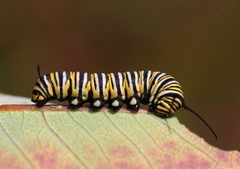
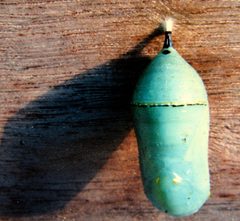
Complete with , larva (five instars), pupa (chrysalis), and stages. Eggs are laid singly on milkweed plants. Larvae feed gregariously or solitarily depending on and instar, requiring sufficient from host plants for complete development; patches with 2-4 closely spaced milkweed ramets provide adequate resources. Late-instar larvae exhibit milkweed abandonment and move in random directions between plants. typically occurs on or near the host plant. Adults emerge and may enter reproductive (in migratory ) or breed continuously in favorable climates. Some populations exhibit extended lifespan: migratory monarchs live 6-8 months, with the completing being reproductively inactive until spring.
Behavior
Several Danaus exhibit remarkable migratory . performs one of the most spectacular insect : eastern North American travel up to 4,000 km from Canada to sites in central Mexico's Oyamel fir forests; western populations migrate to coastal California. Migration involves specific departure tactics, directed using sun compass and magnetic field orientation, and refusal to stop in favorable until the migration program is complete. (D. gilippus) show similar but smaller- migratory patterns. exhibit trap-lining behavior in some tropical relatives (Heliconius), though this is not documented in Danaus. Males patrol territories and seek mates at nectar sources. Both sexes engage in mate location at milkweed patches.
Ecological Role
Danaus butterflies function as during nectar feeding. Their larval herbivory on milkweeds represents a specialized consumer with limited direct impact due to specificity. The of cardiac glycosides creates a that affects : birds and other predators learn to avoid orange-and-black patterned butterflies, potentially conferring protection on similarly colored non-toxic (). The serves as a flagship for insect conservation, with monarch declines driving extensive restoration efforts in North America. Fall-breeding populations in the southern U.S. contribute significantly to population recruitment, buffering variable productivity from northern breeding areas.
Human Relevance
is among the most culturally significant insects globally, symbolizing , , and conservation. The has experienced drastic decline (>80% in eastern migratory population since 1996), prompting candidate status for U.S. Act listing (warranted but precluded, 2020). Conservation efforts focus on milkweed restoration in agricultural landscapes and protection of sites. The is a major research model for migration neurobiology, circadian clock mechanisms, chemical of plant-insect interactions, and evolution. Danaus chrysippus and D. plexippus genomes have been sequenced, revealing insights into structural variation and dynamics. Hawaiian white morphs of D. plexippus provided a classic study system for -mediated following introduction of bulbul songbirds.
Similar Taxa
- ParanticaAlso called tigers; distinguished by subtle wing venation and genitalic differences; shares milkweed association and aposematic coloration
- HeliconiusSimilar orange-and-black warning coloration but belongs to different (Heliconiinae); distinguished by reduced forelegs and different plant associations (Passiflora); longer-lived with pollen-feeding not seen in Danaus
- VanessaPainted lady and related show similar orange-and-black patterns but lack milkweed specialization and cardiac glycoside ; more generalized plant use
More Details
Genome evolution
Comparative reveals substantial variation in architecture within Danaus. The D. chrysippus genome is over 40% larger than D. plexippus (~100 Mb additional repetitive ). Three chromosomal differentiate D. chrysippus from D. plexippus and correlate with intra-specific differentiation peaks in African , suggesting local . content varies dramatically: D. plexippus has 6.21% TE content compared to 33.97% in D. chrysippus and 11.87% in D. melanippus.
Chemical defense
Cardiac glycoside varies among and . Laboratory studies indicate that factors beyond simple cardenolide concentration influence storage and emetic potency; metabolic changes during the pupal stage can increase beyond that of the plant. Temperature affects storage indirectly through metabolic rate alteration. The enzymatic systems handling these compounds appear well-evolved and not physiologically costly.
Movement ecology
Radio-tracking studies of D. plexippus reveal 50 m perceptual range and 30 m step length in , with turn angles varying in relation to milkweed . Larvae exhibit innate abandonment and random movement between plants. Landscape- movement patterns are influenced by spatial arrangement of milkweed patches, with implications for conservation corridor design.
Sources and further reading
- BugGuide
- Wikipedia
- GBIF taxonomy match
- iNaturalist taxon
- NCBI Taxonomy
- Catalogue of Life
- Seen Any Monarchs Lately? | Bug Squad
- Marvels of Migration | Bug Squad
- A Flash of Orange: Welcome, California Tortoiseshell! | Bug Squad
- Royal wanderers settle into a far-away home: Monarch butterflies, Danaus plexippus — Bug of the Week
- Bugs in orange and black IV – Golden Helicon butterfly, Heliconius hecale; Queen Butterfly, Danaus gilipus; Woolly bear caterpillar, Isia isabella (NEED LINKS) — Bug of the Week
- A surprisingly early visit by a royal: Monarch butterflies and their caterpillars, Danaus plexippus — Bug of the Week
- Genome assembly of Danaus chrysippus and comparison with the Monarch Danaus plexippus
- Investigating monarch butterfly (Danaus plexippus) movement ecology to inform conservation strategies
- Journal of Insect Conservation Survival of eggs to third instar of late-summer and fall-breeding monarch butterflies (Danaus plexippus) and queen butterflies (Danaus gilippus) in north Texas
- Prevalence of monarch (Danaus plexippus) and queen (Danaus gilippus) butterflies in West Texas during the fall of 2018
- Migrators Within Migrators: Exploring Transposable Element Dynamics in the Monarch Butterfly, Danaus plexippus
- Some adaptations between Danaus plexippus and its food plant, with notes on Danaus chrysippus and Euploea core (Insecta: Lepidoptera)
- Monarch Butterfly, Danaus plexippus Linnaeus (Lepidoptera: Nymphalidae: Danainae)