
Vespula pensylvanica
(de Saussure, 1857)
Western yellowjacket, Western yellow jacket
Vespula pensylvanica is a social native to western North America, ranging from Mexico through western Canada. In its native range, it forms colonies with a single that typically die off in winter, with new queens to found colonies the following spring. The has become a significant pest in the Hawaiian Islands, where mild climate conditions allow colonies to become and polygynous, reaching enormous sizes—one colony on Maui was estimated at 600,000 individuals. This reproductive plasticity, combined with broad dietary habits including scavenging and on native arthropods, has caused substantial ecological disruption in Hawaii.

Pronunciation
How to pronounce Vespula pensylvanica: /ˈvɛspjuːlə ˌpɛnˌsɪlˈvænɪkə/
These audio files are automatically generated. While they are not always 100% accurate, they are a good starting point.
Identification
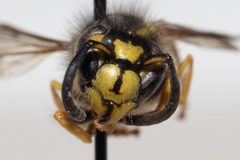
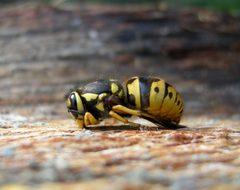
Vespula pensylvanica closely resembles V. germanica in the yellow and black color pattern shared among Vespula . The most reliable distinguishing feature is a continuous yellow ring (-loop) around each eye, though this is absent in most males and occasionally in females. When the eye-loop is absent, identification requires examination of a spotted mark on the below the , a slender in males, and a denser region of 7. Fore wing length ranges from 8.5–10.5 mm in , 12.5–14.5 mm in females, and 12.5–14.0 mm in males. Black antennae distinguish it from the European paper wasp (Polistes dominula), which has orange antennae.
Images
Habitat
In its native range, found in open forest, prairies, urban zones, gardens, parkland, meadows, and houses. Nests are typically constructed 10–15 cm below ground in abandoned rodent burrows or other dark cavities, including wall voids, attics, and hollow trees. In Hawaii, occupies diverse from lowland to subalpine zones, including native forest, agricultural areas, and developed landscapes.
Distribution
Native to western North America, occurring in all states west of the Rocky Mountains from Mexico through western Canada, including the Canadian and Transition Zones. Introduced and established in the Hawaiian Islands on Kauai, Oahu, Maui, and Hawaii Island, where it is considered .
Seasonality
In native temperate range: queens emerge from in late winter to early spring (March–June peak activity), colonies grow through summer, produce new queens and males in August–September, then decline with winter onset. In Hawaii: year-round activity with flying queens captured in every month except January; colonies occur in some years.
Diet
are opportunistic and scavengers. Prey includes small insects, caterpillars, spiders, and other arthropods; in Hawaii, documented on at least 14 taxonomic orders including barklice, planthoppers, Drosophila flies, and native Hylaeus bees. Scavenges on dead animals including roadkill and dead honey bees. Adults consume from nectar and honeydew; in late season, primarily forage for sugars. In Hawaii, known to rob colonies.
Life Cycle
Colonies are typically monogynous and in native range: single fertilized initiates nest in spring, forages until 4–7 emerge, then remains in nest laying while workers assume all other duties. Colony grows through summer; males and new queens produced August–September, mate, and males die while inseminated queens enter to overwinter. Worker lifespan averages 22 days for earliest-born, 40 days for latest-born. In Hawaii, colonies may become and polygynous through queen retention or joining by outside queens, with multiple queens and year-round production.
Behavior
exhibit expressed through mauling—one worker chewing another that remains motionless—particularly when returning foragers enter the nest. Older workers are more successful in competitive attacks. Division of labor is age-dependent but not sharply defined; workers begin foraging, construction, care, and defense within four days of . Foraging includes visual search for prey and olfactory location of carrion; workers malaxate prey by removing legs, wings, and before returning to nest. Cannot communicate food locations to nestmates, so forage individually. Queens and workers fan nest when temperature exceeds 29°C. Workers modulate thoracic temperature based on protein quality of food sources.
Ecological Role
and scavenger that contributes to control. In native range, provides beneficial pest control services. In Hawaii, populations disrupt native through on arthropods including native bees (Hylaeus ) and Drosophila flies. Acts as competitor and for potentially affecting other .
Human Relevance
Major pest in western North America and Hawaii. Defends nests aggressively, with stinging increasing as colonies grow and food becomes scarce in late season. Scavenging frequent picnics, garbage, ripe fruit, and pet food, creating nuisance and sting hazards. Stings can cause severe reactions; medical treatment includes antihistamines and epinephrine for allergic individuals. every 3–5 years in fruit orchards, creating hazards for workers and high control costs. Control methods include baited traps with synthetic attractants (acetic acid combined with isobutanol, heptyl butyrate, or butyl butyrate) and mechanical removal of nests at night.
Similar Taxa
- Vespula germanicaNearly identical yellow and black coloration and similar diamond-shaped black mark on first ; distinguished by continuous yellow -loop around eyes in most V. pensylvanica (usually absent in V. germanica), though this feature is unreliable in males and some females
- Vespula atropilosaOverlapping distribution in western North America; requires careful examination of morphological features for separation
- Polistes dominula (European paper wasp)Frequently confused by lay observers; distinguished by orange (vs. black in V. pensylvanica), open-faced nest architecture with exposed (vs. enclosed paper envelope), and lack of scavenging
Sources and further reading
- BugGuide
- Wikipedia
- GBIF taxonomy match
- iNaturalist taxon
- NCBI Taxonomy
- Catalogue of Life
- Portrait of a Yellowjacket | Bug Squad
- The Wonderful World of Wasps | Bug Squad
- Yellowjacket or Paper Wasp? | Bug Squad
- Wasps: Fascinating Insects But Often Demonized | Bug Squad
- Beware of Yellowjacket Nests | Bug Squad
- Unwelcome guests in Hawai’i: American cockroach, Periplaneta americana, German cockroach, Blattella germanica, and Western yellowjacket, Vespula pensylvanica — Bug of the Week
- Vespula pensylvanica locate odor sources across diverse natural wind conditions
- Vespula pensylvanica locate odour sources across diverse natural wind conditions
- Reproductive plasticity of Vespula pensylvanica (Hymenoptera: Vespidae) on Maui and Hawaii Islands, U.S.A.
- Weak nestmate discrimination behavior in native and invasive populations of a yellowjacket wasp (Vespula pensylvanica)
- Microbiome of the wasp Vespula pensylvanica in native and invasive populations, and associations with Moku virus
- Biology and Impacts of Pacific Island Invasive Species. 21. Vespula germanica, V. pensylvanica, and V. vulgaris Yellowjackets (Vespidae)