
Polistes dominula
(Christ, 1791)
European Paper Wasp
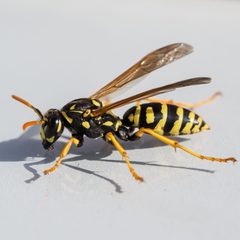
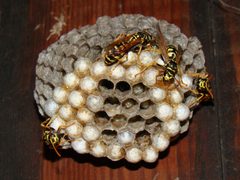
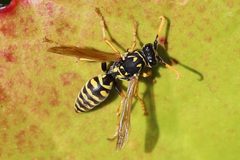
Polistes dominula is a highly successful social native to Eurasia that has established across North America, South America, New Zealand, South Africa, and other regions. First detected in North America near Boston in 1978, it has become one of the most abundant wasps on the continent. The builds small, exposed paper nests in protected locations and preys primarily on live insects, particularly caterpillars. Unlike yellowjackets, it does not scavenge for meat or sugar. Its rapid spread has been attributed to ecological flexibility, superior competitive ability, and of human-altered environments.
Pronunciation
How to pronounce Polistes dominula: /pɔˈlɪstɛs ˈdoʊmɪnjʊlə/
These audio files are automatically generated. While they are not always 100% accurate, they are a good starting point.
Identification
Easily distinguished from yellowjackets by orange (yellowjackets have black antennae). Nest is exposed, open-faced comb with visible hexagonal , unlike enclosed yellowjacket nests. Does not scavenge at picnics or garbage; only takes live prey. More compact body and shorter legs than native Polistes . In North America, facial markings vary and may indicate social dominance status within colonies.
Images
Habitat
Strongly associated with human-modified environments. In native range, nests in cavities, under eaves, in bird boxes, and among shrub branches. In introduced range, predominantly nests in suburban areas within anthropogenic structures; rarely found in native or forests. Prefers protected sites with favorable microclimate. seek sheltered hibernacles such as wooden bird boxes, empty hives, under grapevine bark, sheds, and grave lanterns.
Distribution
Native to Eurasia: central and southern Europe east to China, south to northern Africa and the Middle East. Introduced and established in North America (first record 1978 Massachusetts, now most states and southern Canada except Great Plains and Appalachia), South America (Chile, Argentina), New Zealand (first observed 2016 Nelson-Tasman region), South Africa (Western Cape), and other regions. Most abundant in urban and suburban areas.
Seasonality
Nesting season varies by latitude: approximately 4.6 months in Central Europe (Germany, latitude 49°), longer in warmer climates. In temperate regions, emerge from in late winter to early spring (February–May) to found nests. Colony peaks in late autumn with few dozen individuals. colonies die in fall; only fertilized gynes overwinter.
Diet
prey on live insects, particularly caterpillars (Lepidoptera larvae), which are the primary food for larvae. Diet is broader than most Polistes , including grasshoppers, crickets, katydids, , butterflies, beetles, flies, earthworms, lanternflies, , smaller , small spiders, and cicadas. Adults also nectar on flowers, especially grape and other umbelliferous blossoms, and consume honeydew from aphids and scale insects. Does not scavenge dead meat or processed sugars.
Host Associations
- Danaus plexippus - Major cause of monarch caterpillar mortality in New Zealand; early instars more vulnerable than late instars
- Levisticum officinale - /nectar sourceForaging recorded on lovage in Central Europe
- Foeniculum vulgare - /nectar sourceForaging recorded on fennel in Central Europe
- Xenos vesparum - Strepsipteran ; high stylopization observed in Hungary (5 of 30 parasitized by 18 specimens)
- Vitis vinifera - pest/damagerCan damage ripening grapes in vineyards
Life Cycle
eusocial cycle. Colony founded in spring by one to four (overwintered fertilized females); single founding in 54% of cases, multiple founding in 46%. Foundress builds exposed paper comb nest from chewed wood fibers. Gyne performs all initial roles; established with one primary -layer. Larvae develop in hexagonal , fed pulverized insect prey by . Larvae spin silken caps over cells to pupate. Adults emerge by chewing through caps. Colony produces males in late summer/early autumn for mating with new gynes. Colony dies with frost; only gynes overwinter in /torpor in sheltered hibernacles.
Behavior
-larvae communication via substrate-borne vibrations: females perform abdominal wagging on comb, larvae respond with increased body movement to attract feeding attention. Spatial learning during foraging: rapid reduction in learning after single visit, efficient resource relocation, preference for previously rewarded food sites. Thermoregulatory : primarily ectothermic, uses solar radiation to achieve temperatures; minimal endothermic effort (weak ~1°C endothermy on fennel, none on lovage). Nest defense includes threat display (standing on tiptoe, raising wings) but generally less aggressive than yellowjackets. Social dominance mediated by facial markings in some .
Ecological Role
Significant of lepidopteran larvae and other insects, contributing to biocontrol of agricultural and garden pests. of flowers and potential of yeasts to winemaking grapes. In invaded ranges, can suppress native through (documented declines in in New Zealand). Indirectly benefits plants by suppressing herbivory. Competes with and displaces native Polistes in some areas.
Human Relevance
Considered a pest in some contexts due to nest-building in structures and potential to sting, though less defensive than yellowjackets. Beneficial for natural pest control in gardens and agriculture. Can damage ripening grapes and cherries in orchards. Subject of extensive research on social , learning, communication, and invasion . Name 'dominula' means 'little mistress.'
Similar Taxa
- Vespula pensylvanicaWestern yellowjacket; distinguished by black , enclosed nest, scavenging , and greater aggressiveness
- Polistes fuscatusNorthern paper wasp; native to eastern North America, being displaced by P. dominula in many urban areas; more variable coloration, less compact body
- Polistes chinensisAsian paper wasp; longer established in New Zealand, lower colony survival than P. dominula
- Polistes auriferWestern paper wasp; likely with P. fuscatus based on evidence, golden coloration
Sources and further reading
- BugGuide
- GBIF taxonomy match
- iNaturalist taxon
- NCBI Taxonomy
- Catalogue of Life
- Wasp Love: Pollinators, Artists and Biocontrol Experts | Bug Squad
- Yellowjacket or Paper Wasp? | Bug Squad
- The Wonderful World of Wasps | Bug Squad
- Wasps: Fascinating Insects But Often Demonized | Bug Squad
- Bug Eric: Wasp Wednesday: European Paper Wasp
- Bug Eric: Wasp Wednesday: Northern Paper Wasp
- Polistes dominula spatial learning abilities while foraging
- Brighter-colored paper wasps (Polistes dominula) have larger poison glands
- The Impact of Climate on the Energetics of Overwintering Paper Wasp Gynes (Polistes dominula and Polistes gallicus)
- Comparison of thermal traits of Polistes dominula and Polistes gallicus, two European paper wasps with strongly differing distribution ranges
- The nesting ecology, habitat preference, abundance and impacts of Polistes dominula in New Zealand
- The nesting ecology, habitat preference, abundance and impacts of Polistes dominula in New Zealand
- Reaction of parasitoids of social paper wasp Polistes dominula (Christ, 1791) on the mite infestation of the host
- The Thermoregulatory Behavior of Nectar Foraging Polistine Wasps (Polistes dominula and Polistes gallicus) in Different Climate Conditions
- Foraging Patterns of Two Sympatric Wasp Species: The Worldwide Invasive Polistes dominula and the Native Hypodynerus labiatus
- Observation of high degree stylopization of European paper wasp – Polistes dominula (Christ, 1791) in Hungary
- Rapid Range Expansion of the Invasive WaspPolistes dominula(Hymenoptera: Vespidae: Polistinae) and First Record of Parasitoids on this Species and the NativePolistes marginalisin the Western Cape Province of South Africa
- Nesting behavior of the paper waspPolistes dominulain Central Europe—a flexible system for expanding into new areas
- Relationship between Nest and Body Temperature and Microclimate in the Paper Wasp Polistes dominula
- Adult-larvae vibrational communication in paper wasps: the role of abdominal wagging inPolistes dominula