
Mischocyttarus flavitarsis
(de Saussure, 1854)
Western Paper Wasp, Yellow-legged Paper Wasp
Mischocyttarus flavitarsis is a social paper wasp native to western North America, distinguished by its relatively docile defensive compared to other vespids. Colonies are initiated in spring by foundress queens and persist until autumn, with nests typically containing fewer than 300 . The exhibits flexible nesting habits, utilizing both natural cavities in riparian forests and anthropogenic structures such as building eaves. Unlike many social , M. flavitarsis rarely stings, instead employing ramming behavior against perceived threats. Males engage in elaborate lekking and territorial scent-marking behaviors near female hibernation sites in autumn.
Pronunciation
How to pronounce Mischocyttarus flavitarsis: /ˌmɪʃoʊˈsɪtərəs ˌflævɪˈtɑrsɪs/
These audio files are automatically generated. While they are not always 100% accurate, they are a good starting point.
Identification
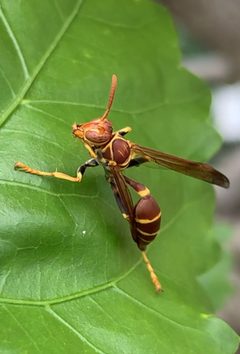
Distinguished from Polistes paper wasps by the (stalked) rather than . Within Mischocyttarus, males are identifiable by sternal brushes—absent in other of the . The M. f. navajo occurs in Arizona and Mexico. Nests are smaller than those of Polistes, typically with fewer than 300 , and often hang from a short 2–3 mm pedicle. The species may be confused with Polistes dominula or other Polistes species, but the stalked abdomen and nest size are diagnostic.
Images
Habitat
Riparian forests at elevations of 1500–2700 meters, typically within 50 meters of rivers. At lower elevations, nests occur in deciduous and hardwood evergreen trees; at higher elevations, in conifers. The also readily colonizes built environments, nesting in protected cavities including wall voids, undersides of eaves, attics, and electric light boxes. In humid climates, shows preference for cavity nesting; in drier areas, more exposed nests occur.
Distribution
Western North America from southern California to British Columbia, Canada, extending east to Nebraska and west Texas. The M. f. navajo occurs in Arizona and Mexico. Records also exist from Hawaii (introduced).
Seasonality
Colonies initiate between March and May, with beginning approximately 60 days after -laying. Colony activity continues through August, with nests abandoned September–November as females enter hibernation. Hibernation occurs October through April. Males are active through summer and autumn but rarely survive winter. Warm winter days may trigger brief emergences from hibernation.
Diet
: caterpillars (primary prey for larvae), flies, and other arthropods. consume nectar and honeydew from colonies; also feed on fresh meat, animal carcasses, and fish hides. Prey detection relies primarily on olfactory cues from plant damage and caterpillar , supplemented by visual cues from leaf damage patterns.
Life Cycle
colony cycle. Queens (foundresses) initiate nests solitarily or in pairs; if paired, one becomes and practices oophagy (-eating) of subordinate's eggs. Egg, larval, and pupal stages each require approximately 20 days. Early-emerging daughters assist with nest construction, care, and defense. Late-season (August–October) are primarily males and non- females. Only mated females hibernate; males rarely survive winter. Nest usurpation by subordinate daughters or foreign can occur, particularly during pre- or early emergence phases.
Behavior
Defensive is context-dependent: colonies in phase or later may sting as altruistic suicide, but typically the rams intruders rather than stinging. Disturbed assume a threat posture—standing high on mid and hind legs with forelegs and raised, forward, and wings buzzing audibly. Males establish near female hibernation sites in autumn, defending perch territories (approximately 10 cm diameter) via scent-marking with abdominal secretions and physical combat. Males perform 'lassoing' behavior during mating, extending curled antennae and drawing female antennae upward. Foraging trips last approximately 5 minutes for pulp and 15 minutes for arthropods/nectar.
Ecological Role
of caterpillars and other soft-bodied insects, contributing to natural pest suppression. Prey to birds (flickers, acorn woodpeckers, Mexican jays, flycatchers), ants, and praying mantises. Nests parasitized by Chalcoela iphitalis, which consumes larvae and pupae. serve as or nectar thieves at flowers and as consumers of honeydew.
Human Relevance
Frequently nests in close proximity to human structures, yet rarely stings—making it less hazardous than many social . Defensive ramming may still cause alarm. Colonies sometimes abandoned due to rather than defended. Can be observed at close range without eliciting attack response. Potential agent for caterpillar pests.
Similar Taxa
- Polistes dominula (European Paper Wasp)Similar nest architecture and habit of nesting under eaves; distinguished by (non-stalked) and larger nest size
- Polistes auriferOverlapping range in western North America; distinguished by and coloration patterns
- Mischocyttarus mexicanusCongeneric with overlapping southern distribution; distinguished by subtle morphological differences and nest site preferences
- Climaciella brunnea (Wasp Mantisfly)Mimic of paper wasps including M. flavitarsis; distinguished by short, quivering , forelegs, and different wing posture (folded roof-like rather than longitudinally)
Misconceptions
Commonly mistaken for more aggressive Polistes ; its docile nature and preference for ramming over stinging is underappreciated. The species' willingness to nest near humans is often interpreted as aggression rather than .
More Details
Unique hibernation strategy
Only in Mischocyttarus to undergo true hibernation, an to the cool, dry climate of its western North American range. Hibernating females may aggregate with conspecifics and even with Polistes species.
Nest architecture plasticity
Nest form varies with climate: exposed pedicellate combs in arid regions, cavity-nesting in humid climates. Rare asymmetric or wall-attached nests observed.
Chemical communication
Males possess enlarged sternal glands (segments 6–8) and unique sternal brushes for distributing territorial ; females also use abdominal rubbing to deposit -repellent secretions on nests.
Sources and further reading
- BugGuide
- Wikipedia
- GBIF taxonomy match
- iNaturalist taxon
- NCBI Taxonomy
- Catalogue of Life
- Bug Eric: Wasp Wednesday: Western Paper Wasp
- Bug Eric: Makin' Paper
- Bug Eric: Wasp Wednesday: Winter Wasps
- Bug Eric: Wasp Mantisfly
- Brazil Bugs #2 | Beetles In The Bush
- Bug Eric: Wasp Wednesday: Polistes flavus
- Mischocyttarus flavitarsis in Arizona: Social and Nesting Biology of a Polistine Wasp
- Influence of caterpillar-feeding damage on the foraging behavior of the paper waspMischocyttarus flavitarsis (Hymenoptera: Vespidae)