
Mischocyttarus mexicanus
(de Saussure, 1854)
Mexican Paper Wasp
Species Guides
2- Mischocyttarus mexicanus cubicola
- Mischocyttarus mexicanus mexicanus(Mexican Paper Wasp)
Mischocyttarus mexicanus is a New World paper wasp exhibiting facultative eusocial , where females can nest either solitarily or in groups and may switch between these strategies throughout life. The includes at least two : M. m. mexicanus ranging from Mexico to Rica, and M. m. cubicola distributed across the southeastern United States and Caribbean. Nests are constructed from paper fibers and attached to vegetation, particularly palm fronds. The species serves as an important model for studying the evolutionary advantages of flexible social organization in insects.
Pronunciation
How to pronounce Mischocyttarus mexicanus: /ˌmɪs.kəˈsɪtə.rəs ˌmɛk.sɪˈkɑː.nəs/
These audio files are automatically generated. While they are not always 100% accurate, they are a good starting point.
Identification
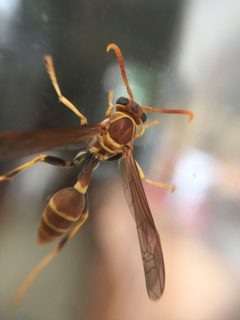
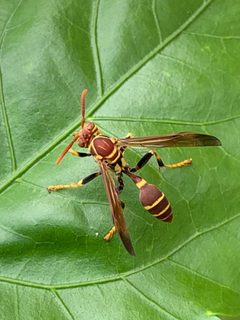
Distinguished from Polistes paper wasps by the (stalked) versus the abdomen of Polistes. The sharp secondary pronotal margin separates it from other Mischocyttarus lacking this feature. Males are identifiable by their short, thick . The species group including M. mexicanus, M. flavitarsis, and M. angulatus shares the sharp pronotal margin, requiring examination of clypeal shape and geographic distribution for definitive identification.
Images
Appearance
typically display orange-yellow coloration. The belongs to a group within Mischocyttarus characterized by a sharp secondary margin on the pronotum ( surface of the prothorax). Males possess very short, thick . Females have a ( plate) with a flattened apex. As with all Mischocyttarus, adults exhibit asymmetrical internal and external lobes of the tarsal segments. Mature larvae have appendix-like projections extending forward from the abdominal sternum. The is (stalked), distinguishing the from the -abdomen Polistes.
Habitat
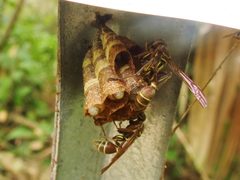
Nests are constructed on various substrates including saw palmetto (Serenoa repens), cabbage palm (Sabal palmetto), oak trees, Spanish moss, and human constructions. Nests show preferential placement on the eastern-facing side of palm fronds, likely due to increased early-day luminance and temperature. The cabbage palm may provide greater protection against avian than other substrates.
Distribution
The ranges from the southern United States through Central America to Rica. M. m. mexicanus occurs predominantly from Mexico to Costa Rica, with records from Texas. Subspecies M. m. cubicola is found in the southeastern United States (including nearly all Florida counties except the northwesternmost), the Bahamas, Cuba, Puerto Rico, Texas, and Missouri. A proposed distribution barrier in northwestern Florida may limit westward spread of M. m. cubicola, though the subspecies has been documented in Texas and Missouri.
Seasonality
Nests can be initiated at any point during the year, though an 'early' period (winter-spring) and 'late' period (fall) are recognized. Haplometrosis (single-foundress nesting) is more frequent in winter and spring; pleometrosis (multiple-foundress nesting) is more frequent in fall. Nest duration is estimated at approximately 8 months, though many nests fail earlier. Daughters emerge approximately 2 months after nest initiation.
Diet
forage for both prey and nectar. Arthropod prey is believed to include larvae, which are captured and brought to the nest to feed developing . Nectar is obtained from flowers including palmetto and Lyonia. Males frequently visit flowers, where they may pursue females for mating.
Life Cycle
Nests are founded by 1-20 females, with founders typically born together and remaining near their natal nest site. The colony cycle includes a pre-daughter (pre-) phase lasting approximately 2 months, followed by a post-daughter (post-eclosion) phase when daughters emerge and remain as active foragers. Future queens and males are produced toward the end of the colony cycle, gradually dispersing from the nest. Mating likely occurs away from the nest. Females may then found new nests, either solitarily or in groups.
Behavior
Two stable nesting strategies exist: haplometrosis (single foundress) and pleometrosis (multiple cofoundresses), with females capable of switching between strategies as . among foundresses are established through biting frequency, ovarian development status, and foraging frequency. The individual with the second-highest dominance (β-individual) typically replaces a removed within approximately one week. Non-nestmates are accepted when young and when nests are new; older and older nests reject foreigners. and nest usurpation occur between unrelated conspecifics. Intercolonial has been observed, with foreign females intruding at rates of approximately once every 5 hours. Nest repair and renesting occurs following damage.
Ecological Role
of arthropods, particularly larvae, which are captured to provision nests. Prey for various birds including Carolina wrens, scrub jays, blue jays, common yellowthroats, cardinals, thrashers, mockingbirds, woodpeckers, and robins. Ants including Camponotus floridanus, Crematogaster ashmeadi, and Pheidole floridana raid nests, primarily those already abandoned or weakened. Competes with sympatric Polistes exclamans and P. metricus for nesting sites. Nectar foraging contributes to pollination.
Human Relevance
Nests on human constructions may bring into proximity with people, though the is generally not aggressive and can be observed at close range without eliciting attack. Serves as a significant research organism for studying the evolution and maintenance of flexible social in insects. The papaya fruit fly (Toxotrypana curvicauda) mimics the coloration and defensive behaviors of M. mexicanus in areas of sympatry.
Similar Taxa
- Polistes exclamansSympatric paper wasp nesting in similar ; distinguished by (non-stalked) and different social structure with more rigid .
- Polistes metricusSympatric competitor for nesting sites; distinguished by and different body proportions.
- Mischocyttarus flavitarsisCongeneric with similar pronotal margin; distinguished by geographic distribution (western North America) and male antennal structure.
- Mischocyttarus angulatusCongeneric in the same species group; distinguished by subtle differences in clypeal shape and geographic range.
Sources and further reading
- BugGuide
- Wikipedia
- GBIF taxonomy match
- iNaturalist taxon
- NCBI Taxonomy
- Catalogue of Life
- Field Guide Selected References
- Grasshoppers of Colorado
- Grasshoppers of Colorado
- Bembicid Holdings | Entomology Research Museum
- Bug Eric: Wasp Wednesday: Western Paper Wasp
- Brazil Bugs #2 | Beetles In The Bush
- Mischocyttarus mexicanus cubicola (Hymenoptera), Distribution and Nesting Plants
- Behavioral ecology of the social wasp, Mischocyttarus mexicanus
- Distribution of Mischocyttarus (Monocyttarus) Mexicanus cubicola in the United States
- Nesting Biology and Defensive Behavior of Mischocyttarus(Monocyttarus) Mexicanus Cubicola (Vespidae: Polistinae)
- Highly Contiguous Genome Assemblies of the Guinea Paper Wasp (Polistes exclamans) and Mischocyttarus mexicanus.