
Mischocyttarus mexicanus cubicola
Richards, 1978
Mischocyttarus mexicanus cubicola is a neotropical paper wasp notable for its flexible social nesting strategies. Females can found nests either solitarily (haplometrosis) or cooperatively with multiple cofoundresses (pleometrosis), with strategy choice dependent on environmental context. This behavioral plasticity has made it a significant model organism for studying social evolution in . The subspecies exhibits , with queens consuming their own larvae when assistance is unavailable.
Pronunciation
How to pronounce Mischocyttarus mexicanus cubicola: //ˌmɪskəˈsɪtərəs mɛkˈsɪkeɪnəs kjuːˈbaɪkələ//
These audio files are automatically generated. While they are not always 100% accurate, they are a good starting point.
Identification
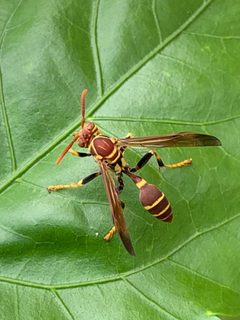
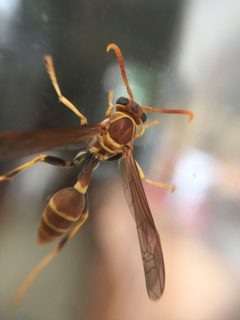
Distinguished from M. flavitarsis and M. angulatus by yellow tibial striping pattern and reddish metasoma with yellow bands. Males identifiable by short, thick ; females by flattened clypeal apex. Tarsal segment asymmetry confirms placement. identity requires examination of leg coloration and metasomal pattern.
Images
Habitat
Occupies neotropical and temperate zones. Nests constructed on vegetation, attached to leaves by paper stem. Founds nests in varied contexts including natural vegetation and human-modified environments. In temperate portions of range, seeks protected hibernation sites including under rocks, logs, loose bark, and building attics.
Distribution
Native to Neotropical region with extension into temperate North America. United States: Florida, Alabama, Georgia, South Carolina, Texas (documented in Bellaire, Houston). Caribbean: Cuba, Bahamas, Puerto Rico. Mexico: Veracruz state. Southernmost nest year-round; temperate populations undergo winter dormancy.
Seasonality
Year-round activity in southern range; winter dormancy in temperate regions. Nest initiation possible throughout year with early and late nesting periods recognized. Nests persist approximately eight months. Females seek hibernation sites in autumn; may emerge on warm winter days.
Diet
forage for nectar, particularly from palmetto and Lyonia flowers. Prey on larvae; queens practice of own larvae when unaided by . Hypothesized to prey on arthropod larvae of other . Adults consume honeydew from colonies.
Life Cycle
Colony founding by 1–20 females. Nest architecture: open paper comb attached to substrate by stem. Two developmental phases: pre-daughter (pre-) and post-daughter (post-eclosion). Multiple queens may coexist; most females reproductively viable. Nest lifetime approximately eight months, though many fail earlier. Haplometrotic nests experience ~80% failure within 20 days.
Behavior
Exhibits context-dependent nesting tactic plasticity: haplometrosis (single foundress) versus pleometrosis (multiple cofoundresses). Strategy switching possible in . Haplometrosis predominates in winter and spring; pleometrosis in fall. Communication via biting between nestmates. Foragers least aggressive colony members; females with least developed ovaries perform most foraging. Older females accumulate cuticular odors associated with nestmate recognition and foreign nest rejection. Males scent-mark territories and form near hibernation sites. Queens practice when -deprived.
Ecological Role
of caterpillars and other larvae; contributes to herbivore . through nectar foraging. Prey for birds (wrens, blue jays, yellowthroats, cardinals, mockingbirds, woodpeckers), spiders (Argiope aurantia, Nephila clavipes), and ants (Camponotus floridanus, Crematogaster ashmeadi, Pheidole floridana). Potential of nests.
Human Relevance
Occasional building inhabitant (attic hibernation). Subject of extensive behavioral research due to social flexibility. No documented agricultural pest status; on caterpillars may provide incidental .
Similar Taxa
- Mischocyttarus flavitarsisOverlapping range and similar pronotal ; distinguished by color pattern and tibial markings
- Mischocyttarus angulatusShared sharp pronotal secondary margin; M. m. cubicola differs in metasomal coloration and leg striping
- Polistes spp.Similar nest architecture; distinguished by (stalked) versus abdomen in Polistes
More Details
Nesting Tactic Plasticity
The capacity to switch between haplometrosis and pleometrosis represents a rare example of behavioral plasticity in social insects, with strategy context-dependent rather than genetically fixed.
Larval Morphology
Larvae possess one- to three-pointed abdominal lobes on first segment surface, hypothesized to function in saliva solicitation responses to .
Sources and further reading
- BugGuide
- Wikipedia
- GBIF taxonomy match
- iNaturalist taxon
- NCBI Taxonomy
- Catalogue of Life
- Field Guide Selected References
- Grasshoppers of Colorado
- Grasshoppers of Colorado
- Bembicid Holdings | Entomology Research Museum
- Bug Eric: Wasp Wednesday: Western Paper Wasp
- Brazil Bugs #2 | Beetles In The Bush
- Mischocyttarus mexicanus cubicola (Hymenoptera), Distribution and Nesting Plants
- Distribution of Mischocyttarus (Monocyttarus) Mexicanus cubicola in the United States
- Nesting Biology and Defensive Behavior of Mischocyttarus(Monocyttarus) Mexicanus Cubicola (Vespidae: Polistinae)