
Milesia virginiensis
(Drury, 1773)
yellowjacket hover fly, Virginia flower fly, Virginia Giant Hover Fly, News Bee
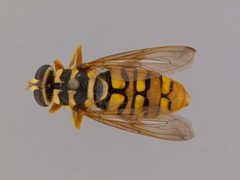
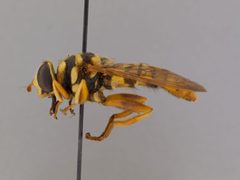
A large, striking syrphid fly native to eastern North America. are notable mimics of yellowjackets and , complete with yellow, brown, and black coloration and a loud droning buzz. The is active primarily in mid-summer to early fall, frequenting forest edges and meadows. Larvae develop in decaying wood. The species carries extensive American folklore, commonly known as the "News " for its habit of hovering near people.

Pronunciation
How to pronounce Milesia virginiensis: /maɪˈliːzɪə vɝˌdʒɪˈniːˈɛnsɪs/
These audio files are automatically generated. While they are not always 100% accurate, they are a good starting point.
Identification
Most easily recognized by its large size combined with yellowjacket-like coloration—unusually large for a North American syrphid. The loud, droning buzz is distinctive and aids detection. Distinguished from actual yellowjackets and by: single pair of wings (flies have Dipteran wing reduction), lack of a constricted waist, and absence of a stinger. Hovering with erratic shifting movements is characteristic. Two occur in North America: M. bella (southwestern U.S.) and M. scutellata (southeastern U.S., Oklahoma to North Carolina), but these do not overlap geographically with M. virginiensis in most of its range.
Images
Appearance
Large syrphid fly measuring 18–21 mm (some sources report up to 28.5 mm). Body robust with bright yellow, brown, and black patterning that closely mimics stinging yellowjackets (Vespula spp.) or European (Vespa crabro). Wings clear. The overall effect is a convincing mimic complete with visual and auditory components. Larvae resemble caterpillars with a narrow neck and a set of .
Habitat
Forest edges and meadows. frequently found in sunny spots in hardwood forest understory. Larval is wet, rotting heartwood of stumps and logs.
Distribution
Eastern North America: United States (widespread in eastern and central regions, from Kansas to Minnesota, south to Texas and Florida), Ontario (Canada), and Mexico.
Seasonality
active mid-summer to early fall in northern portions of range; late May to November in southern latitudes.
Diet
feed on nectar and pollen. Larvae are , feeding on decaying plant matter in rotting wood.
Life Cycle
Complete . Larvae develop in wet, rotting heartwood of stumps and logs. Males may recognize and guard logs as potential oviposition resources.
Behavior
hover conspicuously in sunny areas, making erratic shifting movements before suddenly flying away. Frequently hover near people, which has contributed to "News " folklore. Cannot sting; completely harmless despite intimidating appearance. Males may exhibit territorial around potential larval resources.
Ecological Role
contribute to pollination through nectar feeding. Larvae contribute to decomposition of dead wood. of stinging likely reduces pressure.
Human Relevance
Subject of extensive American folklore as the "News "—hovering near a person was interpreted as "giving them the news." Considered good luck if one alights on a finger. Frequently mistaken for dangerous stinging insects, leading to unnecessary fear. Serves as an accessible example of mimicry for education.
Similar Taxa
- Vespula squamosa (Southern Yellowjacket)Visual model for mimicry; are smaller, queens similar in size but M. virginiensis has only one pair of wings and lacks constricted waist.
- Vespa crabro (European Hornet)Another visual model; distinguished by wing number, body shape, and .
- Milesia bella in southwestern U.S.; geographic separation with limited overlap.
- Milesia scutellata in southeastern U.S. (Oklahoma to North Carolina); geographic separation.
Misconceptions
Despite appearance and containing "," this is a fly (Diptera) not a bee (Hymenoptera). Cannot sting. The "News Bee" folklore has led to confusion with actual bees and ; some accounts incorrectly attribute stinging capability or nest-building to this .