
Vespa crabro
Linnaeus, 1758
European hornet
The European (Vespa crabro) is the largest true hornet native to Europe and the only established Vespa in North America. Introduced to the eastern United States in the mid-1800s, it has spread west to the Rocky Mountains. This eusocial constructs paper nests in enclosed cavities such as hollow trees, wall voids, and abandoned beehives. Unlike many social wasps, it exhibits foraging and is attracted to light. While capable of delivering painful stings when nests are disturbed, it is generally less aggressive toward humans than yellowjackets and is not considered a major threat to colonies.
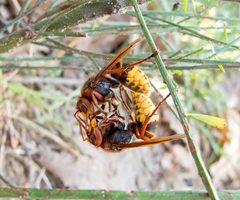
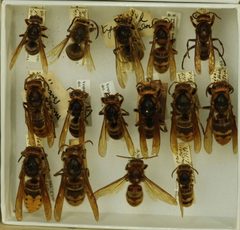
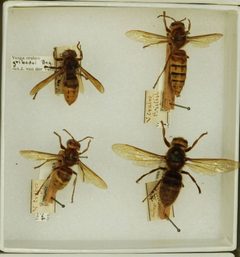
Pronunciation
How to pronounce Vespa crabro: //ˈvɛs.pa ˈkra.broʊ//
These audio files are automatically generated. While they are not always 100% accurate, they are a good starting point.
Identification
Largest vespine in its North American range, with reaching 25–35 mm and queens up to 35 mm. Distinguished from yellowjackets (Vespula, Dolichovespula) by larger size, reddish-brown with yellow markings, and brown and yellow banded rather than black and yellow. Differs from the Asian giant hornet (Vespa mandarinia) by smaller size, less massive , and different abdominal color pattern. The only true ( Vespa) established in North America; all other large wasps in this region belong to different genera.
Images
Habitat
Constructs nests in enclosed cavities including hollow trees, wall voids, building cavities, abandoned beehives, and occasionally outhouses. Occupies rural and urban environments across forested, agricultural, and residential areas. activity patterns lead to frequent presence around artificial lights.
Distribution
Native to Europe and temperate Asia. Introduced to eastern North America between 1840–1860; now established from the Atlantic coast west to the Rocky Mountains. Also introduced to Sardinia, Italy (2010), where currently limited to the northern island area.
Seasonality
Colonies founded by overwintered queens in spring. peak during late summer and early autumn. Colony decline begins in late fall; new queens and males produced in late summer. Queens overwinter in protected locations such as beneath bark or in rotten logs.
Diet
of arthropods including caterpillars, flies, grasshoppers, , cicadas, and other insects. Captures prey to feed developing larvae. consume from ripe fruits (figs, pears, grapes, watermelon), floral nectar, sugary exudates, and tree sap obtained by stripping bark from lilac, birch, rhododendron, and other woody plants.
Life Cycle
eusocial colony cycle: solitary establishes nest in spring after ; first of sterile female emerges and assumes foraging, nest expansion, and defense duties; queen remains in nest producing subsequent broods; colony switches to producing reproductive females (future queens) and males in late summer; males die after mating; new queens disperse and seek overwintering shelter; original colony abandoned by late autumn.
Behavior
foraging distinguishes this from most other social . Attracted to artificial light, often colliding with windows and buzzing around porch lights. strip bark from trees and shrubs to access nutritious sap and plant tissues beneath, which may damage small plants. Ventilatory observed at nest entrances: workers beat wings in synchrony with outward for . Defensive aggression triggered primarily by nest disturbance; individual foragers generally non-aggressive.
Ecological Role
of arthropods, potentially contributing to control of various insect . Mild predator of honey bees (Apis mellifera); attacks primarily tired returning foragers in near hive entrances rather than conducting mass raids. Not considered a significant threat to operations. May provide some pollination services through nectar feeding.
Human Relevance
Stings occur primarily when nests are disturbed; venom painful but not medically significant for non-allergic individuals. Considered a nuisance in residential areas due to light attraction and bark-stripping damage to ornamental trees and shrubs. Occasionally nests in building voids, requiring professional removal. Subject to misidentification as "murder hornets" (Vespa mandarinia), causing unnecessary public alarm.
Similar Taxa
- Vespa mandarinia (Asian giant hornet)Larger size ( to 45 mm, queens to 50+ mm), more massive , distinct orange and black abdominal banding rather than brown and yellow; mass raids on colonies unlike V. crabro's individual .
- Vespula species (yellowjackets)Smaller size ( typically 10–16 mm), black and yellow abdominal pattern, aerial or subterranean nests rather than enclosed cavities, activity, more aggressive general defensive .
- Dolichovespula species (aerial yellowjackets)Smaller size, exposed aerial nests rather than enclosed cavities, distinct black and white or black and yellow coloration.
Misconceptions
Frequently misidentified as the Asian giant hornet ("murder ") in North America due to large size and hornet , causing unnecessary public concern. Not a major threat to colonies despite predatory ; attacks individual bees rather than conducting destructive mass raids. Bark-stripping behavior often attributed to other causes before correct identification.
Sources and further reading
- BugGuide
- GBIF taxonomy match
- iNaturalist taxon
- NCBI Taxonomy
- Catalogue of Life
- Incredible Work, and Timely, on 22 Species of Hornets | Bug Squad
- What You Need to Know About That Invasive Giant Hornet | Bug Squad
- About That Yellow-Legged Hornet Detected in Georgia | Bug Squad
- About Those Asian Giant Hornets... | Bug Squad
- A rather continental hornet - European hornet, Vespa crabro — Bug of the Week
- Big, Beautiful, and Confusing: Deciphering the True Hornets
- Effects of Colors and Appearance of the Potential Aggressor on Defensive Behavior of Vespa crabro L. (Hymenoptera: Vespidae) Colonies.
- Evaluation of Bait Attractiveness for Vespa orientalis and Vespa crabro (Hymenoptera: Vespidae) in Urban and Apiary Environment of Campania Region (Italy)
- Bio-Ethology of Vespa crabro in Sardinia (Italy), an Area of New Introduction
- Technique for rearing the European hornet (Vespa crabro) through an entire colony life cycle in captivity