
Vespa
Linnaeus, 1758
Hornets
Species Guides
2- Vespa crabro(European hornet)
- Vespa mandarinia(Asian giant hornet)
Vespa is a of large social known as hornets, comprising 22 recognized worldwide. Members are distinguished from other vespine wasps by their relatively large top margin of the and rounded abdominal segment behind the waist. Some species reach up to 5.5 cm in length, making them among the largest eusocial wasps. Several species are significant agricultural pests due to their on honey bees, including the Asian giant (V. mandarinia) and yellow-legged hornet (V. velutina), both of which have been detected as in North America.
Pronunciation
How to pronounce Vespa: /ˈvɛs.pa/
These audio files are automatically generated. While they are not always 100% accurate, they are a good starting point.
Identification
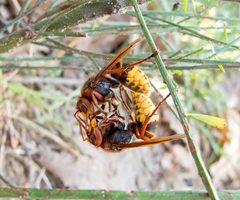
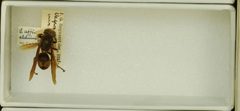
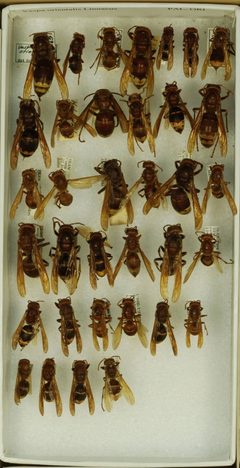
Distinguished from yellowjackets and paper wasps by larger body size, prominent margin, and rounded abdominal segment behind the waist. V. mandarinia (Asian giant ) is uniquely large with yellow head and banded yellow . V. crabro (European hornet) has chestnut/amber head with dark-banded abdomen showing dots. V. velutina (yellow-legged hornet) has distinctive yellow and brown velvety . Accurate identification requires examination of color pattern, body proportions, and geographic origin; molecular confirmation may be necessary for intercepted specimens.
Images
Habitat
Nesting habits vary by : aerial nests in tree branches or shrubs (V. crabro, V. velutina); ground nests in mammal burrows or decayed root cavities (V. mandarinia); crevices, wall voids, or under overhangs. Colonies in temperate zones are typically ; tropical species may maintain colonies. Found in forests, woodlands, rural and suburban areas, occasionally urban environments.
Distribution
Native to Europe, Asia, and parts of Africa. V. crabro introduced to eastern North America (1800s), now established in southeastern United States. V. mandarinia detected in Pacific Northwest (British Columbia, Washington) 2019–2020, colony eradicated; status uncertain. V. velutina detected in Georgia, USA, 2023. Other occasionally intercepted at ports of entry worldwide.
Seasonality
Colonies initiated by solitary queens in spring (temperate zones). peaks late summer. Reproductive phase occurs late summer to fall, when new queens and males are produced. Foraging activity highest in late summer and early autumn when protein demand increases for larval feeding.
Diet
Primarily predatory on other insects. capture and macerate prey (including beetles, other , caterpillars) to feed larvae. Some specialize on honey bees (Apis mellifera), attacking colonies in coordinated raids. Adults also consume tree sap and ripe fruit.
Host Associations
- Apis mellifera - V. mandarinia and V. velutina are significant threats to colonies; hunting, slaughter, and occupation phases described for V. mandarinia attacks
- Mammalia (burrows) - V. mandarinia nests initiated in pre-existing mammal burrows or decayed root cavities
Life Cycle
Eusocial colony cycle: solitary establishes nest in spring, lays , rears first . Workers assume foraging and nest maintenance; queen becomes egg-laying . Colony grows through summer, produces sexual brood (new queens, males) in late summer. Males disperse; new queens mate, overwinter solitarily, and initiate new colonies following spring. Temperate colonies ; tropical colonies may be with successive queen replacement.
Behavior
Colonial defense: aggressively guard nest when disturbed. Foraging: individual hunters capture prey; some conduct mass attacks on colonies. V. mandarinia exhibits coordinated slaughter phase: multiple hornets decapitate defending bees, occupy hive, harvest . range extensive: queens may fly 20+ km/day. Not highly aggressive during spring foraging; aggression increases in late summer/fall.
Ecological Role
Apex insect regulating of other insects. Potential to disrupt pollination services and apiculture where . Native range: integral component of forest and agricultural .
Human Relevance
Agricultural threat: (V. mandarinia, V. velutina) endanger industry and pollination-dependent crops. Public health: stings painful, multiple stings can cause toxic reactions; rare fatalities from anaphylaxis or venom . significance: all Vespa except established V. crabro are USDA-APHIS quarantine concerns. Cultural: larvae and pupae consumed as food in parts of Asia.
Similar Taxa
- Vespula (yellowjackets)Smaller size; more extensive yellow-black banding; aerial or subterranean nests; lack prominent margin and rounded abdominal segment of Vespa
- Dolichovespula (aerial yellowjackets)Smaller, more slender; aerial paper nests; different facial markings; lack robust build and of Vespa
- ProvespaRelated of hornets; three in Southeast Asia; /nocturnal activity distinguishes from Vespa
Misconceptions
Media designation 'murder ' for V. mandarinia is sensationalized; the is not more likely to kill humans than honey bees, though venom volume per sting is higher. Misidentifications common: European hornet, cicada killer , yellowjackets, and even beetles reported as Asian giant hornets by concerned public.
More Details
Invasive Species Management
Washington State Department of Agriculture and USDA-APHIS conduct trapping and surveillance for V. mandarinia. Early spring trapping and late summer nest location/destruction are primary management strategies. Citizen science reporting programs established in Pacific Northwest and Georgia.
Taxonomic Resources
Comprehensive identification key to 22 Vespa published in Insect and Diversity (Smith-Pardo et al. 2020). Online identification tools and image database under development by USDA-APHIS, PPQ, and University of Georgia.
Quarantine Interceptions
From 2010–2018, approximately 50 interceptions of Vespa and Vespula at U.S. ports; Vespa included V. bellicosa, V. crabro, V. orientalis, V. mandarinia, and V. tropica. One interception contained entire live nest of V. mandarinia with and pupae shipped via express courier.
Sources and further reading
- BugGuide
- Wikipedia
- GBIF taxonomy match
- iNaturalist taxon
- NCBI Taxonomy
- Catalogue of Life
- Incredible Work, and Timely, on 22 Species of Hornets | Bug Squad
- About Those Asian Giant Hornets... | Bug Squad
- Lynn Kimsey Sheds Light on Asian Giant Hornets | Bug Squad
- What You Need to Know About That Invasive Giant Hornet | Bug Squad
- About That Yellow-Legged Hornet Detected in Georgia | Bug Squad
- Murder hornets, Take 2: Asian giant hornet, Vespa mandarinia — Bug of the Week