
Vespa mandarinia
Smith, 1852
Asian giant hornet, Japanese giant hornet, yak-killer hornet
Vespa mandarinia is the world's largest , native to temperate and tropical low mountains and forests of eastern Asia. It has been introduced to the Pacific Northwest of North America, where it was first detected in British Columbia and Washington State in 2019. The species poses significant threats to European honey bee colonies through coordinated group attacks, and its establishment could impact apiculture, , and public health.
Pronunciation
How to pronounce Vespa mandarinia: /ˈvɛspa ˌmændəˈrɪniə/
These audio files are automatically generated. While they are not always 100% accurate, they are a good starting point.
Identification
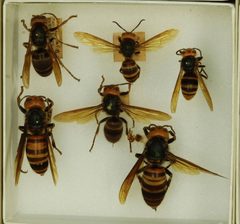
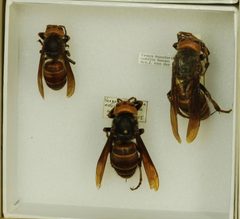
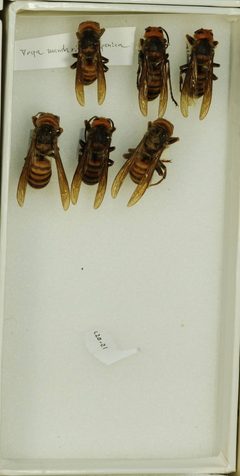
Distinguished from all North American by its exceptional size (3.5+ cm), large orange-yellow contrasting with dark , and broad orange and dark brown abdominal bands. No native Vespa occur in North America. The European (V. crabro) is smaller with reddish rather than orange coloration. Many misidentifications involve cicada killers, yellowjackets, and European paper wasps, which are substantially smaller.
Images
Appearance
measure approximately 3.5–5.0 cm in length, with queens reaching up to 5 cm. The is large and orange-yellow with prominent . The is dark brown or black with a velvety texture. The alternates between dark brown/black and orange/yellow bands. The wings are large, dark brown, and folded longitudinally at rest. The stinger is longer than that of honey bees and can deliver venom repeatedly.
Habitat
Temperate and tropical low mountains and forests; nests in ground cavities including mammal burrows, decayed root cavities, spaces under overhangs, and wall voids. Well-adapted to Pacific Northwest conditions with dense forest .
Distribution
Native to eastern Asia: India, Sri Lanka, Bhutan, Nepal, Myanmar, Thailand, Laos, Vietnam, Malaysia, China, Hong Kong, Taiwan, eastern Russia, Korea, and Japan including Ryukyus. Introduced to North America with detections in British Columbia, Canada and Washington State, USA.
Seasonality
Queens emerge from in early spring (April–May). most visible in August and September as colony size peaks. Late summer and fall is the period of highest aggression when colonies attack hives and produce new queens and drones.
Diet
Feeds primarily on larger insects, especially other hymenopterans. In spring, forages individually for large insects, tree sap, and honeydew. In late summer and fall, shifts to coordinated group attacks on colonies, entering a 'slaughter phase' where kill bees by decapitation and occupy hives to feed to their own larvae.
Life Cycle
eusocial colonies founded by single overwintered . Complete : , larva, pupa, . Queen initiates nest and rears first alone. Colony expands through summer, potentially reaching 700+ workers. Larvae produce rhythmic rasping sounds by rubbing against walls, calling continuously regardless of light or time including calling. Reproductive phase in late summer produces virgin queens and drones; new queens mate and overwinter while original colony dies.
Behavior
Social with colonies. Moderate defensiveness when foraging in spring; highly aggressive defense of nest if disturbed. Late summer colonies become very aggressive during hive attacks. Queens are strong fliers capable of 20 miles per day. use to coordinate mass attacks on colonies.
Ecological Role
Top in native range, regulating of other large insects. threat to honey bees and native in Pacific Northwest. Can decimate colonies in hours, with potential cascading effects on pollination services.
Human Relevance
Severe threat to industry and agricultural pollination. Venom is highly toxic (4.1 μl per ) with potential for tissue and fatal reactions from multiple stings. Stinger longer than and can sting repeatedly. Larvae and pupae consumed as food and used in traditional medicine in Asia. Subject of intensive monitoring, trapping, and efforts in Washington State.
Similar Taxa
- Vespa crabroEuropean is smaller (2.5–3.5 cm), has reddish-brown rather than orange-yellow , and less contrasting abdominal banding; established in eastern US but not major threat
- Sphecius speciosusCicada killer has rusty-colored wings, more slender build, distinct pale yellow markings, and is solitary rather than social
- Vespula speciesYellowjackets are markedly smaller (1.2–1.6 cm), have brighter yellow and black patterning, lack large orange , and are scavengers rather than specialized of live colonies
Misconceptions
The media term 'murder ' is rejected by entomologists; the is no more likely to sting humans than honey bees and venom is considered worse by experts. The hornet does not pose immediate existential threat to all North American bees; detections remain limited to small area of Pacific Northwest with ongoing efforts. The commonly cited 'two-inch' size represents maximum size, not typical specimens which measure approximately 1.5 inches.
More Details
Invasion Detection History
First North American colony detected and destroyed September 18, 2019 on Vancouver Island, BC. First US detection: single dead specimen December 8, 2019 in Blaine, WA. First live trapping July 14, 2020 near Birch Bay, WA. All detections within 10-mile as of 2020.
Quarantine and Regulatory Status
All Vespa except V. crabro considered of importance by USDA-APHIS. Entire nest with live and pupae intercepted at US port via express courier from Asia. Risk assessment identifies 22 high-risk counties in Washington and Oregon for establishment.
Modeling and Prediction
Multiple mathematical models developed including neural networks (97.6% classification for identification), cellular automata for simulation, and climate-based risk assessment. Models suggest circular spread patterns centered on detection points with maximum distances of 985–1184 km.
Acoustic Behavior
Laboratory studies demonstrate larvae produce continuous rhythmic rasping sounds by rubbing against nest walls, hypothesized to function as provisioning cues. Novel finding of calling in mature larvae represents previously undocumented in the .
Sources and further reading
- BugGuide
- GBIF taxonomy match
- iNaturalist taxon
- NCBI Taxonomy
- Catalogue of Life
- About Those Asian Giant Hornets... | Bug Squad
- Trapping the Asian Giant Hornet | Bug Squad
- Lynn Kimsey Sheds Light on Asian Giant Hornets | Bug Squad
- What You Need to Know About That Invasive Giant Hornet | Bug Squad
- Incredible Work, and Timely, on 22 Species of Hornets | Bug Squad
- Murder Hornets: Murder in the First Degree? | Bug Squad
- Analysis of inorganic elements in Vespa mandarinia Smith
- Wolf is Coming—Dynamic Classification Prediction Model of Vespa Mandarinia
- Mature larvae continue calling at night in Vespa mandarinia from laboratory observations
- Figure 1: Hypothesis of accessible areas (M) and representation of the occurrence records of Vespa mandarinia across its native distribution.
- Asian Giant Hornet Vespa mandarinia Smith (1852) (Insecta: Hymenoptera: Vespidae)
- Behavior Prediction of Vespa mandarinia based on Convolutional Neural Networks
- Behavior Prediction of Vespa Mandarinia Based on Convolutional Neural Networks
- Risk assessment for the establishment of the Asian giant hornet ( Vespa mandarinia ) in the Pacific Northwest
- Spatiotemporal distribution analysis of Vespa Mandarinia based on GM model
- Inferring Distributional Shifts of Asian Giant Hornet Vespa mandarinia Smith in Climate Change Scenarios
- A Research of Vespa Mandarinia through Visualization Technology and Convolution Neural Network