
Vespula vidua
(de Saussure, 1854)
widow yellowjacket, long yellowjacket
Vespula vidua is a of social in the Vespidae, commonly known as the widow yellowjacket or long yellowjacket. It is native to North America and exhibits typical yellowjacket with colonies founded by queens. Unlike some urban-adapted yellowjacket species, V. vidua is strictly predatory and does not scavenge at human food sources. The species is known to be a for the facultative social Vespula squamosa (Southern Yellowjacket), which can usurp its nests.
Pronunciation
How to pronounce Vespula vidua: //ˈvɛspjʊlə ˈvɪd.ju.ə//
These audio files are automatically generated. While they are not always 100% accurate, they are a good starting point.
Identification
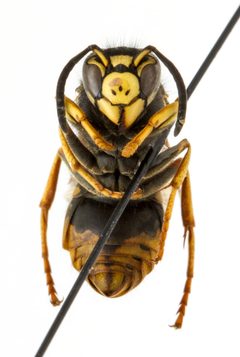
Distinguished from similar yellowjacket by a combination of geographic range, nesting habits, and behavioral traits. Unlike Vespula pensylvanica (Western Yellowjacket) and other scavenging species, V. vidua does not frequent human food sources or garbage. Nests are constructed underground in abandoned rodent burrows or natural cavities. Identification to species level typically requires examination of morphological characters such as clypeal markings, genitalia, or other fine structural details best confirmed by examination or genetic analysis.
Images
Appearance
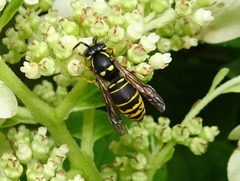
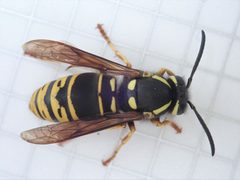
Medium-sized social with characteristic yellow and black banding pattern typical of yellowjackets. Queens and display the standard Vespula coloration with alternating yellow and black abdominal bands. The specific epithet "vidua" (Latin for "widow") may reference coloration or behavioral characteristics. As with other Vespula , workers possess strong for capturing and dismembering prey.
Habitat
Occurs in varied across its range. Nests are constructed underground, typically in abandoned rodent burrows or other pre-existing subterranean cavities. The has been observed foraging on flowering plants such as wild grape (Vitis spp.) in edge habitats. Unlike urban-adapted yellowjacket species, V. vidua appears more associated with natural or semi-natural environments.
Distribution
Native to North America. Documented from the northeastern United States (Vermont) and presumably occurs across a broader eastern or transcontinental range based on its inclusion in comprehensive North American social treatments. The is referenced in the context of the Great Lakes to Atlantic region and areas where it co-occurs with Vespula squamosa.
Seasonality
colony cycle typical of temperate Vespula . Queens emerge from sites in spring to found new colonies. Colony development proceeds through summer with production. New queens and males are produced in fall, after which the colony dies. New queens overwinter in protected locations to initiate the next season's colonies.
Diet
Strictly predatory on other insects, particularly flies (Diptera). capture live prey, chew it with their , and feed the processed protein to larvae in the nest. also consume nectar and other sugar sources for energy. Unlike some , V. vidua has been observed to not scavenge at picnics, barbecues, or garbage sources.
Host Associations
- Vespula squamosa - Facultative social ; Southern Yellowjacket queens can invade and usurp V. vidua nests, converting them to produce V. squamosa
Life Cycle
eusocial colony cycle. Fertilized queens overwinter in protected locations. In spring, queens emerge, feed, and initiate nests in underground cavities. Queens rear the first of alone. Once workers emerge, they assume foraging and nest maintenance duties. Colony grows through summer. In late summer to fall, new queens and males are produced. After mating, males die and new queens seek sites. The original colony dies with the onset of cold weather.
Behavior
Non-scavenging foraging distinguishes this from pest yellowjackets. are predatory, hunting live insects rather than seeking human food sources. When foraging on nectar sources such as grape flowers, individuals are described as relatively placid and approachable. Nests are defended if disturbed, but the species does not exhibit the persistent, aggressive scavenging behavior associated with urban yellowjacket problems. The species is vulnerable to nest usurpation by social .
Ecological Role
of other insects, particularly flies, providing natural pest control services. As a for the social Vespula squamosa, it participates in a complex interaction involving facultative . The contributes to pollination through nectar foraging on flowering plants.
Human Relevance
Generally less problematic for human conflict than scavenging yellowjacket due to its strictly predatory foraging habits and lack of attraction to human food. Stings can occur if nests are disturbed. The species may be encountered by naturalists observing at flowers. Not considered a major pest species.
Similar Taxa
- Vespula pensylvanicaWestern Yellowjacket is a serious scavenger and major pest in western North America; V. vidua differs in being strictly predatory and not attracted to human food sources
- Vespula maculifronsEastern Yellowjacket shares geographic range and is also a known for V. squamosa ; distinguished by morphological characters and preferences
- Vespula squamosaSouthern Yellowjacket is larger, with different coloration (muted ochre and yellow), and is the social that can usurp V. vidua nests
More Details
Etymology
The specific epithet "vidua" is Latin for "widow," the origin of the "widow yellowjacket." The exact reference is unclear but may relate to coloration patterns or historical observations of .
Social Parasitism
V. vidua is one of several Vespula documented as a for the facultative social Vespula squamosa. This interaction involves the Southern Yellowjacket invading an early-stage host nest, dominating or killing the resident queen, and converting the force to rear her own offspring. Evidence of the original host species may persist in nest architecture differences.
Sources and further reading
- BugGuide
- Wikipedia
- GBIF taxonomy match
- iNaturalist taxon
- NCBI Taxonomy
- Catalogue of Life
- The Wonderful World of Wasps | Bug Squad
- Portrait of a Yellowjacket | Bug Squad
- Beware of Yellowjacket Nests | Bug Squad
- Yellowjacket or Paper Wasp? | Bug Squad
- Bug Eric: Wasp Wednesday: Southern Yellowjacket
- Bug Eric: Grape is Blooming