
Dolichovespula arctica
(Rohwer, 1916)
Parasitic Aerial Yellowjacket
Dolichovespula arctica is a social parasitic wasp that lacks a , consisting only of reproductive females and males. It infiltrates established colonies of its primary , Dolichovespula arenaria (Aerial Yellowjacket), and exploits the host's worker force to raise its own offspring. The is rarely observed despite being fairly common across northern North America.
Pronunciation
How to pronounce Dolichovespula arctica: //ˌdɒlɪkoʊˈvɛspjʊlə ˈɑːrk.tɪ.kə//
These audio files are automatically generated. While they are not always 100% accurate, they are a good starting point.
Identification
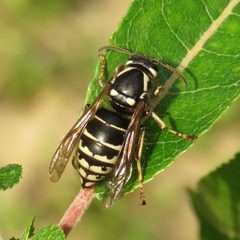
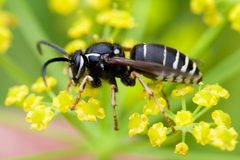
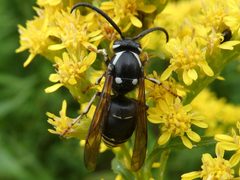
Distinguished from Dolichovespula arenaria by larger size and black-and-white coloration versus black-and-yellow. Western specimens have thicker terminal bands on abdominal segments T-1 and T-2 compared to eastern specimens. Can be confused with Dolichovespula maculata (baldfaced ) but is a found within host nests rather than an independent colony founder.
Images
Appearance
Larger than with black and white coloration instead of black and yellow. Western have thicker terminal bands on abdominal segments T-1 and T-2 with a somewhat darker shade of white compared to eastern populations.
Habitat
High elevation coniferous forests in Colorado and mountainous regions; limited to northern latitudes and higher elevations in the United States.
Distribution
Alaska, throughout Canada except Nunavut, northern United States, and along major mountain ranges south to Kentucky, Georgia, Arizona, and California.
Seasonality
Active during summer months when colonies are underway but before ; observed in July in Colorado.
Host Associations
- Dolichovespula arenaria - primary Infiltrates existing colonies when underway but before emerge from pupa stage; does not usually kill immediately but may evict her or consume her
Life Cycle
Lacks ; only reproductive females and males present. Female infiltrates colony, eventually produces offspring raised by host workers. New queens and males emerge, mate, and seek hibernal shelter before winter.
Behavior
Female periodically emerges from nest interior to wander on exterior paper envelope; reason unknown but possibly related to colony odor management and . Does not kill host immediately, instead waiting until she produces workers or following her to consume . Host workers ultimately raise offspring.
Ecological Role
Social ; exploits colony labor force. Host colony can still reproduce through unfertilized producing males, limiting host to male production during late summer reproductive season.
Human Relevance
Sting potential unknown but likely similar to related vespids; nests can be approached closely without aggression if not disturbed. Misidentification with baldfaced or yellowjackets common.
Similar Taxa
- Dolichovespula arenariaPrimary ; D. arctica found within its nests and distinguished by larger size and black-and-white coloration versus black-and-yellow
- Dolichovespula maculataSimilar black-and-white coloration but is an independent colony-forming , not a social ; builds its own large paper nests
Misconceptions
Often mistaken for baldfaced due to black-and-white coloration; actually a social living within yellowjacket colonies. Reports of "bald-faced hornets and yellowjackets sharing a colony" likely represent observations of this parasite with its .
More Details
Geographic Variation
Eastern US and eastern Canada have thinner terminal bands on abdominal segments T-1 and T-2 and somewhat lighter shade of white compared to western populations.
Colony Dynamics
may be evicted or followed and have consumed; offspring raised by host workforce represents a subtle form of slavery.
Sources and further reading
- BugGuide
- GBIF taxonomy match
- iNaturalist taxon
- NCBI Taxonomy
- Bug Eric: One of These is Not Like the Others....
- Be careful around baldfaced hornets, Dolichovespula maculata — Bug of the Week
- An inside look at baldfaced hornets, Dolichovespula maculata — Bug of the Week
- Paper nests here and there: Baldfaced hornets, Dolichovespula maculata, and tropical nest builders, Polybia spp. — Bug of the Week
- High fiber diets for baldfaced hornets? Nah, construction materials for enlarging nests: Baldfaced hornets, Dolichovespula maculata — Bug of the Week
- What do insects do in winter, Part 2? Tolerating the big chill: Banded woolly bears, Pyrrharctia isabella, field crickets, Gryllus spp., baldfaced hornets, Dolichovespula maculata, and others — Bug of the Week