
Aphomia sociella
(Linnaeus, 1758)
Bee Moth, Bumble Bee Wax Moth
Aphomia sociella, commonly known as the bee moth or wax , is a small pyralid moth native to Europe that has become an economically significant pest of colonies. The is notable for its unique dual-modal mating system combining and ultrasonic courtship songs produced by males using specialized tegular tymbals. Females lay in nests of bumblebees, , and occasionally weakened honeybee hives, where larvae feed on nest materials, pollen, honey, and . levels increase with proximity to commercial , causing reduced host reproductive output and weakened immune responses in bumblebees.
Pronunciation
How to pronounce Aphomia sociella: /əˈfoʊmiə soʊˈsiɛlə/
These audio files are automatically generated. While they are not always 100% accurate, they are a good starting point.
Identification
Distinguished from similar wax moths by the female's dark forewing spot and the ' specific association with above-ground bumblebee and nests rather than stored products. Males can be identified by their striated tegular tymbals used for ultrasound production, a feature absent in females. The combination of and is unique within Galleriinae.
Images
Appearance
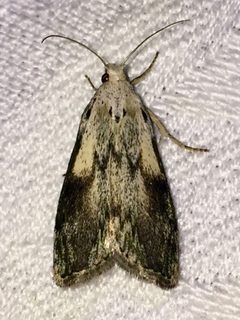
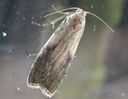
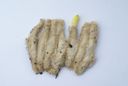
have a wingspan of 18-40 mm. Body and forewings are typically reddish brown, tan, or dark green. Males are generally more brightly colored and distinctly patterned than females. Females possess a dark spot in the center of each forewing, a key diagnostic feature. Larvae are yellow in color and 22-30 mm in length.
Habitat
Associated with active nests of bumblebees (Bombus spp.) and vespine , particularly those in elevated, exposed positions. Also found in weakened commercial honeybee hives. In natural settings, larvae overwinter in nests and pupate in spring.
Distribution
Native to Europe, including Britain. Established in Asia. Introduced to North America with records from California, Utah, New York, Virginia, and Connecticut. Found in temperate regions of the Northern Hemisphere where bumblebee occur.
Seasonality
fly from June to August in temperate regions such as Belgium and The Netherlands. from larvae occurs in early spring (March-July) to exploit temporary weakness in colony defenses.
Diet
Larvae feed on , larvae, and pupae left unprotected in nests, as well as pollen, honey, stored food, meconia, and nest waste materials.
Host Associations
- Bombus terrestris - primary Buff-tailed bumblebee
- Bombus hypnorum - Tree bumblebee
- Dolichovespula maculata - Bald-faced hornet
- Dolichovespula arenaria - Common aerial yellowjacket
- Vespula germanica - German wasp
- Apis mellifera - occasional Weakened commercial honeybee hives only
Life Cycle
Females are attracted to odors of active bumblebee nests and lay up to 100 per nest. Larvae emerge in early summer, spin protective silk, and tunnel through nests while feeding. Larvae overwinter in nests and pupate in spring. eclose and mate during scotophase (dark period).
Behavior
Males initiate mating through silent wing fanning with release at one-second intervals. Upon female approach, males switch to courtship involving , wing fanning, and ultrasonic "courting songs" (60-120 kHz, peak 80-90 kHz) produced by tegular tymbals. Females respond with wing fanning and receptive posture. Rival males produce ultrasound and physically attack intruders at calling sites. When threatened, exhibit (death-feigning) by falling and remaining motionless on their backs.
Ecological Role
of bumblebees and . In large nests, coexistence is possible when expand downward, leaving upper levels for larvae. near correlates with reduced host immune response, potentially facilitating additional parasite and spillover. Becoming economically important in bumblebee mass-production facilities.
Human Relevance
Considered a significant pest of commercial and bumblebee mass-production facilities. Larval feeding causes severe damage to honeycombs, stored pollen, and , potentially leading to colony collapse. sequencing supports development of sustainable pest management strategies.
Similar Taxa
- Galleria mellonellaGreater wax moth; also a pyralid pest of nests but primarily associated with honeybee hives rather than bumblebee nests, and lacks the dual-modal acoustic- mating system of A. sociella
- Achroia grisellaLesser wax moth; smaller size, different associations, and distinct mating communication system
- Aphomia cephalonicaCongeneric with close phylogenetic relationship but different ecological specialization and geographic distribution
More Details
Acoustic Communication
Aphomia sociella is the only known in Galleriinae to use a dual-modal system combining and ultrasound for mating. Male courtship songs average 1122 ms duration with maximum estimated range of 0.45 m. Tegula removal experiments confirm that ultrasonic signaling significantly increases mating success.
Pheromone Biosynthesis
The male component mellein (3,4-Dihydro-9-hydroxy-3-methylisocoumarin) may be biosynthesized by Aspergillus ochraceus fungus found in larval intestines and honeycombs, suggesting a microbial contribution to chemical communication.
Sources and further reading
- BugGuide
- Wikipedia
- GBIF taxonomy match
- iNaturalist taxon
- NCBI Taxonomy
- Catalogue of Life
- Infestation levels of Aphomia sociella in bumblebees increase with proximity to apiaries and result in lower reproductive output and weaker immune response
- Male Moth Songs Tempt Females to Accept Mating: The Role of Acoustic and Pheromonal Communication in the Reproductive Behaviour of Aphomia sociella
- Whole-genome assembly and annotation of the bumblebee wax moth, Aphomia sociella.