
Galleria mellonella
(Linnaeus, 1758)
Greater Wax Moth, Honeycomb Moth
Galleria mellonella is a globally distributed in the Pyralidae, best known as a destructive pest of honeybee colonies. The larvae tunnel through honeycomb, consuming wax, pollen, honey, and cast skins of larvae, causing significant economic damage to apiculture. are , with males producing ultrasonic mating calls at 75 kHz. The has become an important model organism in biomedical research due to its innate immune system functionally similar to mammals, and has attracted recent attention for the ability of its larvae to degrade polyethylene plastic through salivary .
Pronunciation
How to pronounce Galleria mellonella: /ɡæˈlɪəriə mɛloʊˈnɛlə/
These audio files are automatically generated. While they are not always 100% accurate, they are a good starting point.
Identification
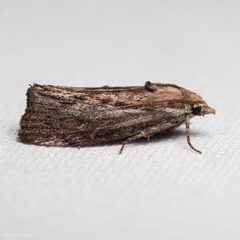
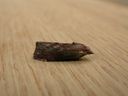
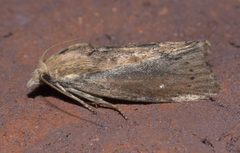
Distinguished from the lesser wax moth (Achroia grisella) by larger size—greater wax moth are 10–18 mm with 30–41 mm wingspan versus smaller stature of A. grisella. Male G. mellonella have a semilunar notch on the forewing and produce ultrasonic calls at 75 kHz; females have a beaklike . Larvae are larger (up to 30 mm vs. ~20 mm in A. grisella) and more destructive to combs. In the field, larvae are identified by their tunneling through honeycomb and the silk-lined galleries they construct. The can be distinguished from other Pyralidae by association with hives and the specific damage pattern to wax comb midribs.
Images
Habitat
Found exclusively in association with social and colonies, particularly honeybee (Apis mellifera) hives. Occurs in wild honeybee nests and cultivated . Larvae develop inside hives, tunneling through wax comb structure. are and found near hive entrances at night. Climate is broad: optimal development at 29–33°C and 29–33% humidity, with lethal temperatures above 45°C and below 0°C even for short exposures.
Distribution
distribution throughout all continents where honeybees are kept. Native to Asia; first reported as pest in Asia before spreading to northern Africa, Great Britain, parts of Europe, North America, and New Zealand. Now present in at least 27 African countries, 9 Asian countries, 4 North American countries, 3 Latin American countries, Australia, 10 European countries, and 5 island countries. Distribution closely tracks human activity.
Seasonality
In temperate regions, fly from May to October. laid in early spring; undergoes 4–6 annually in favorable conditions. Eggs, larvae, and pupae enter by December, resuming development with warmer weather. Mating occurs at night, 1–3 hours after dark, with females leaving shortly before daylight.
Diet
Larvae feed on honeycomb midrib, cast skins of honeybee larvae, pollen, and small quantities of and honey. They do not consume live larvae. of molting instars has been observed under food scarcity. Less commonly, larvae found in bumblebee and nests, or feeding on dried figs. do not feed.
Host Associations
- Apis mellifera - Primary ; larvae parasitize hives, tunnel through combs, cause galleriasis (silk-lined tunnels that entangle emerging bees)
- Bombus spp. - Secondary ; larvae occasionally found in bumblebee nests
- Vespidae - Occasional in nests
Life Cycle
Complete with four stages: , larva, pupa, . Eggs hatch in 7.2–21.8 days. Larvae undergo 8–10 molting stages, lasting 28 days to 6 months depending on conditions. Final instar spins silk cocoon and pupates for 1–9 weeks. Adults emerge from cocoons; females live ~12 days, males ~21 days. Total from egg to adult ranges from approximately 5 weeks under optimal conditions to several months with . In temperate zones, occurs as egg, larva, or pupa in diapause.
Behavior
activity pattern: females enter hives 1–3 hours after dark to oviposit, departing before daylight. Males generate ultrasonic sound pulses at 75 kHz (200 μs per pulse) by twisting the tymbal with wings to attract females; isolated males do not call. Females respond with wing fanning at 40 and 80 Hz, detected by males, who then release (nonanal, decanal, hexanal, heptanal, undecanal, and others) to enable location. Both sexes possess tympanic hearing organs (0.55–0.65 mm) on side of first abdominal segment, capable of detecting frequencies up to ~300 kHz—possibly the highest frequency sensitivity of any animal. Upon detecting bat-like echolocation frequencies, larvae and exhibit evasive : tilting, dropping, looping, and freezing. Females preferentially oviposit in strong, healthy colonies but achieve higher success in weak colonies. laid in clusters of 50–150 (United States) to 300–600 (India); maximum recorded 1,800 eggs per female.
Ecological Role
As a hive , G. mellonella weakens or destroys colonies, particularly those already stressed by , queenlessness, or starvation. The serves as for including Apanteles galleriae and Habrobracon hebetor, which may provide natural . Larvae contribute to nutrient cycling through wax degradation. In laboratory contexts, larvae have been demonstrated to degrade polyethylene plastic, suggesting potential bioremediation applications. The species including Israeli acute paralysis virus (IAPV) and black virus (BQCV) to honeybees.
Human Relevance
Major economic pest of apiculture, causing millions of dollars in damage; southern U.S. alone loses 4–5% of profits yearly. Control methods include heat treatment (45–80°C for 1–4 hours), cold treatment (-15 to -7°C for 2–4.5 hours), and carbon dioxide . Male sterilization technique (MST) using 350 Gy gamma radiation investigated for control. Widely used as model organism in biomedical research: alternative to mammals for toxicology, testing, and innate studies. Larvae raised commercially as food for captive reptiles, amphibians, and arthropods, and as fish . Research interest in plastic-degrading from larval saliva for waste management applications.
Similar Taxa
- Achroia grisellaLesser wax moth; distinguished by smaller size, less destructive larvae, and different (lacks semilunar notch in males, no beaklike female )
- Plodia interpunctellaIndian meal moth; different (Pyralidae but different ), associated with stored grain products rather than hives, larvae have different color pattern
Misconceptions
None documented in sources.
More Details
Plastic degradation
In 2017, larvae were shown capable of degrading polyethylene. Salivary oxidize and depolymerize polyethylene at room temperature and neutral pH within hours—unprecedented for biological degradation of this recalcitrant plastic. Research ongoing for potential waste management applications.
Research model utility
Innate immune system functionally similar to mammals makes larvae excellent model for studying bacterial and fungal , including Staphylococcus aureus and Candida albicans , and for testing antimicrobial therapies including - combinations.
Hearing sensitivity
Tympanic organs detect ultrasonic frequencies approaching 300 kHz, possibly the highest frequency sensitivity of any animal, evolved as defense against echolocating bat .
Sources and further reading
- BugGuide
- Wikipedia
- GBIF taxonomy match
- iNaturalist taxon
- NCBI Taxonomy
- Catalogue of Life
- National Moth Week: Here's One Moth that Beekeepers Won't Celebrate | Bug Squad
- Why These Moths Are Unwanted | Bug Squad
- It's National Moth Week! | Bug Squad
- Neonics: Should They Be Banned? | Bug Squad
- It's Like Winning the Triple Crown | Bug Squad
- Entomology 2020: Attendees Share Early Reactions to On-Demand Presentations, Posters
- The Joint Action of Bacteriophage and Antibiotics in the Treatment of Staphylococcus aureus infections in Galleria mellonella.